
VOL. 6 NO. 2 FALL 2009
Published: October 15, 2009
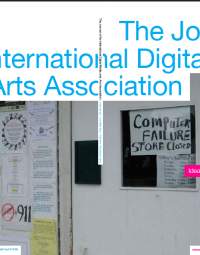
According to iDMAa Journal editor Jeff Ritchie, we all experience a mental “lag.” He says, due to the time it takes to actively perceive the world, we never really live in the present, but rather, in what he calls, the “experiential past.” This year’s conference theme adopts this frenetic idea where the future is unobtainable and never actually experienced. Tomorrow becomes today and the only reality we know is “an ephemeral present that we think we are experiencing yet is actually located in the experiential past due to the above mentioned physiological lag in perceiving and processing information.”
As an academic, we often concern ourselves with with critiquing artifacts. Ritchie goes on to say that, with some predictive exceptions, “the work of criticism neither focuses on the future nor really on the present, but on the past and is by its nature just as much an historical artifact as the artifact itself.” In a world where we live in an experiential past or unobtainable future, designing for interactivity requires understanding, predicting, and then designing and developing potential actions/interactions.
In this volume, the art described in Eber’s article or Cliquet’s idea of datatainment both detail historical phenomena, yet these historical documents may in some small way allow us to imagine or predict better what might yet be. Petite, Dinh, and Fisher’s article “Towards a Transmedia Search Engine: A User Study on Perceiving Analogies in Multimedia Data” illustrates their movement toward refining search engines that extend beyond textual and metadata searches and constitutes a vastly different way in which data on the internet can be used. O’Neil’s paper on “Remix Identity” “interprets the superabundance of video mash-ups (the remixed/repurposed media creations that have made YouTube iconic) as a generational, aesthetic response to identity crisis.” George-Palilonis, et al, document their past struggles with teaching students how to create new interface designs for delivering news to mobile phones in their paper “Research Informed Design.” Nyhoff’s paper “Performing the Interface” expands upon historical discussions of the theatricality of the graphical user interface. And Burg, et al, detail ways in which educators might better incorporate sound into digital media courses. All of these papers deal with past patterns, trends, objects, or ideas, yet all can help us better chart out our own future interactions, ideas, and projects.
In a world defined by rapid change, we need to reduce the lag in how quickly we understand and react to this change. For those curmudgeons out there, we actually can learn something from Beatniks and Hippies. Often we are either unable to see the pattern of changes unfolding around us or choose not to question the paradigms of our world, yet all of us would agree that we have to understand the past and see beyond paradigmatic thinking in order to understand what is actually happening and successfully plan for the future. I trust that you might think, as I do, that the annual iDMAa conference and these conference proceedings can provide us with the means of readily understanding both what has occurred and what might yet.
(A Synopsis of Jeff Ritchie’s article “What Might yet.” Click here for full text.)
In this issue
About the Journal
The Journal of The International Digital Media and Arts Association responds to the rapidly developing field of digital media and arts in a variety of settings—academic, educational, artistic, political, and social. Membership in iDMAa includes a subscription to the journal. Get more information on becoming a member.
The annual subscription rate for institutions is $95 which covers access to the electronic version. To subscribe to the journal, click button below and email request to subscribe.
-
V6N2: datatainment
By Grégoire Cliquet | March 5, 2013
Datatainment (data + entertainment) stems from experiments conducted in the field of mapping whereby it first and foremost aims at representing the digital territory.
-
V6N2: Integrating Sound into a Digital Media Course
By Jennifer Burg, Jason Romney, Roymieco A. Carter | March 4, 2013
Why Include Sound in Digital Art? Art departments in colleges and universities have traditionally divided their curriculum between art history and studio art, the studio art portion being devoted to drawing, painting, sculpture, printmaking, photography, […]
-
V6N2: Performing the Interface
By Jeff Nyhoff | March 4, 2013
Reflecting upon the rise to dominance of the commercial graphical user interface over the course of the latter half of the 1980s following the introductions of the Apple Macintosh and Microsoft Windows operating systems in […]
-
V6N2: Remix Identity: Cultural Mash- Ups and Aesthetic Violence in Digital Media
By Jamie O’Neil | March 4, 2013
When one has been hurt by new technology, when the private person or corporate body finds its entire identity endangered by physical or psychic change, it lashes back in a fury of self-defense. — Marshall […]
-
V6N2: Research Informed Design: Process, Experience & Results from Students & Their Audiences: A Case Study
By Michael Hanley, Vinayak Tanksale, Jennifer George-Palilonis | March 4, 2013
This paper reports a number of related outcomes of a project that involved design, development, and usability tests of new applications for two emerging types of interactive media: 1) an interactive television platform, and 2) a local news application or Apple’s iPhone and iTouch.
-
V6N2: Towards a Transmedia Search Engine: A User Study on Perceiving Analogies in Multimedia Data
By Victoria Petite, H. Quynh Dinh, Ebon Fisher | March 5, 2013
The goal of our Transmedia Search Engine is to enable people to discover non-literal connections between text, audio samples, images, 3D geometry, and videos. It is based on the psychological notion of transderivational search, which is a fuzzy match that enables people to find contextual meaning in every stimulus and forms a primary component of human language and cognitive processing.
-
V6N2: What might yet?
By Jeff Ritchie | March 4, 2013
Often we are either unable to see the pattern of changes unfolding around us or choose not to question the paradigms of our world, yet all of us would agree that we have to understand the past and see beyond paradigmatic thinking in order to understand what is actually happening and successfully plan for the future. I trust that you might think, as I do, that the annual iDMAa conference and these conference proceedings can provide us with the means of readily understanding both what has occurred and what might yet.