
VOL. 2 NO. 1 SPRING 2005
Published: March 15, 2005
Editor’s Note
Welcome to the first issue of the second volume of the International Digital Media and Arts Association Journal. Inspired by our first efforts, the journal continues to bring to our members an in-depth review of a particular area of digital media and arts activity. In this case the various aspects of game research, pedagogy and design provide the opportunity for us to gain insight into the dynamic gaming environment and its emerging academic disciplines.
This issue owes its existence to the inspiration and commitment of our guest editors, Ken S. McAllister and Judd Ethan Ruggill, co-directors of the Learning Games Initiative at the University of Arizona. Together they have organized a journal that will undoubtedly become a pivotal reference for future researchers. Because of their work the iDMAa Journal continues to fulfill its goal to become a forum for the myriad ways that academia is adapting to the disciplines of digital media and art.
The contributors to this issue are experienced scholars, professionals and graduate students. The broad spectrum of gaming is apparent in the variety of areas they cover; but it is their perceptive and insightful views that help to define the current state of research and academic approaches to gaming.
The first section presents six papers that bring to our attention how we should look at gaming—its history, evolution, language and roles of participants re-shaped by interactive environments. Together they focus our attention on achieving a way to shape the meaning of gaming today and how our perceptions of the field may evolve.
Most of the discussion in sections two and three is based in learning and teaching. It is here that we confront the implications that game studies can have on pedagogy and contributes to the changing view of our thinking selves. Several of the authors share their experiences in putting game studies into action. They offer an invaluable glimpse at planning a program, meeting studentsʼ expectations with novel curriculum design and developing a research agenda that will realize the potential of games in society.
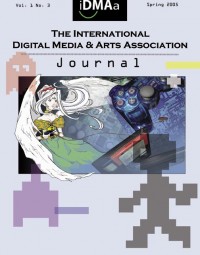
The iDMAa Journal is grateful to the authors and the guest editors for the opportunity to broaden the audience for their compelling field. The production schedule was extremely tight and the editorial board wishes to acknowledge the generous time and effort Gail Rubini and Katrina Ferguson put toward preparing this issue. Jennifer deWinter and Aaron MacGaffey designed the cover, also under a tight deadline. Together everyone involved contributed to fulfilling the founding mission of iDMAa—to offer a place to exchange ideas and embrace the complex diversity of emerging digital communities. Underlying the vision that motivates our commitment you will notice we all share an infectious level of enthusiasm. Something is happening and we want share it with you. Let us know what you think—your thoughts, comments and participation are always welcome.
Conrad Gleber
Editor
In this issue
About the Journal
The Journal of The International Digital Media and Arts Association responds to the rapidly developing field of digital media and arts in a variety of settings—academic, educational, artistic, political, and social. Membership in iDMAa includes a subscription to the journal. Get more information on becoming a member.
The annual subscription rate for institutions is $95 which covers access to the electronic version. To subscribe to the journal, click button below and email request to subscribe.
-
V2N1: Asking What Is Possible: The Georgia Tech Approach to Game Research and Education
By Ian Bogost, Michael Mateas, Janet Murray, Michael Nitsche | March 11, 2013
Game Studies is a new field of education and research, and occupies many disciplinary territories within the academy. At Georgia Tech, as at other institutions, games are a subject of serious investigation in multiple academic […]
-
V2N1: Discovering a Lexicon for Video Games: New Research on Structured Vocabularies
By Patrick Burkart | March 8, 2013
In knowledge-based industries, such as media and software, specialized languages have been developed to express technical and artistic concepts. Niche languages exist among groups who film and edit movies, build and compile software code, and package television program streams.
-
V2N1: Game Studies: What is it Good For?
By Espen Aarseth | March 8, 2013
Computer games (game software) have been around at least since A. S. Douglas programmed a tic-tac-toe game for his doctoral dissertation in Computer Human Interaction at Cambridge in 1952. And after more than two decades […]
-
V2N1: Games for the Thinking Person: Teaching Computer Game Development in an Academic Environment
By Monica Evans | March 11, 2013
When I tell people I teach a course in computer game development, they usually ask me two questions: what programming language do I use, and can I get them into the industry? These questions illustrate […]
-
V2N1: Gamingʼs Non-Digital Predecessors
By Laurie N. Taylor, Cathlena Martin | March 11, 2013
While video games have been analyzed in comparison to other new media forms by scholars like Lev Manovich, and to older media like novels and plays by scholars like Janet Murray and Brenda Laurel, few studies have examined the influence of older toys on video games.
-
V2N1: Poised to Play: the Evolution of Games on DVD Releases
By John Reid Perkins-Buzo | March 11, 2013
DVD technology has been a colossal success in delivering feature films and other long-format video, with figures for consumer purchasing showing that by the end of 2005 more than 80 percent of U.S. households will […]
-
V2N1: Preface
By Ken S. McAllister, Judd Ethan Ruggill | March 12, 2013
Scholars from disciplines across the academy are discovering what game developers, publishers, and players have known for years: video and computer games are not only fun, but remarkably compelling. They engage players deeply, and facilitate […]
-
V2N1: Preventing Piracy within the Video Game Industry
By Ginger Myles | March 11, 2013
According to many analysts, the video game industry generates more revenue than Hollywood each year. However, little public research and attention is directed toward video game piracy.
-
V2N1: Real-Time Performance: Machinima and Game Studies
By Henry Lowood | March 8, 2013
In computer and video games, the player resides at the interface of viewer and actor. This position makes possible the playerʼs creative participation in these interactive media, a contribution that cannot be described in terms of the traditional roles of creator or consumer.
-
V2N1: Teaching Media Culture with Computer Games
By Judd Ethan Ruggill, Ryan Moeller, Bryan Pearce, Ken S. McAllister | March 11, 2013
A common complaint among those who teach in wired classrooms is that students often become immersed in games of MS-Solitaire or Minesweeper instead of their class work.
-
V2N1: The Generation Gap: Bridging Learners and Educators
By Linda L. Baer | March 11, 2013
No matter what the generation, there is likely to be a gap between learners and educators. Learners and educators often have different styles within the classroom, including those that hinge upon introversion and extroversion, as […]
-
V2N1: The Two Faces of Reality
By Chris Crawford | March 8, 2013
One of the ideas that dominates my thinking about game design is the distinction between two completely different kinds of thinking. There is a dichotomy fundamental to our universe and our thinking. It takes many […]
-
V2N1: Video Games, Mind, and Learning
By James Paul Gee | March 11, 2013
In this essay, I will stress the contribution Game Studies can make to our thinking about learning, knowledge, and the human mind. Video games are a relatively new technology replete with important, and not yet […]
-
V2N1: ʻModdingʼ Education: Engaging Todayʼs Learners
By Nora Paul, Kathleen A. Hansen, Matt Taylor | March 11, 2013
Educators are poised to fail the next generation of learners. Students are showing educators by their entertainment choices and information seeking behaviors (and sources) the way they want to learn and engage with media. There […]