
V2N1: Discovering a Lexicon for Video Games: New Research on Structured Vocabularies
By Patrick Burkart | March 8, 2013
Introduction—The Value of a Lexicon
In knowledge-based industries, such as media and software, specialized languages have been developed to express technical and artistic concepts. Niche languages exist among groups who film and edit movies, build and compile software code, and package television program streams. Workers in computer software, media, and telecommunications typically learn the language of their work while in school or on the job, and they speak the same language (or dialects of the same language) to new collaborators as they move from project to project, and job to job. Biotechnology, medical publishing, geosciences, geography, and other theory-based academic disciplines and business practices use lexical information to guide practices and procedures (Heichler; Joselyn; Getty).
The situation is somewhat different in the video game industry. Video game software writing is experiencing rapid growth in relation to other media and software industries. Its workgroups include both artists and engineers, and these groups must interact frequently, translating concepts and descriptions from software engineering language to language about game play and animation. More successful translations improve productivity.
As a software-based, innovation-driven industry, the video game sector is driven by tight release schedules and continuing integration with other media markets such as animation, film, and telecommunications. The usefulness of an industry-standard vocabulary, with shared semantics and an agreement about common categories of knowledge, increases with organizational complexity, industry convergence, and the dispersion of practical and theoretical knowledge across organizations and electronic networks. The National Information Standards Organization develops formats and best practices for managing structured vocabularies, including thesauri (NISO).
In the process of sectoral consolidation, in which video game software companies have grown through mergers and acquisitions, many companies have experienced disruptions in markets for labor. Endemic high employee turnover rates incur search and training costs for the entire industry; “integration risks” in mergers and acquisitions also include culture clashes (Osur 32). The very languages spoken in video game shops exhibit a high degree of variance—vocabularies and concepts can correlate, but it takes time to learn the new cant. For example, designers argue about distinctions between concepts related to perspective, such as “3D” and “2.5 D,” “tunnel vision” and “peripheral vision,” and “person” and “first person camera.” They also draw genre-based distinctions between games, such as “real world fantasy” versus “magical realism” and “complete fantasy.” Industry executives complain that new employees spend extra time learning the new local language when they arrive, and they have even developed a formal curriculum for video game schools to adopt—to teach concepts consistently, if not a standardized vocabulary (IGDA).
Lexicon building puts the epistemologies of the video game “producer” and “consumer” under special scrutiny. The roles of both are united in a pursuit of improved game play, or playability, but designers must also put themselves in the position of the player while producing software code. While game designers are also players, not all players are designers. Designers write and manipulate the code base from which game play derives, and they produce natural language documents addressing the functionalities and capabilities of their software. Shared, player-and-tester roles exist in game shops and in the so-called “mod” community. Game testers share recommendations for fixes and improvements from the consumerʼs perspectives. Members of fan communities collectively modify video games and develop plug-ins, expansion packs, and other integrated software tools for informal distribution through the Internet.
Knowledge management (“KM”) literature can capture organizational dynamics that enable and suppress diffusion of information within complex organizations (Flanagin; Contractor and Monge). The networked architecture of contemporary work environments and information repositories creates opportunities for using technology for capturing and codifying electronic documents, code bases, and other intellectual property circulating in game shops, such that information resources can be easily found and re-used in the firm. KM experts with exposure to software databases and enterprise content management software find complementarities between information sharing through organizational roles and the disseminating functions of information and communications technologies (Goodwin).
Knowledge Management for the Industry Proceeds From a Lexicon
Although librarians and cultural studies researchers have developed subject gateways to virtual libraries about media and art, including Cyberstacks, the Art, Design, Architecture and Media information gateway (“ADAM”), and the Getty Art and Architecture Thesaurus, these resources do not contain robust video game vocabularies (Cyberstacks; ADAM). A knowledge base for video game artists, designers, and other practitioners would benefit from a structured vocabulary because key words linked to unique concepts in the video game shops could be used to label documents consistently and with a high degree of accuracy (Church). Improved accuracy reduces erroneous interpretations and ambiguities of meaning, and in so doing, can promote better understanding and more effective communications within a game shop. The lexicon approach to knowledge management structures is designed to help game developers iteratively design a vocabulary and put it to use for classifying and categorizing documents, objects, and tools. A lexicon can be a heuristic, and lead to innovative solutions to recurring problems that designers experience: “While a lexicon on its own will never suffice as a tool, it is the indispensable complement to any conceptual tool or method” (Kreimeier).
Developing a smart portal or a similar KM system would permit rationalization of firm-level and industry-level production processes. Non-technological practices for articulating, capturing, and sharing knowledge in collaboration still persist, but corporate decision-makers justify information technology and software expenditures based on cost reduction and efficiency, improved accountability, knowledge management and collaboration. KM has become “an integral business function for many organizations as they realize that competitiveness hinges on effective management of intellectual resources” (Grover & Davenport). Leaders in video game development acknowledge that the basis for sharing knowledge is language:
The primary inhibitor of design evolution is the lack of a common design vocabulary. Most professional disciplines have a fairly evolved language for discussion. Athletes know the language of their sport and of general physical conditioning, engineers know the technical jargon of their field, doctors know Latin names for body parts and how to scribble illegible prescriptions. In contrast, game designers can discuss ʻfunʼ or ʻnot fun,ʼ but often the analysis stops there. (Church)
For Doug Church, a seasoned professional in video game software design, feels a common vocabulary would enable game designers to improve their abilities to transpose a concept from one project to another, and from one medium to another:
We should be able to play a side-scrolling shooter on a Game Boy, figure out one cool aspect of it, and apply that idea to the 3D simulation weʼre-building. Or take a game weʼd love if it werenʼt for one annoying part, understand why that part is annoying, and make sure we donʼt make a similar mistake in our own games. If we reach this understanding, evolution of design across all genres will accelerate. But understanding requires that designers be able to communicate precisely and effectively with one another. In short, we need a shared language of game design. (Church)
As media conglomerates produce more and more cross-platform media products as part of a single “franchise”—such as the Spider-Man movies, video games, and action figures—game designers are called upon more frequently to translate aspects of design and game play from one medium to another, for other designers and for engineers as well.
Discovering and Expressing Agents, Artifacts, Art and Design, Genres, and Tools
Doug Church and developers associated with the International Game Developers Association (IGDA) promoted the idea of “game school” to the Digital Media Collaboratory, a research group at the University of Texas at Austinʼs IC2 Institute in 2003. In the midst of the twin dot-com and telecom boom of the 1990s, Austin emerged as an important location where independent game shops opened and grew. In a call for projects, the IGDA group solicited research proposals that would help the industry with its unique knowledge management needs.
The lexicon team, led by this paperʼs author, proposed a prototype for an industry-standard, structured vocabulary for the video game industry. The vocabulary would function as a thesaurus, providing an easy structure for looking up terms for their definitions, synonyms, and antonyms. The vocabulary would conform to the ISO standard for thesauri (NISO), so that its data structure could be re-used in multiple applications useful for KM. The project is not intended to impose a vocabulary on practitioners in the video game industry, but instead, to discover and present commonly used terms that are labels for concepts shared by the larger community of game producers and developers. Compare art and film schools, on the other hand, which inculcate students in lexicons of art and technology practices specific to their trades, through training and an imposition of language conformity. There is a strong likelihood that multiple vocabularies exist in practice at this time, waiting for discovery. It is possible that these multiple vocabularies will converge and standardize in time, as industry consolidation and bureaucratic rationalization squeeze out heterodoxy, and as competing “schools” learn how to make their vocabularies work with each other, perhaps by devising video game “ontologies,” or meta-vocabularies.
The Lexicon project identified XML as the best coding language for expressing hierarchical relationships among concepts, because it could be adapted to express metadata using the Dublin Core (“DC”) format. DC is the XML encoding scheme of choice for cyber-librarians. Figure 1 presents the elements of every DC record:
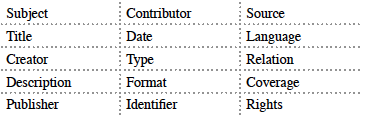
Figure 1: Dublin Core Metadata Elements
Source: ISO
Creating entries for each of these data fields requires identifying keywords and concepts from academic scholarship, video game design journals, and personal interviews with game developers.
Under the “subject” and “relation” nodes, lexicographers will be classifying entries as instances of concepts related to video game agents, artifacts, art and design, genres, and tools. The lexicon team derived the “artifacts” root node from the Getty Art and Architecture Thesaurus (or “AAT”), and the rest from Wolf. Online sources of information that were critical to the project included gamedeveloper.com and help wanted ads published by video game shops. Wherever possible, the team collected definitional information for each term from the source of the term. Definitions will be merged into the subsequent version of the video game lexicon. However, the AATʼs structure is generally unsuitable for the video game lexicon. The AATʼs location of Video Games is too constraining. Video games are listed under Activities > Physical and Mental Activities > Video Games, and the definition fits the perspective of an art historian, rather than a designerʼs or playerʼs perspective. The AAT designation for “video game” is to be used “for any of various interactive computer games in which a player controls electronically generated images on a video display screen; usually restricted to those written after the late 1970s for microcomputers, arcade systems, or dedicated consoles” (Getty). The AAT stresses the play activity with video games, rather than other facets of the video game concept, such as attributes, styles, agents, or objects.
To build the hierarchy of nodes, the Lexicon team first created a flat list, or a “bag of words,” for preliminary classification, and then transformed the “bag of words” into a structured vocabulary by sorting out the broadest terms first, then arranging these under each of our five vocabulary branches. Figure 2 illustrates some entries from a section of the vocabulary as displayed in the MetaTagger GUI.
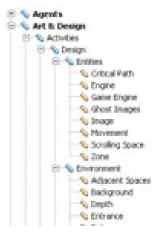
Figure 2: Art & Design > Activities > Design > Entities and Environment
Source: Author
In an effort to reduce complexity, the team took pains to avoid creating a polyhierarchy, in which the same term occurs in more than one location in the taxonomy. The team decided against using an “ontology” for the vocabulary, or a meta-schema for classifying the vocabulary consistently with other vocabularies, because ISO/NISO standards do not require integration with an ontology, and because the team discovered no consensus about the best ontology for commercial grade data sharing applications.
A Knowledge Base for the Video Game Industry?
Working together, the structured vocabulary, appropriate metadata schema, and a search engine can help gaming educators and researchers make the right searches and find the right documents (Lee-Smeltzer). A software package called the MetaTagger Suite, by Interwoven, Inc. of Sunnyvale, California, contains a Dublin Core compliant taxonomy builder and a classification engine, and can be used for future experiments with automatic document tagging for a prototype knowledge base for the Web. The Lexicon research team envisions the use of an industry-standard vocabulary for tagging documents, software tools, and code bases with Dublin Core compliant metadata for searching in an intelligent Web portal. Because every record for every resource will have a Subject descriptor, this element will be mapped back to the controlled vocabulary. The semantic approach to indexing for search and navigation “offers the potential for searcher and indexer to speak the same language, and for a user to be guided to fruitful terms when searching a particular collection for a particular purpose” (Tudhope).
An economic impetus drives most knowledge management needs, including those in the media industries. Sales of video games are approaching movie box office receipts in the US—$7.3 billion and $9.2 billion, respectively in 2004 (Weiss and Vargas)—and the market for product placement advertising in video games is already $200 million annually (Wong). Cross-ownership of video game companies by vertically integrated firms with film studios such as Sony and Viacom promotes an ongoing convergence among video games and film formats. Representing knowledge about the video game domain in a thesaurus can provide educational and organizational benefits for a young and growing industry. Contemporary work on that goal proceeds on the assumption that accessible, codified knowledge in a database provides the field with advantages for players, practitioners, researchers, and educators.
Acknowledgements
The author gratefully acknowledges the support of the Digital Media Collaboratory (“DMC”), IC2 Institute, UT-Austin for research support.
Works Cited:
ADAM [Art, Design, Architecture & Media Information Gateway]. About ADAM. 17 Feb. 2005 <http://www.adam.ac.uk/adam/index.html>.
Church, Doug. Formal Abstract Design Tools. 1999. Gamasutra.com. 17 Feb. 2005 <http://www.gamasutra.com/features/19990716/design_tools_01.htm>.
Contractor, Noshir, and Peter Monge. “Managing Knowledge Networks.” Management Communication Quarterly 16.2 (2003): 249-258.
Cyberstacks. 17 Feb. 2005 <http://www.public.iastate.edu/~CYBERSTACKS/>.
Davenport, Thomas H., and Varun Grover. “General Perspectives on Knowledge Management: Fostering a Research Agenda.” Journal of Management Information Systems 18 (2001): 5-21.
Flanagin, Andrew J. “The Elusive Benefits of the Technological Support of Knowledge Management.” Management Communication Quarterly 16.2 (2003): 242-248. Getty.
Getty Thesaurus of Geographic Names Online. 17 Feb. 2005 <http://www.getty.edu/research/conducting_research/vocabularies/tgn/>.
Goodwin, Phil. “Information Life-Cycle Management and Enterprise Content Management: The Confluence of Technology and Business.” Content & Collaboration Stragtegies, Infrastructure Strategies, Server Infrastructure Strategies. Stanford, CT: Meta Group, 2004.
Heichler, Elizabeth. “Biotech Targets Knowledge Management Tools.” 16 Apr. 2002. Infoworld. 17 Feb. 2005 <http://www.infoworld.com/articles/hn/xml/02/04/16/020416hnbiotech.html>.
IGDA [International Game Developers Association]. “Curriculum Framework.” 17 Feb. 2005 <http://www.igda.org/academia/curriculum_framework.php>.
ISO [International Organization for Standardization]. “Information and Documentation: The Dublin Core Metadata Element Set.” 2/26/2003. International Organization for Standardization. 17 Feb. 2005 <http://www.niso.org/international/SC4/n515.pdf>.
Joselyn, Mark. “Building a Geodatabase for Watershed Management.” 11 Jul. 2002. ESRI Annual Usersʼ Conference. 17 Feb. 2005 <http://gis.esri.com/library/userconf/proc02/pap0929/p0929.htm>.
Kreimeier, Bernd. “Game Design Methods: A Survey.” 3 Mar. 2003. Gamasutra.com. 17 Feb. 2005 <http://www.gamasutra.com/features/20030303/kreimeier_03.shtml>.
Lee-Smeltzer, Kuang-Hwei (Janet). “Finding the Needle: Controlled Vocabularies, Resource Discovery, and Dublin Core.” Library Collections, Acquisitions, & Technical Services 24 (2000): 205-215.
NISO [National Information Standards Organization]. Guidelines for the Construction, Format, and Management of Monolingual Thesauri. 2003. 17 Feb. 2005 <http://www.niso.org/standards/resources/Z39-19.html>.
Osur, Elizabeth. “Equity Research: United States Leisure Products.” Video Game Publisher Initiation. Citigroup Smith Barney. 22 Dec. 2004.
Tudhope, Douglas. “Thesauri and Classification Systems.” 2003. University of Glamorgan—School of Computing-Research. 17 Feb. 2005 <http://www.glam.ac.uk/soc/research/hypermedia/facet_proj/thesauri_class.php>.
Weiss, Eric M., and Jose Antonio Vargas. “Video Gamesʼ Chaos Echoed in Streets, D.C. Leaders Say.” The Washington Post. 4 February 2005. A01. 17 Feb. 2005 <http://www.washingtonpost.com/wp-dyn/articles/A61945-2005Feb3.html>.
Wolf, Mark. The Medium of the Video Game. Austin: University of Texas Press, 2002.
Wong, May. “Video Game Ads Turn Pro.” CBSNews.com. 18 October 2004. SciTech Section. 17 Feb. 2005 <http://www.cbsnews.com/stories/2004/10/18/tech/main649832.shtml>.