
V2N1: The Generation Gap: Bridging Learners and Educators
By Linda L. Baer | March 11, 2013
No matter what the generation, there is likely to be a gap between learners and educators. Learners and educators often have different styles within the classroom, including those that hinge upon introversion and extroversion, as well as varying levels of comfort with informational abstraction. Many educators today perceive a gap between their technological expertise and that of their students. Children raised with computers think differently than those raised without. The challenge for educators and educational institutions is to incorporate the tools and media of the information-age to maximize the learning opportunities for todayʼs learners.
Research on children who have grown up with video games indicates that game technology changes the way they think. Kids play the most games between the ages of five and fifteen, often averaging 13 hours a week. This is also the age when the basic neural pathways of the brain are being formed (Beck and Wade 1), and extensive brain research shows that long term experience and use of games and other digital technologies alters the brain—a phenomenon known as “neuroplasticity.”
In this article, I will describe the characteristics of what seems to be a new generation of learners, that is, those who have grown up with video games and other digital technologies. Given the different life experiences between the Next Generation learners and the Baby Boomers who represent the majority of educators, a potential paradox of learning styles and preferences has developed. I will explore these differences, and discuss the role games and simulations can play in learning environments. I will conclude by calling for a new model of learning.
Characteristics of this generation
There is a new generation of learners. Drolly called the “Millennials” or “Net Generation,” they were born after 1982 and exhibit many learning characteristics that are different than previous generations of students. As Diana Oblinger notes, “these studentsʼ attitudes and aptitudes have been shaped by technology and the media rich environment” (“The Next Generation of Educational Engagement”). Millennials are, in part, products of the World Wide Web, mobile devices, instant messaging, online communities, and, of course, video games. By comparison, Baby Boomers were raised on television, typewriters, and communication by memos.
According to a recent study by The Pew Internet & American Life Project, Millenials continue to game, even after they enter college. According to the 2003 study, seventy percent of college students surveyed reported playing video, computer or online games at least once in awhile, while sixty-five percent reported being regular or occasional game players (Jones). As Mark Prensky explains, however, this time spent gaming has not been wasted:
Since their earliest years the workers now coming in to our schools and companies have solved daily mysteries (Blue Clues, Sherlock Holmes); built and run cities (Sim City), theme parks (Roller Coaster Tycoon), and businesses (Zillionaire, CEO, Risky Business, Start-Up); built civilizations from the ground up (Civilization, Age of Empires); piloted countless airplanes, helicopters and tanks (Microsoftʼs Flight Simulator, Apache, Abrams M-1); fought close hand-to-hand combat (Doom, Quake, Unreal Tournament); and conducted strategic warfare (Warcraft, Command and Conquer)—not once or twice, but over and over and over again, for countless hours, weeks and months until they were really good at it. (Digital Game-Based Learning 38)
Academics are just now starting to try to harness this kind of “stealth learning.”
The paradox of learning in the 21st century
One way to understand the potential generation gap between educators and learners is to view the difference between “digital natives” and “digital immigrants.” Members of the Net Generation are digital natives, that is, they are born into a culture that speaks the digital language of computers. Digital immigrants, by contrast, are those to whom computer-ese is foreign. As the chart below suggests, the differences in characteristics present a potential generation gap in education and learning.

Table 1. Ten Ways the Games Generation is Different (Prensky 52).
These differences set the stage for discussions about how the Net Generation operates, learns, and lives today. The Net Generation is keyed to immediate responses supported by access to multiple media devices. They operate in parallel contexts, multitasking in several venues at once. Many in this generation talk on the phone while online, and listen to the radio or CDs while sending instant messages. The Net Generation is also “play-oriented,” meaning they have extensive experience with computer games. Play actually becomes work for many in this generation; they expect active environments and respond more to graphic or visual portrayals of material (Prensky 51-65).
Oblinger takes Prenskyʼs digital native/digital immigrant model a step further, transposing it onto students and faculty.
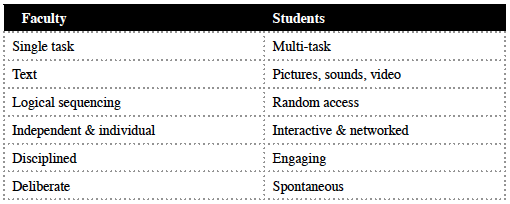
Table 2. Comparison of student and faculty characteristics (Adapted from Oblinger, “Next Generation Learner”)
Oblinger asserts that if educators can better understand the learning styles and preferences of their students, they can better devise appropriate teaching styles and learning environments. Ultimately, says Oblinger, it is not about whether you are a digital native but whether you can adapt to those whose style does not match your own.
Bridging the Gap
To bridge the potential generation gap, educators need to develop new learning tools, and in essence see teaching and learning in new ways. Indeed, “todayʼs students are no longer the people our educational system was designed to teach” (Prensky 2001). As a result, many faculty are starting to consider using games to enhance their courses. Bransford and Schwartz have studied a number of courses that incorporate challenge-based environments that are game-like in nature (“Rethinking Transfer”). They argue such environments increase attentiveness and help students learn how to operate as real-world professionals.According to Bransford:
Classrooms tend to be much less interactive than games and simulations. This limits studentsʼ abilities to receive feedback and revise their thinking – a critical part of the learning process. By the time students realize they need to revise their thinking, the class has already moved on to another topic. Yet much of learning involves opportunities to engage in increasingly complex, just-manageable difficulties, and games are built on that kind of structure. Games offer the self-pacing and feedback that make the student want to go back and master the experience. In fact, a key benefit of gaming lies in acquiring massive amounts of time on task. (Rickart and Oblinger, 2003)
Foreman agrees, noting that
learning through performance requires active discovery, analysis, interpretation, problem- solving, memory, and physical activity and results in the sort of extensive cognitive processing that deeply roots learning in a well-developed neural network. (14)
He argues that technologies that can support such immersive learning environments are converging and maturing in the mass market and the feasibility of using them in higher education is increasing. A critical component of maximizing the potential of learning through games is the connection to sound learning pedagogy. In order to consider games as potential learning environments, the design, structure and practice of games must have useful parallels to sound pedagogy. Oblinger offers the following comparison:
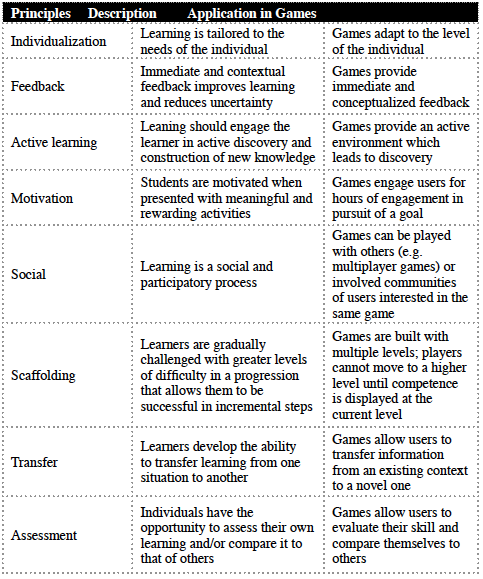
Table 3. Some principles of good pedagogy and parallels in a game environment (Oblinger 14).
As the table suggests, the benefits of games in educational settings are multiple: motivation, engagement, critical thinking, scenario development, and risk taking. Games can build on an individualʼs existing capacity, and in a more customizable way, move the learner to next levels of learning as appropriate:
Learning through performance requires active discovery, analysis, interpretation, problem-solving, memory and physical activity which results in the sort of extensive cognitive processing that deeply roots learning in a well-developed neural network. One of the limitations of many learning situations is that they stimulate rote learning or learning that cannot be applied to new situations. The learning-by-doing approach of games encourages transfer to future learning activities–or life. (Oblinger 9)
In this knowledge age, more employers are calling for more skills and competencies in higher order critical thinking, communications, and technology. Games and simulations can provide learners with opportunities to explore decision making and the consequences in a less risky environment.
A Call for a New Model of Learning
Higher education needs to heed the call for a new learning ecology where educators understand the life experiences of todayʼs students and incorporate these understandings into more personalized learning opportunities. Technology is at a level where scholars can meet studentsʼ learning styles, and capture the powerful imagination within all learners. Among the tools in this “new learning ecology” as John Seely Brown calls it, are educational games and simulations. However, scholars need to develop a deeper understanding of how games can allow educators to move away from lectures, test taking, and classrooms into fun, immersive interactive learning environments. The problem is that
to move educational gaming to the next level will require hard work and a real commitment of resources. It will require strong collaboration between educators and game designers. It is of critical importance to realize that games and simulations will not substitute of all traditional learning practices. Research continues to refine the thinking of where the uses of games and simulations are best aligned with targeted learning environments and needs. (Squire and Jenkins 30)
The incorporation of games into the learning environment will require commitment, focus, resources and a realistic assessment of the current structure of education. Squire and Jenkins relate that
using games to create rich learning environments in schools may mean changing the “game” of school itself so that routinized knowledge of facts or higher performance on standardized tests are not the ultimate end goal. Instead, studentsʼ ability to participate in complex social practices; learn new knowledge; and perform well in novel, changing situations needs to be considered valuable learning. (31)
Games and simulations are one way to teach this Net Generation in their own language. Games can present content in ways that were previously unavailable, thus facilitating new understandings of traditional and new learning materials, creating innovative avenues for research and assessment, and energizing discussions about the future of higher education.
Works Cited:
Beck, John C. and Mitchell Wade. “The Generation Lap: Video Games Put the Young Way Ahead.” Boston.com. January 2, 2005. The Boston Globe. 20 Feb. <2005 http://www.boston.com/ae/games/articles/2005/01/01/the_generation_lap?mode=PF>.
Bransford, John D. and Daniel Schwartz. “Rethinking Transfer: A Simple Proposal with Multiple Implications.” Review of Research in Education 24 (1999): 61-100.
Brown, John Seely. “Growing Up Digital: How the Web Changes Work, Education, and the Ways People Learn.” USDLA Journal 16.2 (February 2002). 20 Feb. 2005 <http://www.usdla.org/html/journal/FEB02_Issue/article01.html>.
Foreman, Joel. “Next Generation Educational Technology versus the Lecture.” EDUCAUSE Review (July/August 2003): 12–22.
Jones, Steve. “Let the Games Begin: Game Technology and Entertainment Among College Students.” Pew Internet & American Life Project (July 6, 2003). 20 Feb. 2005 <http://www.pewinternet.org/reprot_display.asp?r=93>.
Oblinger, Diana. “The Next Generation of Educational Engagement.” Journal of Interactive Media in Education 8. May 2004. JIME. 20 Feb. 2005 <http://www-jime.open.ac.uk>.
–––. “Next Generation Learner.” National Learning Infrastructure Initiative Spring Board Meeting. MS-PowerPoint presentation. 20 Feb. 2005 <http://www.nwacc.org/conferences/2004_Spring_Board_mtg?oblinger.pdf>.
Prensky, Marc. “Digital Natives, Digital Immigrants.” On the Horizon. NCB University Press 9. No. 5, October 2001.
–––. Digital Game-Based Learning. New York: McGraw-Hill, 2001.
Squire, Kurt and Henry Jenkins. “Harnessing the Power of Games in Education.” Insight 3 (2003). 20 Feb. 2005 <http://www.ael.org/snaps/inSight%5F3%2D1%5Fvision%2Epdf>.
Rickart, Wendy and Diana Oblinger. “Microsoft Higher Education Leaders Symposium: Unlocking the Potential of Gaming Technology.” Redmond, Washington. September, 2003.