
V8N3: Tinkering with the iPhone: Subversion and Re-Appropriation of Power in Apple’s World
By Cynthia Wang | April 9, 2011
“You have a video recording application 33 on your iPhone?” I stared incredulously at my friend’s iPhone, which, from the outside, looked a lot like mine. When I bought my iPhone 3G back in the summer of 2008, before the flashy new iPhone 4 and iOS5 additions at the time of this writing in late 2011, I was rather disappointed to discover that the iPhone 3G does not offer video recording or cut and paste capabilities. I had thought Apple would undoubtedly add that feature, as it is ubiquitous on other forms of smart phones like the Blackberry and the Treo, and even regular non-smart (dumb?) phones. Yet my friend’s iPhone 3G clearly had video capturing and playback capabilities. It turns out his iPhone was jailbroken, and able to run applications that were not purchased or downloaded through Apple’s iTunes Application Store. Had I not spoken to my hacker friend, I would never have conceived that my little black electronic box has additional capabilities that Apple withholds from us. More importantly, I, like many other iPhone customers, would probably never have thought to question the functionality limits of our iPhones, nor would we be aware of Apple’s total control over the experience we have.
This article will explore the structures of power that govern digital media through both technological determinism and/or social and institutional determinism. Specifically, I will be looking at hacking (“unlocking” and “jailbreaking”) the iPhone and developing and distributing iPhone applications. There are inherent tensions between the potentially democratizing, and occasionally subversive, processes that tinkering with the iPhone has by allowing consumer and citizen participation in the process, and the structures of power (Apple Inc.) in place in the world of the iPhone. These powers still, to a large extent, have control over our iPhone experiences. I will examine how we live in a world of manufactured consent where we agree to have our experiences structured by “The Powers That Be,” how subversive cultures (read: iPhone hackers and programmers, or “tinkerers”) potentially puncture this structure, and also how these acts of subversion are co-opted by those in power and re-positioned in order to maintain the dominant hegemonic framework.
A quick word; we must take into account the fact that technology sometimes advances faster than research can keep up. Because much of this research was done before the inception of the iPhone 4, and before Verizon started selling the iPhone, some technological aspects may seem outdated and historical, yet the theories and ideas encompass anxieties that are still present.
Structures of Power DO Exist in Digital Media
Computers and operating systems have allowed us to obtain information and experience the world in previously unthinkable ways. Computer operating systems and Internet browsers have become as ubiquitous as newspapers, televisions, and telephones as technological forms of communication. As Douglas Thomas says in Hacker Culture, “The degree to which machines are user-friendly, then, corresponds directly with the degree to which the user is ignorant of the computer’s actual operations.”1 The ways in which operating systems are organized feel natural and pre-determined. We simply point, click, and drag, not thinking about the intricate codes that are built into our computer in order to enable such actions. This technological normalization is due to software companies selling operating systems, which make using a computer easy and visual. Moreover, as the Internet has been normalized into society, the decentralized architecture of the Internet has also been “naturalized,” and the powers controlling the Internet often go unquestioned.
As Alex Galloway discusses in his book, Protocol: How Control Exists after Decentralization, digital protocols, or rules, determine actions by which a computer functions. These actions, then, are dictated by powers that are technologically determined. However, structures of power that are socially and institutionally determined have the potential to take advantage of protocols and these technological structures of power. Apple uses both technologically determined and socially determined power structures to maintain near total control over the usage of the iPhone. Hackers, then, not only understand the structures that Apple enforces, but they also use the same structures to subvert Apple’s power, perpetuating the cat-and-mouse-like game that subversion and re-appropriation play in iPhone tinkering.
UNPLUGGED! Subverting Apple’s Power
As we can see, there are unseen powers that dictate the way we experience 1) operating systems 2) Networks and the Internet, and 3) the iPhone. For many users, these unseen powers create the only experience we know, and therefore, we tend not to question this experience. Yet hackers do. Much like Morpheus, Trinity, Neo, and their team in the Wachowski Brothers film, The Matrix, hackers challenge protocol, structure, and design. They work to subvert the power the institutions that produce and construct these structures have over our perception and experience of the digital world.
In his essay “The Spectacle of the Scaffold,” Michel Foucault talks about torturing criminals. He states that “The entire criminal procedure, right up to the sentence, remains secret: that is to say opaque, not only to the public, but to the accused himself…The secret and written form of the procedure reflects the principle that in criminal matters the establishment of truth was the absolute right and the exclusive power of the sovereign and his judges.”2 Foucault draws a strong connection between knowledge and power, even using the word “opaque” to imply the importance of the gaze for those in power. Those in power have knowledge that is held from those they wish to dominate. As with Foucault’s account of trial proceedings and sentencing, the technologically determined power that Apple, Microsoft, and other such massive digital media corporations serves to control. Apple created the code of the operating system and their proprietary software, which then manifests visually for the general iPhone user as the iPhone interface, which hides said code.
Hackers, then, represent a subversion of this technologically determined power, because they understand the language of the code and hence can change it, thereby subverting the sovereign power that companies like Apple have over digital devices like the iPhone. Hackers, like my friend who jailbroke his iPhone and rendered it with video recording capabilities, unlock the full capability of the hardware system they are using. My friend has knowledge of not only the interface of the iPhone — the obviously visible aspect of the iPhone- but the actual workings, the mechanisms of production, of the iPhone. Because of this, he is able to expand upon how he experiences his little black electronic box, rendering his iPhone, much like Neo in The Matrix, unplugged. “Unplugging” constitutes gaining existential knowledge that one’s experience is being tightly controlled by an unseen force, be it through the naturalization of the iPhone’s interface or having Amazon know what books/CDs/DVDs a consumer prefers, which is a more institutionally determined power, as Dan Hunter discusses in his review of Cass Sunstein’s REPUBLIC.COM. Hackers, in this “unplugged” mode, then learn to master and command the structure. Tinkering with the iPhone is potentially subversive if said tinkering brings the iPhone out of the control of Apple, as is the case with a jailbroken or unlocked phone.
There are two main ways of hacking the iPhone — jailbreaking and unlocking. Unlocking the iPhone means allowing the iPhone to work with a service provider other than Cingular/AT&T, which was the only carrier in the United States for the iPhone until early 2011. Ellen Lee’s report on the iPhone carrier on SFgate.com’s The Tech Chronicles back in 2007 stated that she had “confirmed that Apple’s new iPhone will require a two-year cell phone plan and will not be sold without it.”3 The partnership between Cingular/AT&T and Apple parallels some of the arguments for net neutrality that Tim Wu brings up in his article, “Why You Should Care About Net Neutrality.” What Apple is doing here clearly goes against the concept of neutrality. It is also inherently anti-democratic, reducing the choices people have for cell phone carriers by tying a shiny new gadget with a specific carrier. In fact, because many people wanted the iPhone, they switched their cell phone carrier over to Cingular/AT&T. Wu calls the Internet “meritocratic,” yet states, “When who you know matters more than anything, the market is no longer meritocratic and consequently becomes less efficient. At the extreme, a market where centralized actors pick favorites isn’t a market at all, but a planned economy.”4 This is what Apple did with its exclusive partnership with Cingular/AT&T. A similar theory can be put to use when discussing the fact that certain iPhone applications are “featured” in the Application Store. I will come back to this point later, but unlocking the iPhone can be read as a subversive act against “The Powers That Be” — Apple and Cingular/AT&T, using the technology created by these organizations to give people more choices outside of those offered.
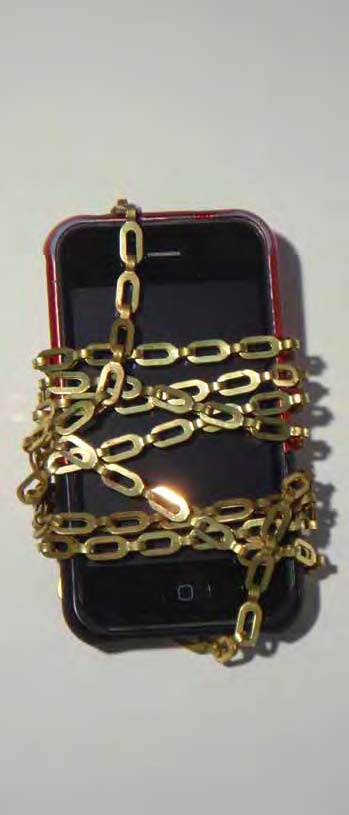
The second conventional way of hacking the iPhone is to “jailbreak” the device. An Electronic Frontier Foundation article explains “Apple’s iPhone, has been designed with restrictions that prevent owners from running applications 35 obtained from sources other than Apple’s own iTunes App Store. “Jailbreaking” is the term used for removing these restrictions, thereby liberating your phone from Apple’s software jail. Estimates put the number of iPhone owners who have jailbroken their phones in the hundreds of thousands.” 5
Here, again, we see Apple’s control over the experience of iPhone users. However, even in the use of terms, we see a blatant subversion of power. The use of the words “jail” and “lock” connotes the presence of a state, an institution, or some other embodiment of power. We can apply Foucault’s concept of the Panopticon in this situation. The central tower of the Panopticon (representing Apple) maintains control over the inmates (users) by “[inducing] in the inmate a state of conscious and permanent visibility that assures the automatic functioning of power.”6 I speak of visibility in this case, not so much as the biological definition of “seeing,” but rather the “oversight” and hence, control, that Apple has of the process of iPhone application building and distribution—Apple can “see” and hence, control, through funneling all legitimate applications linearly though the iTunes App Store, the experience of iPhone users.
Foucault ties in Truth with the idea of power, which plays into the concept of co-optation. To draw a parallel, hackers are like bloggers, who “hack” the Truth—or hack our epistemological consciousness. Traditionally, the Truth is only doled out by validating institutions like The New York Times or The Wall Street Journal, reputable and powerful institutions in the world of information dissemination. The establishment of Truth lies with those in power. As Todd Gitlin would say, “The routines of journalism… select certain versions of reality over others.”7 In other words, The New York Times can very easily create a framework that maintains the dominant hegemonic ideology, and before the age of blogging, the average American citizen would know no better and believe the framework to be Truth. Bloggers puncture this framework changing the way information is disseminated, oftentimes framing stories in such a way that may not reflect the dominant ideology.
We can equate the tensions between the mainstream news outlets and bloggers with the tensions between powerful digital media companies like Apple and Microsoft and tinkerers. Similar to the acceptance of Truth from The New York Times, people tend to buy pre-designed OS systems from Microsoft/Apple, and rarely question how to use it, or if it can be changed. Like Adorno & Horkheimer’s fear of us becoming automatons, through manufactured consent we are feeding an insidious power which holds sway over how we get information, how we experience digital media and the Internet—and that gives those in power economic advantages.
Applications, Applications, Everywhere
The iPhone premiered in American consciousness in early 2007, and was released in the spring of 2007. Speculation and discussion about the workings of the iPhone and the possibility of third party applications followed closely on the heels of the announcement of the iPhone. An early article about the iPhone on Roughlydrafted.com reports, “Apple executives have made comments that have been construed by some analysts to mean that no third party software will ever appear. At the same time however, Apple reps at Macworld were actively soliciting iPhone ideas and directing interested parties to its developer relations group.”8
This excerpt implies that Apple initially did not anticipate allowing third parties to build applications. Furthermore, in the beginning, Apple seemed to want to control and keep development ideas proprietary by directing people to an Apple-controlled group, probably with the purpose of taking people’s ideas and developing applications in-house. This was, however, not to be the case, as I will discuss later in examining the history of the open source community’s involvement with iPhone applications.
Today, third party application developers can build applications for the iPhone through Apple’s Software Development Kit (SDK) distributed via the Apple Application Store. Hence, the iPhone enables a potentially democratizing process — the building of applications by people not employed by Apple or other big software companies. There are strong parallels between citizen journalism/ blogging and iPhone tinkerers/application builders. In The Myth of Digital Democracy, Matthew Hindman gives examples of many people who “have concluded that the Internet’s challenge to traditional media is real… Most talk about Internet-fueled democratization has been quite specific about the political changes that the internet ostensibly promotes. In these accounts, the Internet is redistributing political influence; it is broadening the public sphere, increasing political participation, involving citizens in political activities that were previously closed to them, and challenging the monopoly of traditional elites… that the technology will amplify the political voice of ordinary citizens.”9
In the case of iPhones, the potential democratizing effects of the Internet are relevant when thinking about iPhone applications, which are generally written by individuals and companies outside the control of Apple.
The fact that most of the applications are built by nonaffiliates of Apple does not prevent Apple from boasting about its “development community, saying that it has received 800,000 SDK download requests and has 50,000 companies and individuals working on developing Apps. Apple defended its track record of approvals, which has received a lot of attention of late, saying that it approved 96 percent of submitted Apps, rejecting a mere 4 percent.”10 This passage is particularly interesting in its appropriation and co-optation of the “development community,” which consists mostly of people who do not work for Apple. This appropriation of subcultures is nothing new to Apple Third parties and hackers have been developing their own applications and running open source software on the device since the iPhone came into consumer hands in June 2007.11 By fall of the same year, the practice became so widespread and visible that there was talk of documenting Application Programming Interfaces (APIs) and “[teaching] developers how to write application for the iPhone.”12 Clearly, hacking of the iPhone and creation of “illicit,” thirdparty applications installed on jailbroken iPhones occurred long before Apple announced in October 2007 the expected release date of its iPhone SDK, which it anticipated releasing in February 2008.13 According to Zdziarski, 37 the SDK allows people to easily design and build their own application, all using a kit designed by Apple in the first place. It seems as though Apple threw up its hands and said, “Well, if you can’t beat ‘em, make something to re-appropriate the previously illicit tinkering, thereby positioning it within the dominant hegemonic framework!” Zdziarski is less kind when he writes:
Jump ahead to March 2008. Apple finally realized what a huge financial opportunity they were missing out on when they snubbed third party developers, and decided to release their own version of what the community already had been using for nearly a year, a software development kit (the Apple SDK) and application distribution chain (the iTunes AppStore). Ironically, due to this delay, Apple was surprisingly the one lagging behind the open community, and rather than the open source community duplicating commercial efforts, Apple embarrassingly became the one trying to duplicate the open source community today.14
Apple officially released the iPhone SDK in March of 2008,15 almost a year after the iPhone came out, and after the open source community had basically written the procedure for the SDK that Apple adopted and appropriated. By creating the SDK and legitimizing the process of third party application development, Apple was able to take a previously subversive act and reposition it into its hegemonic framework in order to maintain dominance over those who seek to work outside the realm of Apple’s power. Insidiously, Apple also placed certain limitations in its SDK so that “developers have found that they don’t have access to the same low-level functions of the iPhone, such as the ability to run applications in the background, build certain types of objects, or use low-level frameworks such as CoreSurface, Celestial, or LayerKit — all of which provide direct access to graphics and sound components. These, along with many other features, are found in Apple’s own applications, but nowhere to be found in the SDK.”16
By placing limitations on their SDKs, Apple, seeming to relinquish the power to be the sole developer of applications, clearly made sure that it still held the power to make better applications. In a Benjaminian sense, Apple still retains the “aura” of application producing mechanisms. Without actually revealing the modes of production in making applications, like allowing access to the low-level frameworks in its SDK, developers of iPhone applications cannot truly be free of Apple’s “aura,” or the magic of making an application, and the process is not truly disclosed and hence, not democratized. The good news is the open source and hacker community is aware of such limitations and, through articles like Zdziarski’s, speaks out against the perpetration of Apple’s control.
Dick Hebdige speaks of subcultures that “[violate] the authorized codes through which the social world is organized and experienced” and “have considerable power to provoke and disturb.”17 iPhone hackers and tinkerers indeed violate the authority that Apple has over the iPhone and its applications, creating their own experience outside that which Apple condones. Hebdige goes on to say, “As the subculture begins to strike its own eminently marketable pose, as its vocabulary (both visual and verbal) becomes more and more familiar, so the referential context to which it can be most conveniently assigned is made increasingly apparent. Eventually, the mods, the punks, the glitter rockers can be incorporated, brought back into line, located on the preferred ‘map of problematic social reality’.”18
In the case of the iPhone tinkerers, Apple assessed the deviancy of this hacker subculture, and decided to normalize it by incorporating tinkering into their company plan, garnering great economic and social advantages. Before the advent of Apple’s SDK, creating applications was rooted in open source philosophy, and was a particularly democratizing, independent, unregulated process through which tinkerers could experiment creatively while defying Apple’s dominance and celebrate being anti-establishment. Now, with the distribution of the SDK, the entire process from development to distribution is completely controlled by Apple. The application must also be vetted and approved by Apple before it is allowed to appear in the Application Store. The Application Store, in turn, is the only legitimate way to obtain iPhone applications. To obtain applications outside the Application Store, one must jailbreak the iPhone, which Apple now claims “constitutes copyright infringement and a DMCA violation.”19 This is another example of scaring potential deviants into bending to the will of Apple. However, as the article states, it makes no sense at all, because jailbreaking your iPhone would be akin to popping the hood of your car to tinker with it or annotating a book you own. And I doubt anyone has gotten arrested for the latter situations.
Developing / Distributing Apps
As mentioned earlier, the creation and distribution of applications by a third party programmer is theoretically democratizing, seemingly taking control of the process out of the hands of Apple. However, Apple upends the potential democratization of a user’s experience of the iPhone by asserting control over all points of the process, from production to distribution, in addition to re-appropriating third party developers who are not affiliated with Apple as part of their “development community.”20 We cannot deny, even with the measure of control Apple retains, that a third party has a certain modicum of freedom in the creation of applications. There is a caveat though. Theodor Adorno expresses this in his essay, “Culture Industry Reconsidered:” “What parades as progress in the culture industry, as the incessantly new which it offers up, remains the disguise for an eternal sameness; everywhere the changes mask a skeleton which has changed just as little as the profit motive itself since the time it first gained its predominance over culture.”21
The creative process of making an application for the iPhone may seem, at first glance, the creation of something new, with the potential for application builders (who, like bloggers, do not belong to or work for a powerful institution) to get their work distributed. Lev Manovich mentions the concept of the “long-tail.” Applied to the case of applications, he states that, though not all applications will be downloaded one million times, all applications will have at least a few patrons.22 This idea can be construed as the glimmer of hope for the democratization of building applications. However, the profit motive itself is soldered to the creation and distribution of applications, as are unseen forces that tilt the economic advantage to those institutions in power, maintaining a dominant hegemony. Hindman thus refutes the idea of a democratizing Internet:
Aside from the digital divide, scholars have suggested other reasons that the Internet may have little impact on politics… Some have proposed that the movement of traditional actors and political interests online means that cyberpolitics will mirror traditional patterns… Others have worried that market concentration within Internet-related technology sectors… would compromise the medium’s openness. The search engine marketplace has been a particular locus of concern; as Lucas Introna and Helen Nissenbaum explain, search engines “provide essential access to the Web both to those with something to say and offer as well as those wishing to hear and find.23
While Hindman does not directly speak about software distribution online, the trends he sets forth are applicable to the iPhone application distribution process. One such trend is reflected in Hindman’s mention of market concentration. Apple clearly benefits economically from having third party developers build iPhone applications and tightly controls the entire process of application making, from creation to distribution. If one wanted to develop an iPhone application, one must enroll in the iPhone Developer Program through Apple, which charges users anywhere from $99 to $299, depending on the type of program the developer desires. Apple’s website (Apple.com) states, “The iPhone Developer Program offers a complete and integrated process for develop- 39 ing, debugging, and distributing iPhone or iPod touch applications. Select the iPhone Developer Program that best fits your type of development and preferred method of distribution.”24
Apple does two things that seem to benefit the developer, but actually end up benefitting Apple. First, it offers ease of use by stressing a “complete and integrated process.” As a developer, I would be sucked into Apple’s shiny world of easily distributing my application, much like the masses that Adorno and Horkheimer discuss in their essay, “The Culture Industry: Enlightenment as Mass Deception:” “It is claimed that standards were based in the first place on consumers’ needs, and for that reason were accepted with so little resistance. The result is the circle of manipulation and retroactive need in which the unity of the system grows ever stronger. No mention is made of the fact that the basis on which technology acquires power over society is the power of those whose economic hold over society is greatest.”25
In Apple’s case, the SDK that Apple offers seems to cater to my needs, and may very well compel me to buy the SDK, which, in the end, benefits Apple, both from the front-end profit of my purchase of the SDK, and through the development of my application, which will be sold in Apple’s Application Store, where Apple will get a cut of the profits.
Second, Apple highlights the seemingly customizability of the SDK. In this way, Apple’s SDK “[perpetuates] the individual as a supposedly independent unit in a small hygienic dwelling make him all the more subservient to his adversary—the absolute power of capitalism.”26 The culture of consumption has been extensively explored in books such as Thomas Frank’s The Conquest of Cool and Jean Twenge’s Generation Me. In short, we now live in a culture where we are drawn to the idea of customizability and individualization, which compels us to consume more products put out by those in economic power in order to differentiate ourselves from our neighbors. The crazy thing is, we are content to live in this sort of culture. “The Powers That Be” have manufactured our consent to be advertised to, and to give massive amounts of money to those who are already economically powerful. Apple uses this culture to its advantage to attract people to its SDK and its iPhone Developer Program.
Once I, the prospective iPhone application developer, buy the program and create an application within the framework Apple set, I submit my application to Apple to be approved. Apple has final say as to whether or not my application can be seen by the general iPhone-consuming populace. Although Apple claims it has a 96% approval rate for application submissions,27 one cannot help but wonder about the 4% that did not get approved. Once my application has been approved and is available in the iTunes App Store, I cannot be sure if it will gain the popularity I need in order to recuperate my investment through customer purchases. The iTunes App Store features certain applications, pushing it into a more visible position for customers. With very little clout in the Apple corporation, the chance of my application being featured, and hence producing a healthy return on investment, is slim to none.
Nissenbaum and Introna’s discussion about the “dual possibilities of media: to be democratizing or to be colonized by specialized interests at the expense of the public good”28 is easily applied to the featuring of applications in Apple’s Application Store — Nissenbaum and Introna look at how search engines elevate the visibility of certain sites, while other sites get buried under the monstrosity of information on the Internet, and their findings tend to lean toward the latter possibility. Some companies hire people who try to decode a search engine’s ranking algorithm, by hiring people to design a website in order to optimize its ranking on search engines. There is something inherently undemocratic about this process, since only those companies with money can afford to spend money on designing such a site with ranking algorithm in mind. The article then goes on to talk about the touchy business of buying top slots on search engines: “Beyond the challenge of secondguessing ranking algorithms, there may yet be another, more certain, method of getting results. Some producers of Web sites pursue other ways of elevating their ranking outside of the technical fray: They try to buy them. This subject is an especially sensitive one, and representatives of several major search engines indignantly deny that they sell search positions.”29
However, Nissenbaum and Introna go on to talk about two search engines that have publicized allowing advertisers to buy positions in top slots, while also contemplating the implications of the mechanisms behind search engines:
We may wonder how all this affects the nature of Web users’ experiences. Based on what we have learned so far about the way search engines work, we would predict that information seekers on the Web, whose experiences are mediated through search engines, are most likely to find popular, large, sites whose designers have enough technical savvy to succeed in the ranking game, and especially those sites whose proprietors are able to pay for various means of improving their site’s positioning. Seekers are less likely to find less popular, smaller, sites, including those that are not supported by knowledgeable professionals. When a search does yield these sites, they are likely to have lower prominence in rankings.30
We can apply this line of thinking to looking at which applications get featured in the Application Store, which is certainly not a democratic process. Although an article in October 2008 by MG Siegler on VentureBeat.com states, “It’s all about creating a game (or application) that will showcase the technology the iPhone possesses in a fun way, the company says,”31 one of the comments by Matt Brian on the site states, “Although third-party advertising isn’t allowed, THQ, [an iPhone application developer] still has the money to influence Apple. Independent publishers might not get the same exposure as they don’t have the finances, something about this makes me think there are marketing dollars at work here.”32 There is still skepticism that the featuring of applications is solely merit-based, and based on what we know about how search engines work, we can assume a correlation between application developers with clout and influence, and applications featured in the App Store.
So let’s get back to me — the poor, uninfluential iPhone developer, and my puny, yet brilliant application. In the event that my application is purchased by an iPhone user, Apple takes 29.7% of the price of the purchase. As a matter of fact, if the user decides to return my $0.99 application, I “would not only have to refund the $1.00 to the user, but still pay Apple its original $0.297 cut,” as Dianne Morrison points out.33 In the end, it is I, the developer, who takes a bigger risk in selling my application, since I, and not Apple, must take financial responsibility for the application should the customer be dissatisfied. Clearly, Apple’s iPhone enables the potential profit I can make from applications as a developer (without the iPhone, iPhone applications would not exist at all), yet through the Applecontrolled App Store, Apple still makes a hefty profit, taking a cut from less powerful and financially-fortunate souls, pushing the financial risk completely upon the developer. Through the application and money process, we can see that Apple still maintains dominance over applications and over iPhone consumers and users.
No wonder hackers want to jailbreak the iPhone and obtain applications outside the factory-like process that is completely within Apple’s control. “Jailbreaking” is a very apt term to describe the subversion hackers perform in order to circumvent the power Apple has over the iPhone, which, in order to function, is in a “jail” of Apple’s construction. While the rest of the world may be oblivious, or accepting of the power Apple has over them, hackers are not content to be fed candy that rots their teeth.
iPhone Tinkerers
Unite Hackers and tinkerers of the iPhone have formed what Chris Kelty would call “a recursive public… a public that is vitally concerned with the material and practical maintenance and modification of the technical, legal, practical, and conceptual means of its own existence as 41 a public; it is a collective independent of other forms of constituted power and is capable of speaking to existing forms of power through the production of actually existing alternatives.”34
There are well-organized websites like iphonehacks. com (a blog) and hackthatphone.com (a how-to guide) that help other like-minded folks, well, hack their iPhone. It is a culture of subverting “The Powers That Be” — Apple Inc. Much like the tinkerers of Free Software and Open Source, the iPhone hacking community shares information online about the best ways to jailbreak or unlock one’s iPhone, as well as providing actual software and programs to facilitate the process.
The idea of the Panopticon — the internalization of a higher power watching our every move, and hence keeping social deviancy in check — does not fully manifest in the digital realm. Hence, there is a blatancy in hacking the iPhone online. The separation of the body and identity on the Internet cultivates a sense of anonymity in one’s actions online that seems to be free of surveillance. Hackers go by their handles, as can be seen in Douglas Thomas’s Hacker Culture. Even on hackthatphone.com, we only know the webmaster’s name is Mark, but we know almost nothing more about him (if, indeed, Mark is a “him”). In the discussion forums for the same website, participants use handles rather than their real name, and on iphonehacks.com, one would be hard-pressed to find the real and full name of the article contributors. As a matter of fact, the articles on iphonehacks.com refer to individual hackers by their handles only.
Hackthatphone.com includes a reassurance that jailbreaking one’s phone is “a risk-free process that will not void your warranty,” as Apple would like us to believe.35 The site also mentions that one can easily reset the iPhone settings to erase all signs that the device had ever been hacked. There is a beautiful irony here. The work of tinkerers and hackers is re-appropriated into Apple’s Matrix of power and control; yet hackers and tinkerers are seducing those who internalize Apple’s position of power and authority, who may be reluctant to jailbreak or unlock their iPhones. Ultimately, the Apple Panopticon still flourishes.
Many iPhone users, myself included, have been duped into thinking the way our iPhone functions now, under Apple’s strict gaze, is the natural, normal, and only way our little black electronic box can function. Similarly, many computer users think this way about operating systems, simply because we are not conditioned to question the “natural” state of our digital media. As people who possess knowledge of code – hackers and tinkerers – pass from the realm of the unseen into the seen, the institutions in power struggle to re-appropriate and re-incorporate these counter-hegemonic forces. This paper’s intent was to examine the tension between these subversive forces and The Powers That Be, predominantly in the digital realm, but these tensions are easily translatable to society as a whole.
This paper certainly did not cover all aspects of power and the iPhone. One area of research I did not pursue is the issue of copyright and ownership of the iPhone applications. Nor did I explore the implications of applications that provide VOIP (voice-over IP) service. I also only touched very briefly on the question of whether or not Apple will take legal action should one jailbreak or unlock one’s iPhone, including the potentially frightening, but poorly defined “kill-switch” mechanism which could do something to unauthorized applications. According to Zdziarski, as quoted by Antone Gonsalves, “We do not know just how active this mechanism is. It might vaporize applications. It might simply prevent them from using the GPS [global positioning system]. For all we know, it could trigger world war three, or it could cause some computer somewhere to spit out recipes for buttermilk pancakes.”36 The hacker community has since developed ways to disable the kill-switch function.
So why does this matter? Why should we not let Apple have all the control and be lulled into contentment with the metaphorical candy it feeds us? In short, it is not democratic. We live in an ideological framework that places democracy in the “good” category. Let us disregard, for purposes of my arguments, Jacques Derrida’s question about whether we can speak democratically about democracy. Let us work with the mentality that democracy in our society equals good. According to Paul Starr, “modern democratic liberalism seeks to promote the creation as well as the control of power,”37 and “liberty is a species of power – the power to make choices about what is rightfully yours, free of removable hindrances.”38 Apple undermines both of these statements by restricting creativity through their SDK and iPhone application process, clamping down on jail-breaking and unlocking iPhones, thereby preventing people from choosing their carrier or having a full spectrum of application choices, and essentially claiming a monopoly over all things affiliated with the iPhone. Apple, as one of The Powers That Be, as a corporation, as an institution, as a social icon, the last of which misleadingly promotes customer participation and choice, goes against democratization, and that, gentle reader, is why this matters.
Selected Bibliography:
Benjamin, Walter. “The Work of Art in the Age of Mechanical Reproduction,” 1936 http://www.marxists.org/reference/ subject/philosophy/works/ge/benjamin.htm (accessed May 9, 2009).
Frank, Thomas. The Conquest of Cool: Business Culture, Counterculture, and the Rise of Hip Consumerism. The University of Chicago Press, 1997.
Galloway, Alex R. Protocol: How Control Exists after Decentralization. Cambridge: The MIT Press, 2004.
Gillepsie, Tarleton. “Engineering a Principle: ‘End-to-End’ in the Design of the Internet.” Social Studies of Science 36, no.3 (2006).
Hunter, Dan.“Phillipic.com.” California Law Review (2001). http://ssrn.com/abstract=295245 or DOI: 10.2139/ ssrn.295245.
iPhone Developer Program. Developer Connection. http:// developer.apple.com/iphone/program/apply.html (accessed May 11, 2009).
iPhonehacks.com. http://www.iphonehacks.com/ (accessed May 12, 2009).
WikiAnswers. “What is the Difference between unlocked and jailbroken?” http://wiki.answers.com/Q/What_is_the_ Difference_between_unlocked_and_jailbroken (accessed May 9, 2009).
Wikipedia. “The History of the iPhone.” http://en.wikipedia.org/ wiki/History_of_the_iPhone (accessed May 10, 2009)
Footnotes:
- Douglas Thomas, Hacker Culture (Minneapolis: University of Minnesota Press, 2002). 49
- Michel Foucault, Discipline and Punishment: The Birth of the Prison, (New York: Random House, 1975). 35
- Ellen Lee, “Apple iPhone Requires Two-Year Cingular Plan and Cisco’s iPhone,” http://www.sfgate.com/cgi-bin/blogs/techchron/ detail?blogid=19&entry_id=12482 (last modified January 9, 2007).
- Tim Wu, “Why You Should Care About Network Neutrality,” http://www.slate.com/id/2140850/ (last modified May 1, 2006).
- Fred Von Lohmann, “Apple Says iPhone Jailbreaking is Illegal,” http://www.eff.org/deeplinks/2009/02/apple-says-jailbreakingillegal (last modified February 12, 2009).
- Michel Foucault, ibid. 201
- Todd Gitlin, The Whole World is Watching: Mass Media in the Making and Unmaking of the New Left (Berkeley: University of California Press: 2003). 4
- Roughlydrafted.com, “Inside the iPhone: Third Party Software,” http://www.roughlydrafted.com/RD/RDM.Tech.Q1.07/ D79522A8-B27A-486C-84AC-17D286B4D23C.html (last modified January 14, 2007).
- Matthew Hindman, The Myth of Democracy (Princeton University Press, 2009). 6
- Jason Mick, “Apple Announces iPhone OS v3.0,” http://www.dailytech.com/Apple+Announces+iPhone+OS+v30/article14599. htm (last modified March 17, 2009).
- Jonathan Zdziarski, “The iPhone SDK: APIs Apple Didn’t Want You to Know About,” http://www.onlamp.com/pub/a/ onlamp/2008/03/25/the-apple-sdk-apis-apple-didnt-want-you-to-know-about.html (last modified March 25, 2008).
- ibid.
- Paul Miller, “Apple planning iPhone SDK for February!”, http://www.engadget.com/2007/10/17/apple-planning-iphone-sdkfor- february/ (last modified October 17, 2007).
- Jonathan Zdziarski, ibid.
- Greasyguide.“Apple Unleashes the iPhone/iPod Touch SDK,” http://greasyguide.com/2008/03/06/apple-unleashes-theiphoneipod- touch-sdk/ (last modified March 6, 2008).
- Jonathan Zdziarski, ibid.
- Dick Hebdige, Subculture: The Meaning of Style (Routledge, 1979). 91
- ibid., 93-94
- Fred Von Lohmann, ibid.
- Jason Mick, ibid.
- Theodor W. Adorno, “Culture Industry Reconsidered,” New German Critique 6 (1975), 12-19. (14)
- Lev Manovich, Software Takes Command (released under CC license, 2008).
- Matthew Hindman, ibid., 9
- Aayush Arya, “Apple Touts iPhone and App Store Stats.”, http://www.macworld.com/article/139435/2009/03/iphone_stats. html (last modified March 17, 2009).
- Theodor W. Adorno and Max M. Horkheimer, “The Culture Industry: Enlightenment as Mass Deception,” Dialectic of Enlightenment (New York: Herder and Herder, 1972). 121
- ibid., 120
- Aayush Arya, ibid.
- Helen Nissenbaum and Lucas Introna, “Shaping the Web: Why the Politics of Search Engines Matter,” The Information Society 16, no. 3 (2000), 1-17. (170)
- ibid., 174
- ibid.
- MG Siegler, “How to Really Sell an iPhone App: Get Apple to Promote it in its Retail Stores,” http://venturebeat. com/2008/10/02/how-to-really-sell-an-iphone-app-get-apple-to-promote-it-in-its-retail-stores/ (last modified October 2, 2008).
- ibid.
- Diane See Morrison, “Developers Cry Foul Over Apple’s App Store Refund Policy,” http://moconews.net/article/419-developerscry- foul-over-apples-app-store-refund-policy/
- Chris Kelty, Two Bits: The Cultural Significance of Free Software, (Durham: Duke University Press, 2008). 3
- Hackthatphone.com. “read_me.” http://www.hackthatphone.com/20/read_me_first.html (accessed May 11, 2009).
- Antone Gonsalves, “No Answers From Apple On iPhone ‘Kill Switch’,” http://www.informationweek.com/news/personal_tech/ iphone/showArticle.jhtml?articleID=210000467 (last modified August 8, 2008).
- Paul Starr, Freedom’s Power: The True Force of Liberalism, (New York: Basic Books, 2007). 17
- ibid, 20