
V8N2: Processing: Understanding Art as Encountering Ongoing Narratives
By Hedi May | February 28, 2013
Living life under the sign of the digital is about the emergence of a spatiality and duration in which relative speeds and differential relations are foregrounded in embodied experience. It is these conditions that constitute the basis for an approximate aesthetics of the digital. (1)
I advocate a narrative theory that enables the differentiation of the place of narrative in any cultural expression without privileging any medium, mode, or use; that differentiates its relative importance and the effect of the narrative (segments) on the remainder of the object as well as on the reader, listener, viewer. A theory, that is, which defines and describes narrativity, not narrative; not a genre or object but a cultural mode of expression. (2)
In many instances, art today has become less about producing an object or form, and more about the processes and relations that emerge from the production of the work. The aura of the art-object has shifted to the encounter and the relations produced from the work, the latter often referred to as “relational aesthetics.” (3) When Nicolas Bourriaud published his theory of relational art from the 1990s, he described the human relations and social context of these types of art practices as the actual aesthetics; in other words, the viewer-participants’ actions constituted the aesthetics of relational art. However, when contemporary artists incorporate digital media into relational and participatory art, there is a particular aesthetic experience that is informed by the processes of the media. I am referring primarily to artworks that incorporate digital media yet perhaps do not fit easily into traditionally defined categories of fine art or new media. Encounters with these artworks can lead to a sensation or awareness about our cultural relationships with digital media, thus allowing the digital to perhaps be perceived as something more than media. Drawing on ideas cited above by both Anna Munster and Mieke Bal, this paper examines artworks that generate an embodied experience through an “approximate aesthetics of the digital” and elicit “narrativity” of the behavioral and societal processes inherent with/in digital technology.
It has been argued that in order to understand the basics of new media art we need to understand the dynamics of information aesthetics—design symbols and concepts now being what pulls us into the work, ideally inviting viewers and users to participate with narrative elements. (4) Information aesthetics is the combined understanding of information society, human experience, and visualization techniques. As the amount of digital information increases in our society, artists and researchers exploring new media and digital technologies continue to propose separate, yet somewhat related, understandings of database aesthetics, (5) network aesthetics, (6) and web aesthetics, (7) each of which can be understood in direct relation to the individual ways data is structured, stored, and accessed. In other words, artists are responding to the variety of ways in which we interact with and experience technology. A common thread I see amongst these creative and theoretical pursuits is the desire to know and express ephemeral aspects of the digital technologies we live with and use—the invisible processes that ultimately affect how we connect and communicate with one another.
Extending on the ideas mentioned above, this paper examines artworks in which I argue a digital aesthetic contributes to an expression of narrative processes that are perhaps reflective of one’s existence in digital culture. Through my analysis, I discuss how certain artworks appear to contemplate and work through narrative constructions of digital media and, by doing so, reveal processes of searching and attempts at understanding our contemporary existence. I argue for an expanded understanding of aesthetics, one that encompasses experiential and relational aspects. I begin by discussing how this thesis is aided by Bal’s theory of narrative, elaborating on the concept of narrativity. This is followed by further description of Munster’s theory of a digital aesthetic, before moving into my analysis of two examples of digital media art: *glisten) HIVE, by Julie Andreyev with Simon Overstall and Maria Lantin (2010), and LoopLoop, by Patrick Bergeron (2008).
Narrating Ephemeral Processes
According to the narrative paradigm, a theory proposed by professor Walter Fisher, there is a natural tendency for human beings to search for a story within all forms of communication, to comprehend life as a series of ongoing narratives. (8) Just as our perceptual system directs us to create visual shapes out of random elements, our minds also create a narrative out of pieces of information, whether the pieces consist of images or text. As human beings, we are naturally driven to understand what is happening to us in our lives—we piece individual occurrences together to make sense of them, organizing and arranging things into stories that we tell to ourselves and share with others.
Narratology, the theory of narrative and narrative structure, has never been all that popular in art history since art historical interpretation has often relied on the narratives that the image allegedly illustrates, as opposed to literary narrative. (9) In her book Narratology: Introduction to the Theory of Narrative, cultural theorist Mieke Bal suggests that in addition to film narratology, “the analysis of visual images as narrative in and of themselves can do justice to an aspect of images and their effect that neither iconography nor other art historical practices can quite articulate.” (10) It has also been argued by Bal that attention to visuality can greatly enrich the analysis of narratives derived from text, allowing for interpretation not restricted to the text alone. Definitions of narrative in fine art discourse have always been kept general and vague, perhaps to allow for individual subjectivity and to avoid structural methods of analysis that some feel can often distract from the effect of the work. A recent description of narrative on a popular website for artists and educators defines it as, “The representation in art, by form and content, of an event or story. Whether a literal story, event, or subject matter—or a more abstract relationship between colors, forms and materials—narrative in visual art applies as much to the work as it does to the viewer’s “story” of what they see and experience.” (11) By this definition, narrative in visual art can be anything from a depiction of a simple event, a detailed linear sequence, or even a fragmented process, and applies to not only what we see but also what we experience.
As someone with a background in fine art, I am less interested in analyzing the structural system we apply to the understanding of digital narratives and more interested in examining aspects of narrativity, which Bal defines as, “not a genre or object but a cultural mode of expression.” (12) My understanding of narrativity might also be explained as a meta-narrative approach to understanding the network of narratives that constitute our lives. By exploring the narrativity of digital media artworks, and by contemplating the aesthetic approaches to these works, I intend to address both the experiential and relational aspects of what I see as a cultural mode of expression that reflects a kind of processing of, or grappling with, our everyday encounters with/in digital technologies.
Contemplating the Invisible
Digital media researcher and artist Anna Munster argues that although the content and ideas expressed through new media or digital art should be addressed over and above the technology that supports them, an “approximate aesthetics of the digital” can be found within the production, dissemination, and reception of these art practices:
Despite the fact that the notion of digitality to promote, describe or identify a still emerging aesthetic seems already jaded, I want to argue that there is nevertheless something specific about digital art. This specificity is in part a result of the mode of producing, consuming and participating with those machines that are the condition of possibility for digital art practice…I want to suggest that there is increasingly a sense in which it is possible to aesthetically locate the digital. (13)
Munster writes that the notion of the aesthetic needs to be rethought of as an “arena of sensation,” rather than dependent upon the style or formal qualities of an artwork. In her 2001 article, she refers to Graham Harwood’s Internet artwork Uncomfortable Proximity (2000), (14) in which the artist creates a mirroring of the Tate gallery’s website, where new images and ideas are offered that are collaged from his own experiences and readings of Tate artworks and publicity materials. This piece functioned on top of the official Tate website during the year 2000, and every third online visitor was directed to Harwood’s reworked site. The artist used sections of paintings from the Tate Collection—extreme close-ups digitally photographed and scanned into a computer—and combined them with face and skin close-ups of his friends and family.

Uncomfortable Proximity, by Graham Harwood, 2000, website artwork, http://www.tate.org.uk/netart/mongrel/collections/
default.htm (screenshots from https://www.tate.org.uk/
intermediaart/entry15470.shtm) (accessed May 11, 2011)
Harwood’s use of digital media reveals that which we cannot see and which is often concealed: “The digital camera allows a proximity to material, to skin, to the surface of paint that excels the eye’s trained ability to sort and recognize. Skin pores become alien matter folding in billows, blunt bags trimmed with iridescent grease, pinked mudflats.” (15) By altering and disrupting the visual aesthetic of these master paintings, and by manipulating the content of the gallery’s website, the artist challenges the viewer/ user to question the essence of larger narratives withheld by society, yet does so in close proximity to the infrastructure it critiques: “The sensation the work produces for the viewer/user is not suspension of belief and/or acquiescence to the phantasmagoric digital world but disbelief, disconnection, discomfort.” (16) It is an example of artwork that makes visible what we cannot physically see, while also addressing hidden aspects of society, ultimately producing a feeling of distress in the viewer-participant.
Now, nearly ten years after Munster’s writing of the digital aesthetic, how has the arena of sensation in relation to contemporary digital art changed or evolved? How have the developments within digital culture influenced our perception of art that uses digital media, namely art that does not fit easily into traditionally defined categories? What is to be understood from the narratives of these works? Similar to how experimental video art often encouraged a critique of televisual language by utilizing an apparatus inherently connected to the source, (17) how might the digital aesthetic address our relationships and interactions with current digital media? Perhaps by looking at contemporary digital art through the lens of narrativity—expressions of encounters with/in digital culture as opposed to narrative objects—we can better think about these questions in a way that approaches the work from both a relational and a behavioral perspective as opposed to an object-oriented mode of thinking.
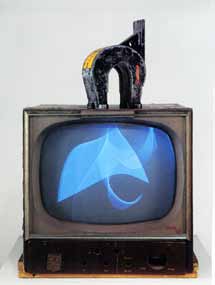
Magnet TV, by Nam June Paik, 1965. 17 in. black and white television and magnet ((http://www.paikstudios.com/gallery/10.html).
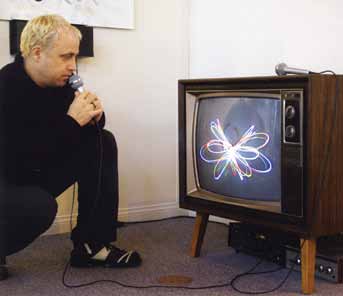
Participation TV, by Nam June Paik, 1963. Manipulated television, signal amplifiers, and microphine. Installation
view, 2007. (Frieling et al., 2008, p. 99: http://www.sfmoma.org/explore/multimedia/audio/aop_tour_403).
As with a great deal of visual art, the invisible is made visible, regardless of whether the purpose is experimental or critical. The use of computers in the production of art grew out of formalist art practices from the 1970s (Minimalism, Neo-Constructivism) and Conceptual aesthetic tendencies explored during the 1960s and beyond. (18) In 1965 Nam June Paik made a piece entitled Magnet TV which employed neither videotape or broadcast images but instead was created by moving a large magnet across the surface of a television set in order to produce a moving abstract pattern. Paik, a member of the Fluxus anti-high art movement, created works in which the television was emptied of its usual function and transformed into a statement about technology in general. Similar to Paik’s exploration of the television set in the 1960s, contemporary artists such as Julie Andreyev and Patrick Bergeron are choosing to manipulate digital media to incite new understandings and possibilities. Julie Andreyev, a new media artist based in Vancouver, creates work that includes interactivity with audio-video installations. Andreyev’s recent projects within Animal Lover examine the distinct being of the animal through the use of digital technologies. The interactive and animated piece *glisten)HIVE (19) explores issues surrounding communication, social media, and animal experience. Participants are asked to send text messages via Twitter based on what their companion animals are thinking, feeling, or doing. The text messages are then randomly processed according to a computer algorithm and visually composed on screen in a real-time space. What transpires is an abstract amalgamation of words, characters, and sound that is suggestive of the networked processes behind the screens of our mobile devices while also resembling insect swarming patterns.
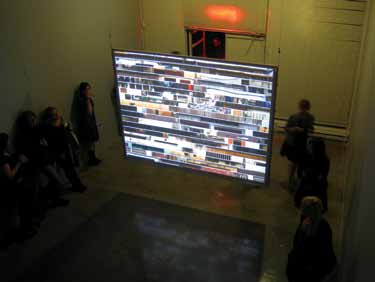
Patrick Bergeron, a video artist and researcher based in Montreal, makes work that can be classified as a mix of animation, documentary, and experimental film. LoopLoop, (20) a work that was conceived in 2008 and continues to be exhibited now, is a five-minute video loop constructed from a sequence of film captured from within a train traveling to Hanoi in Vietnam. The looped video consists of multiple horizontal strips of cropped imagery that individually shift back and forth in different directions, suggestive of the multidirectional interactions that takes place in one’s cognitive visual database. Although Bergeron’s work may not intentionally be about narrative processes that take place in a networked culture of transportable screens and mobile devices, through a combination of fastpaced rhythmic movement and layering of multiple screen divisions and fragments, the artist manages to convey a sense of space and time representative of the ongoing process of working through our digital existence.
Assembling, Processing, and Working Through
The term “working through” is derived from psychoanalysis and is known as the point of therapy when the subject realizes something relevant and feels a need to replay and reanalyze things continuously. Freud coined the term, describing it as the boring part of the process from the analyst’s point of view as he states, “this workingthrough of the resistances may in practiceturn out to be an arduous task for the subject of the analysis and a trial of patience for the analyst.” (21) The act of working through is crucial to a better understanding of the self and therefore, the self in relation to culture.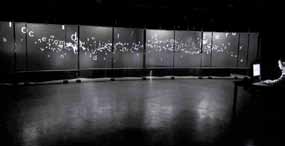
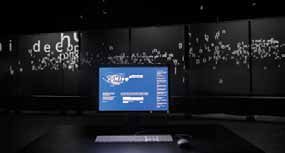
Figure 3:*glisten)HIVE, by Julie Andreyev (technical collaboration with Simon Overstall ), 2010. Installation for CODE Live 2, Vancouver Cultural Olympiad, Vancouver. Photo courtesy of Valen Keeven. http://youtu.be/LbhXr86XX6A
In regards to understanding ourselves in relation to technology, Marshall McLuhan argued that we need to recognize that technology is in fact an extension of ourselves. In an interview in 1969, McLuhan writes, “The centralpurpose of all my work is to convey this message, that by understanding media as they extend man, we gain a measure of control over them.” (22) Richard Cavell has brought McLuhan’s argument into contemporary discourse by writing about his interests in “biomedia,” elaborating on McLuhan’s notions of technology not only being an extension of the human, but being human, stating: “McLuhan… was arguing that…technology is the pre-condition of thought insofar as it is the pre-condition of being, at which point technology and ‘being human’ collapse into each other.” (23) In applying this theory to digital communication systems in contemporary culture, Cavell reiterates what I feel to be a significant point to consider from McLuhan’s often undervalued theories: “In any communication, it is the sender who is sent.” (24) Cavell argues that we have a tendency to see the reflection of ourselves in the Internet without fully realizing we are located in this reflection, similar to how the Greek hero Narcissus fell in love with his reflection without realizing it was his own. The artworks by both Andreyev and Bergeron illustrate relational and perceptual processes we have with the technologies we use to communicate with one another, however, the viewer-participants are more likely to become self-reflective when engaged with the overall effect of the work as opposed to when examining the individual text messages or singular images that make up the larger works.This level of engagement can occur if one allows him or herself to become absorbed into the continuous looping process, the narrativity, while also forming personal responses to the questions posed by the work.
As mentioned above, with Andreyev’s *glisten)HIVE, participants submit text messages based on how they are interpreting their companion animals feelings and actions. The messages then transpire, via digital projection, onto the semi-transparent screens that line the wall of an exhibition space experienced in real-time. Visitors to the exhibition space can also contribute messages using an on-site computer terminal. The participatory interaction mimics the “acute form of self-reflection” (25) that can often occur on social networking websites, such as Twitter and Facebook, but requires humans to reflect on the subjective experiences of animals. Snippets of text, restricted to the 140-character limit of the Twitter social media program, are generated into swarms of social-insect patterns, resembling the movement of bees navigating themselves toward a hive. The concept of “emergence,” and the related underlying theory of complexity science, is exemplified in the visual arrangement of messages that are assembled and projected in the darkened room. The artist describes this emergent pattern as a “collective effect,” in which “each organism is primarily reliant on the movement of others in its immediate vicinity.”26 The viewer of the piece is therefore required to work through the overall aesthetic experience and, whether the texting participants are aware or not, they are also involved in a self-reflexive act. *glisten) HIVE demonstrates ongoing processes of narrative, yet requires the viewer to work through its aesthetics in order to decipher the actual messages—words and letters are playfully rearranged and presented backwards once the messages are filtered through the computer software program. The emphasis is therefore placed more on the invisible processes of communication and the overall narrativity, rather than the individual content of each text message.
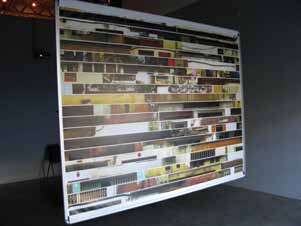
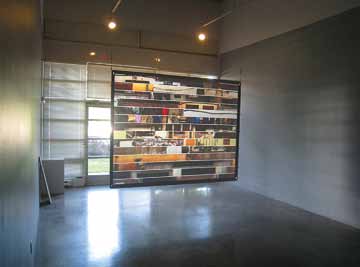
LoopLoop, by Patrick Bergeron, 2010. (photo side)
Installation at grunt gallery, Vancouver. Photo by author.
Similarly, in Bergeron’s LoopLoop, images are assembled into a continuous, ongoing panoramic sequence that communicates less about the individual photos and more about the sensory qualities of the experience of global traveling. Bergeron captured the everyday events, places, and people he encountered and composed an audio-video animation made up of 1,000 images stitched into one long panoramic image that loops rhythmically on screen, moving back and forth to echo the way memories are replayed in the mind. The work is encountered in the gallery space as a large photograph suspended from the ceiling with the looped video projected on the reverse side of the image—with a suspended support resembling that of a classroom or home theatre screen (upper right). If interpreted as a screen for home movies or slideshows, viewers might be reminded of moments from the past when travel photos were presented one at a time, as opposed to the multilinear perspective we now have in front of our miniature digital screens. Upon reflection, one might consider the animation of these photographic sequences as a representation of the mind searching through the static images that often becomes the signifier to a forgotten time. At one point in the loop, perhaps at the beginning, the video is still, but upon close examination one can see subtle flickering movement that soon disappears as the assemblage of imagery shifts once again through the sequence. These glimpses are contrasted by the warm aesthetics that we usually associate with analog media and which invite us in to the work, to search for understanding and perhaps a reflection of ourselves.
Sensing Aesthetics and Decoding Narrative
Raymond Williams once wrote about the difficulty to respond and to interpret television’s intrinsic visual experiences and the lack of description surrounding the topic. Williams felt that the attentive moments belonging to the viewer, “an experience of visual mobility, of contrast of angle, of variation of focus,” (27) may be one of the most significant aspects of that medium’s power, further describing it as one of the primary processes of the technology itself. The sense of visual mobility experienced with television was transferred over to the aesthetics of the computer screen and later to the multidirectional abilities of the Internet, ultimately contributing to a flickering web that has now transformed into what some might define as an embodied experience.
Although clearly constructed and presented through digital means, LoopLoop merges viewing mechanisms of the past and present in a manner in which we are reminded of the intimate relationships we have with the technologies we use. As described above, the suspended screen resembles a modified version of the kind of home movie screen on which many of us viewed slideshows and 8 mm films of family vacations. The subtle use of a computerized transition effect might easily go unnoticed amongst the predominant attention to visual characteristics of texture, color, and formal composition (Figure 5 LoopLoop). As an artist myself, and someone who comes to digital media with a background in painting, I can appreciate the artist’s sense of mixing media, in terms of the use of both painterly and photographic language, situated within the larger context of a video installation. Bergeron reveals the primary processes of not only the visual representation of these captured moments, but through his rhythmic placement of detailed close-up shots, he seems to suggest a journey through an archive of memories. In an artist
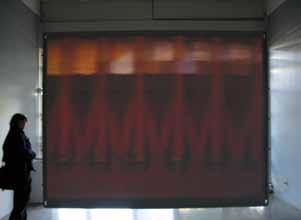
LoopLoop, by Patrick Bergeron, 2010. (video still) Installation at grunt gallery, Vancouver. Photo by author.
statement, Bergeron reflects on his relationship to the documentation of his travels, stating, “When I came back home, many experiences and details had been forgotten. My brain failed at accommodating the abundance of the subjects met…. My memory is activated by these images. By watching them several times, I detect new interesting facts.” (28) The formal qualities of the selected imagery, distorted soundtrack and layered, continuous horizontal movement, combine to transport the viewer to another time and place.
Bergeron’s manipulation of digital footage could be viewed as similar to or influenced by certain experimental animation that used single images one after the other in quick succession, fusing static imagery into motion. Robert Breer’s Recreation (1956) (29) combined split second shots into a sequence that makes the viewer uneasy and nearly nauseous. Breer described his treatment of the single images as individual sensations and his fast-paced technique seems representative of today’s Internet culture in which we constantly click from one image to the next. Bergeron’s LoopLoop may not be intentionally directed at the subject of the Internet, however, the quantity of imagery that continues to fill the screen, combined with a design that feels as if it is meant to be interacted with, results in an aesthetic experience conveyed by the artist that one might relate to our online world.
The sensory experience of Julie Andreyev’s *glisten) HIVE is heightened by a processed soundscape of bells and flute, layered with low blips and constant pulses, and the recorded voice of Tom, the artist’s dog. As the text enlarges on the wall, certain words and phrases of animal thoughts and feelings become legible:
—Sometimes when I’m anxious at night I puke in the morning— We’ll just sit and wait—If you close your eyes no one can see you—Maybe there’ll be some fun today *hopeful*.
Except for the small amount of light emanating from the projected animation, the room is pitch-black. As the swarm of tweets become slower in pace and reduced in size, the volume of the sound lessens, and it feels like a quiet summer night. The technologically busied mind now becomes subdued and the strings of words transform to floating dots that recede into darkness. As new visitors approach the screens, digital sensors are re-triggered and a feedback loop instigates the projection once again.
Andreyev’s installation consists of a digital aesthetic, an arena of sensation, that emanates from within the networked relations that make up the work—physical, technological, psychological, and social—rather than focusing purely on formal qualities alone. In other words, the aesthetic experience not only emerges from the visual and audio components, but is also informed by the participants’ interactions and past experiences with the technology (cell phones, computer station, and motion sensors) and, in particular, a social media platform that has come to represent a global language. The rhythmic and visual movement of the text in *glisten)HIVE clearly contrasts the usual grid-like structure in which we receive messages in Twitter, and ultimately interrupts any sense of a sequential story. The flowing text could be interpreted as an abstract representation of an aerial view of the communications that span social networks like Twitter, perhaps resembling the reduced form of ASCII (30) art from the 1990s. In Vuk Cosic’s ASCII History of the Moving Images (31) from 1998, film clips from such classics as King Kong, Star Trek, and Blow Up were manipulated to reveal the normally hidden coded properties of the digital forms we see on screen, which makers of web browsers work very hard at concealing from us. Lev Manovich describes the experience of this artwork “as satisfying poetically as it is conceptually—for what we get is a double image, a recognizable film image and an abstract code together. Both are visible at once.” (32) The code becomes a character in the narrative, while simultaneously disrupting the story to draw attention to the historical and social aspects embedded in the visuals produced on screen. As we search for recognizable forms, our minds work to fill in the gap between the code and moving imagery. Similar to *glisten)HIVE, the visual elements foreground the larger meaning and narrativity of the work—the complex relationship between technology and culture, and our individual experiences in contemporary society.
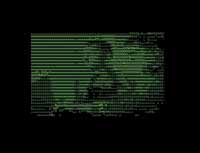
ASCII History of the Moving Images, by Vuk Cosic, 1998. Screenshots from http://www.ljudmila. org/~vuk/ascii/film/ (accessed May 20, 2011).
Conclusion
Our current fascination, some might say obsession, with daily text/image updates to social networking websites can perhaps be explained by the narrative paradigm and our innate desire to comprehend life as a series of ongoing narratives. And if one incorporates Freud’s theory of working through into the mix, the contemporary networked self starts to become clearer. With this in mind, we can consider the invention of the blog for instance, which has now evolved into the form of a digital photo diary, as the individual’s way of working through ideas and feelings in an effort to connect with others. Artists’ recent exploration of the blog as a medium (or postmedium) (33) to work within and perhaps reinvent, is a continuation of the need to provide critical reflection of our everyday interactions with/in digital culture. Some artists are using the blog format as a way to document relational art (Marianela Ramos Capelo, A Stranger A Day), whereas others are making work on blogs in which our use of the technology is central to the subject of the work (Cory Arcangel, Sorry I Haven’t Posted, (35) and Heidi May, Selfpost|Postself (36). The use of online technologies and social media websites provide artists the opportunity to merge visual and textual explorations, creating a multimedia account that appropriately reflects our contemporary existence.
Regardless of the particular type of digital media used in the artworks discussed throughout this paper, each of them have explored a notion of invisible processes that contribute to human experience—how we see, how we think, how we remember, and how we speak. I have explored qualities of narrativity that, in addition to notions of the invisible, have allowed for analysis of artworks in which cognitive processes (working through) and sensory relations (aesthetic encounters) are made apparent through the use of digital media. Finally, I have argued for a theoretical approach to understanding artistic modes of expression that capture the inner processes of digital technologies, revealing digital media as an extension of ourselves.
Footnotes:
- Anna Munster, “Digitality: Approximate Aesthetics,” in CTHEORY, (a093, March 14, 2001), eds. Arthur and Marilouise Kroker. http://www.ctheory.net/articles.aspx?id=290 (accessed May 11, 2011).
- Mieke Bal. Narratology: Introduction to the Theory of Narrative, 2nd ed. (Toronto: University of Toronto Press, 2009), 222. (italics in orig.)
- Nicolas Bourriaud, Relational Aesthetics (Dijon: Les presses du réel, 1998; trans, 2002).
- Margaret Lovejoy, Digital Currents: Art in the Electronic Age (New York: Routledge, 2004).
- Victoria Vesna, “Seeing the World in a Grain of Sand: The Database Aesthetics of Everything,” in Database Aesthetics: Art in the Age of Information Overflow, ed. Victoria Vesna (Minneapolis: University of Minnesota Press, 2007).
- Warren Sack, “Network Aesthetics.” in Database Aesthetics: Art in the Age of Information Overflow, ed. Victoria Vesna (Minneapolis: University of Minnesota Press, 2007).
- Vito Campanelli, interview by Geert Lovinck, “Interview with Vito Campanelli about Web Aesthetics,” <nettime>, May, 2007, http:// www.nettime.org/Lists-Archives/nettime-l-0705/msg00012.html. (accessed May 11, 2011).
- Walter Fisher, “The Narrative Paradigm: In the Beginning.” Journal of Communication 35, Autumn (1985): 74-89.
- Mieke Bal. Narratology: Introduction to the Theory of Narrative, 2nd ed. (Toronto: University of Toronto Press, 2009).
- Ibid, 162.
- Art21 Glossary, http://www.pbs.org/art21/education/glossary_pop.html (accessed May 20, 2011).
- Mieke Bal, Narratology: Introduction to the Theory of Narrative, 2nd ed. (Toronto: University of Toronto Press, 2009), 222.
- Anna Munster, “Digitality: Approximate Aesthetics,” in CTHEORY, (a093), eds. Arthur and Marilouise Kroker, March 14, 2001, para. 2. http://www.ctheory.net/articles.aspx?id=290, (accessed May 11, 2011)
- Graham Harwood, Uncomfortable Proximity, 2000, website artwork, http://www.tate.org.uk/netart/mongrel/collections/default.htm (accessed May 11, 2011)
- Matthew Fuller, “Breach the pieces,” in Intermedia Art Archive (Tate Online, 2000). https://www.tate.org.uk/intermediaart/ entry15470.shtm (accessed May 11, 2011)
- Anna Munster, “Digitality: approximate aesthetics”, CTHEORY, a 093 (March 14,2001), Ed Arthur and Marilouise Kroker,, http:// www.ctheory.net/articles.aspx?id=290.
- Heidi May, “Interrupting the Program: Descrambling TV through Video,” Canadian Art 18, no. 2, (2001): 66-73.
- Margaret Lovejoy, Art in the Electronic Age (New York, NY: Routledge, 2004).
- Julie Andreyev, *glisten)HIVE, 2010, video documentation, 3:12, http://youtu.be/LbhXr86XX6A (accessed May 11, 2011)
- Patrick Bergeron, LoopLoop, 2010, video documentation, 4:31, http://youtu.be/Rr4qbL0Z50c (accessed May 11, 2011)
- Sigmund Freud, “Remembering, repeating and working-through; The case of Schreber; Papers on technique and other works,” The Standard Edition of the Complete Psychology Works of Sigmund Freud, Volume 12, ed. James Strachey (London: The Hogarth Press Ltd., 1964), 155.
- Marshall McLuhan, “The Playboy Interview: Marshall McLuhan,” Playboy Magazine (March, 1969), http://www.mcluhanmedia. com/m_mcl_inter_pb_02.html. (accessed May 11, 2011).
- Richard Cavell, “McLuhan and the Body as Medium,” Sk-interfaces: Exploding Borders—Creating Membranes In Art, Technology, and Society, ed. J. Hauser (Liverpool UP and FACT Gallery, 2008): 32-41.
- Ibid.
- Clive Thompson, “Brave New World of Digital Intimacy,” The New York Times, (September 7, 2008), http://www.nytimes. com/2008/09/07/magazine/07awareness-t.html. (accessed May 11, 2011).
- Julie Andreyev, *glisten)HIVE, project statement, 2010.
- Raymond Williams, Television: Technology, and Cultural Form (London: Wm Collins Sons & Co. Ltd., 1974), 77.
- Patrick Bergon, LoopLoop, synopsis, http://www.patrickbergeron.com/looploop/index.html (accessed May 11, 2011).
- Robert Breer, Recreation, 1956, video, 1:24, http://youtu.be/7JEDYnSStug (accessed May 11, 2011).
- ASCII is an abbreviation of American Standard Code for Information Interchange. Manovich (1999) describes how the code was originally developed for teleprinters and was only later adopted for computers in the 1960s. Towards the end of the 1980s, it was commonplace to make printouts of images on dot matrix printers by converting the images into ASCII code.
- Vuk Cosic, ASCII History of the Moving Images, 1998, http://www.ljudmila.org/~vuk/ascii/film/ (accessed May 20, 2011).
- Lev Manovich, “Cinema by Numbers: ASCII Films by Vuk Cosic,” Contemporary ASCII. (Ljubljana, 1999), para. 14.
-
Julian Stallabrass (2010) describes the lack of materiality and (often) gallery displays of Internet art (and, I would include, the lack of materiality of other kinds of digital art) as its “post-medium condition”—the Internet not being a medium, but rather a transmission system. Digital media in contemporary art often self-consciously refers to itself to draw attention to the processes and structures that contribute to its ephemeral identity. In these cases, the artists are not so much concerned with modernist interests of formalism, as they are with the fundamental characteristics of the behavioral and societal aspects of digital media.
-
Marianela Ramos Capelo, A Stranger A Day, 2010 and ongoing, blog, http://astrangeraday.tumblr.com/archive (accessed May 11, 2011).
-
Cory Arcangel, Sorry I Haven’t Posted, 2010 and ongoing, blog, http://sorry.coryarcangel.com (accessed May 11, 2011).
-
Heidi May, Selfpost | Postself, 2010 and ongoing, blog, http://postself.wordpress.com (accessed May 11, 2011).
Bibliography:
Andreyev, Julie. *glisten)HIVE, 2010, video documentation, 3:12, http://julieandreyev.com/glisten-hive/
Andreyev, Julie. *glisten)HIVE, project statement, 2010.
Arcangel, Cory. Sorry I Haven’t Posted, 2010 and ongoing, blog. http://sorry.coryarcangel.com. (accessed May 11, 2011).
Art21. “Glossary.” http://www.pbs.org/art21/education/glossary_pop.html. (accessed May 20, 2011).
Bal, Mieke. Narratology: Introduction to the Theory of Narrative. 2nd ed. Toronto: University of Toronto Press, 2009.
Bergeron, Patrick. LoopLoop, 2010, video documentation, 4:31, http://youtu.be/Rr4qbL0Z50c. (accessed May 11, 2011).
Bergeron, Patrick. LoopLoop, synopsis. http://www.patrickbergeron.com/looploop/index.html. (accessed May 11, 2011).
Bourriaud, Nicolas. Relational Aesthetics. Dijon: Les presses du réel, 1998; trans. 2002.
Breer, Robert. Recreation, 1956, video, 1:24, http://youtu.be/7JEDYnSStug (accessed May 11, 2011).
Capelo, Marianela Ramos. A Stranger A Day, 2010 and ongoing, blog, http://astrangeraday.tumblr.com/archive. (accessed May 11, 2011).
Cavell, Richard. “McLuhan and the Body as Medium.” In Sk-interfaces: Exploding Borders—Creating Membranes In Art, Technology, and Society. Edited by J. Hauser, Liverpool UP and FACT Gallery, 2008.
Cosic, Vuk. ASCII History of the Moving Images. 1998, http://www.ljudmila.org/~vuk/ascii/film/. (accessed May 20, 2011).
Harwood, Graham. Uncomfortable Proximity. 2000, http://www.tate.org.uk/ netart/mongrel/collections/default.htm (accessed May 11, 2011).
Fisher, Walter. “The Narrative Paradigm: In the Beginning.” In Journal of Communication 35, Autumn (1985): 74-89.
Frieling, R., Pellico, M. & Zimbardo, T. The Art of Participation: 1950 to Now. Edited by R. Frieling. New York: Thames & Hudson, Inc., 2008. Published in conjunction with an exhibition of the same name, shown at San Francisco Museum of Modern Art.
 Freud, Sigmund. “The Case of Schreber; Papers on Technique and Other Works,” In The Standard Edition of the Complete Psychology Works of Sigmund Freud. Vol. 12. Edited by James Strachey. London: The Hogarth Press Ltd,, 1914; reprint, 1964.
Fuller, Matthew. “Breach the pieces.” in Intermedia Art Archive (Tate Online, 2000). https://www.tate.org. uk/intermediaart/entry15470.shtm. (accessed May 11, 2011). 22
Lovejoy, Margaret. Digital Currents: Art in the Electronic Age. New York: Routledge, 2004.
Lovinck, Geert. “Interview with Vito Campanelli about Web Aesthetics.” <nettime> (May, 2007). http://www.nettime. org/Lists-Archives/nettime-l-0705/msg00012.html. (accessed May 11, 2011).
Manovich, Lev. “Cinema by Numbers: ASCII Films by Vuk Cosic,” In Contemporary ASCII. (Ljubljana, 1999). Exhibition catalogue. Available at http://manovich.net/articles/. (accessed May 20, 2011).
May, Heidi. Selfpost | Postself. http://postself.wordpress.com (accessed May 11, 2011).
May, Heidi. “Interrupting the Program: Descrambling TV through Video.” In Canadian Art 18, No. 2, (2001): 66-73.
Munster, Anna. “Digitality: approximate aesthetics.” In CTHEORY, a093, March 14, 2001. Edited by Arthur and Marilouise Kroker, http://www.ctheory.net/articles.aspx?id=290 .(accessed May 11, 2011).
Sack, Warren. “Network aesthetics.” In Database Aesthetics: Art in the Age of Information Overflow. Edited by Victoria Vesna. Minneapolis: University of Minnesota Press, 2007.
Stallabrass, Julian. “Can Art History Digest Net Art?” In netpioneers 1.0: contextualising early net-based art. Edited by D. Daniels and G. Reisinger. Berlin-New York: Sterberg Press, 2010.
“The Playboy Interview: Marshall McLuhan.” Playboy Magazine. March, 1969. Also available at http://www.mcluhanmedia. com/m_mcl_inter_pb_02.html .(accessed May 11, 2011).
Thompson, Clive. “Brave New World of Digital Intimacy.” In The New York Times. September 7, 2008. Accessed online at http://www.nytimes.com/2008/09/07/magazine/07awareness-t.html .(accessed May 11, 2011).
Vesna, Victoria. “Seeing the World in a Grain of Sand: The Database Aesthetics of Everything.” In Database Aesthetics: Art in the Age of Information Overflow. Edited by Victoria Vesna. Minneapolis: University of Minnesota Press, 2007.
Williams, Raymond. Television: Technology and Cultural Form. London: Wm Collins Sons & Co. Ltd., 1974.
Facing page and right:
LoopLoop, by Patrick Bergeron, 2010.
(video still) Installation at grunt gallery, Vancouver. Photos courtesy of the artist..