
V8N2: Journeys in Travel: A Recombinant, Computercontrolled Cinematic Essay
By Christin Bolewski | February 28, 2013
Introduction
Journeys in Travel is a work-in-progress artistic research project and evolves from the interest in developing new contemporary modes of travel narrative within the realm of digital storytelling rather than investigating the genre of the digital database narrative itself. The author of the video installation and this paper is a digital media artist and experimental filmmaker who works intensively on the subject of travel and the cinematic essay in her artistic practice. Referring to current developments and conceptual approaches towards nonlinear or recombinant1 narratives in recent mainstream cinema, film studies, new media theory, and fine art practice, Journeys in Travel combines knowledge of traditional and multi-plot storytelling with segmentation of interactive storytelling and experimental filmmaking. It uses the form of the cinematic essay, which is characterized by a collage of associative and subjective reflections on a set theme intertwining different streams of episodic narratives in a mixed genre of narrative, documentary, and experimental filmmaking with a variable relationship between image, text, sound, and music.
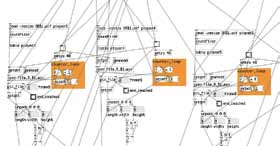
Detail of PD control algorythm of the recombinant essay Journeys in Travel, © Christin Bolewski 2010
According to Paul Arthur (2), essay films are still “on the margins” of the film making world, and the category is under-theorized. The link between recombinant narrative and cinematic essay has not yet been intensively investigated and emerges as one of the central aspects of the project. But there are also close and historical connections between travel, film, and narrative that are revisited and re-contextualized in the digital era. All time-based media including film, music, and literature share elements of movement, pace, and rhythm. They structure time and information through temporal and spatial arrangements, composition, sequencing, and montage, and the recipients are engaged in sequential perception. Travel can be understood as the reading of an audio-visual narrative, a sequence of images and sounds of unfolding events, captured while we are moving through time and space. Michel de Certeau suggests that “every story is a story of travel—a spatial practice.”(3)
The Cinematic Essay, the Travelogue, and the Database Narrative
Essay film became an identifiable form of filmmaking in European cinema European cinema in the 1950s and 1960s, and emerged as the leading non-fiction form for both intellectual and artistic innovation with Chris Marker (Lettre de Siberié, 1957; Sans Soleil, 1983) representing probably the most prominent example. It emphasizes theme over plot and the discovery of narrative through a flexible, reflexive, and self-critical approach. The theme thereby becomes extremely important and often suggests the form that the film might take.“ The cinematic revolution now in progress is based on what is essentially a very simple idea: that a subject can engender form and that to choose a subject is to make an aesthetic choice.” (4) The cinematic essay typically piles up a series of stylistically diverse fragments and can incorporate shifting narrative forms, documentary practices, dramatized elements, and experimental approaches. It can incorporate biography, autobiography, history, culture, poetry, fiction, criticism, photographs, drawings, cinema, etc. Jakob Hessler states:
The essay takes into account the crisis of rationality in post-enlightenment modernity. Instead of using its object merely as an example for already established concepts, neatly separating form and content in a positivist manner, the essay configures its material in a non-hierarchical textual process.(5)
The above description bears a resemblance to contemporary developments in nonlinear, interactive, or database film. New media theorist Lev Manovich writes in Database as Symbolic Form, “Since in a database all data are simultaneously present, databases do not have a beginning or end; in fact they do not have any development, thematically, formally, or otherwise that would organize their elements into a sequence.” (6) In database or interactive film, the digital artist is afforded a seemingly infinite number of possibilities through the recombination of small narrative units. Manovich’s aim is to expand the possibilities for new, interactive digital media. However, his ideas apply also to contemporary (digital) narrative cinema and he considers filmmakers Peter Greenaway and Dziga Vertov as pioneers in his database cinema genre. Manovich has created himself the database narrative, or what he calls “Soft Cinema,” Installation Texas (2004). Its database contains 425 clips shot at various locations over several years to capture the iconography of a “global city.” It is a modern version of a city symphony film, which is a genre rooted in early cinema with a strong connection to the cinematic essay. Walter Ruttmann’s “city symphony film” Berlin: Symphony of a Great City (1927) is sometimes referred to as an essayistic film. It portrays the life of a city mainly through visual impressions in a semi-documentary style that implies though the sequencing of events a kind of loose theme or impression. The montage concept of the film is based on soviet montage theory, and there exist many parallels between Ruttmann’s film and Dziga Vertov’s Man with a Movie Camera (1924).
Comparably, the genre of the travelogue suggests a close connection to an episodic non-hierarchical narrative. Jeffrey Ruoff writes in the introduction to Virtual Voyages: Cinema and Travel:
Generally speaking the travelogue is an open form, an episodic narrative, essayistic, it often brings together scenes without regard for plot or narrative progression. Episodic narration offers an alternative to both the linear cause-and-effect structure of classical Hollywood cinema and the problem-solution approach of Griersonian documentary. The episodic narrative does not subordinate time and place to the regime of plot or story nor are its elements typically yoked to an argument. (7)
The travelogue is not only the first chapter in the history of documentary film, but also a key element of ethnographic and fiction films. Under close examination, it appears that many of the most prominent cinematic essays include elements of a travelogue or are a travelogue and vice versa. Important examples are Lettre de Siberié (1957) and Sans Soleil (1983) from Chris Marker, Alexander Sokurov’s Elegy of a Voyage (2001), or Peter Mettler’s Gambling, Gods and LSD (2002). Lettre de Siberie, Chris Marker’s first major cine-essay, is a travelogue presented in the form of a personal letter that reflect his impressions of the modernization of Siberia in the aftermath of Stalin’s death. The film’s travelogue is as much a journey into the possibilities of cinema itself as an experimental medium. Laura Rascoroli suggests in her essay “On Fog and Snow: Thought as Movement, or the Journey of the Essay Film,” that Alexander Sokurov’s video Elegy of a Voyage is a sort of travel diary; it “conveys the idea of a musing about travelling, or perhaps even of musing as travelling. Sokurov conjures such notions by thinking aloud while he travels, and by letting the thinking be triggered by the travelling, thus associating the two activities; as well as by problematizing and undermining his own agency as both traveller and filmmaker.” (8)
The cinematic essay often includes a self-referential reflection on cinema and Journeys in Travel includes a reflection on the relationship of travel and film, the analogy to cinematic perception, and the emergence of cinema itself. There is a cultural-historical amalgamation of train and film that can be traced back to its beginning. Through the train carriage window, passengers were offered a cinematic experience years before the emergence of cinema itself.
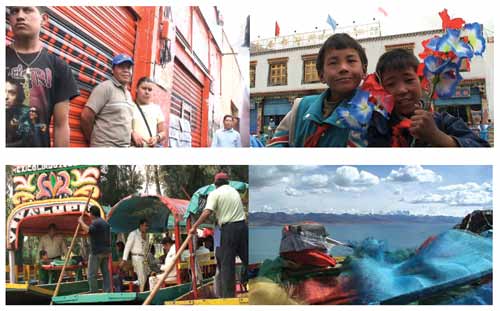
Documentary clips of the recombinant essay Journeys in Travel. The database contains clips filmed in Asia, Australia, West Africa, Europe, and North and South America. © Christin Bolewski 2010.
Therefore, it was not a coincidence that the history of cinema began with the entry of a train. The “phantom ride,” a train trip filmed from the locomotive, was one of the most popular forms of early cinema and presented a dynamic new style of filmmaking, since the camera in early films was usually stationary. Soon after, the travelogue dominated the early cinema, constantly striving to enhance the sensation of motion, whether via the camera itself being in motion in panoramic pan shots and phantom rides, or through capturing busy street scenes. The travelogue heightened awareness of cinema as a technology for moving through space and time, and of cinema itself as a mode of travel.
Journeys in Travel: A Digital Recombinant Database Essay
Journeys in Travel investigates the cinematic essay as a digital database and reconstructs the historical genre of the travelogue and its episodic structure as a contemporary open-ended digital narrative. It stems from the position of experimental filmmaking, but it does not neglect narrative traditions. There is a computer algorithm in place that controls the narrative by offering logical permutations because the final aim is to tell a (complex) story. However, because there is no need for linear cause-and-effect driven sequence of actions and events in essayistic film, the computer algorithm can provide more or less any possible connection between the narrative units. Paul Arthur writes in “Essay Questions:”
Essays are distinctly process-oriented: they are rhetorical journeys in which neither an exact route nor final destination are completely spelled out. The essay assumes that what it tells us, and the order in which it is communicated could have taken an entirely different route, that it is one of several possible versions of the same concept. It delights in quirky arcs of logic sudden digressions, unexpected epiphanies, pauses for self-reflection. (9)
The dramatic units of Journeys in Travel consist of video and sound sequences of lengths between 30 seconds and 2 minutes and provide travel observations from various countries and locations worldwide, socio-philosophical reflections, and a multi-voiced travel narration that references Marc Auge, Jean Baudrillard, Arthur Asa Berger, Alain de Botton, Ryszard Kapuściński, Cees Nooteboom, and Claude Levy Strauss, to name only a few. A particular emphasis lies on a complex relationship between image and text as Paul Arthur notes:
The conjunction of language and image, fundamental to film grammar, is a key ingredient of the essay film. In some sense all great essays are about complex relationships between words and pictures, the mechanism by which speech can annotate, undermine, or otherwise change the significance of what we see— and vice versa. (10)
Therefore, image and sound files are treated separately within the computer script and multiple combinations can be generated. This creates a post-modern dialogue in a continuous movement that always permits new (and contradictory) varieties of readings and conclusions. The story of Journeys in Travel becomes an endless performative act, which never arrives at an end, and as such, it mirrors the “rhetorical journey without exact route or final destination” of the cinematic essay described by Paul Arthur. Journeys in Travel is conceptually designed as a continuously growing “living” organism. Additional sequences, image, sound, and text files can be uploaded at any time creating an infinite system of narratives and reference points similar to the multi-dimensional hypertext structure of the internet to emphasize the complexity of moving through a globalized, hyper-connected world with multiple layers, references, and interdependencies.
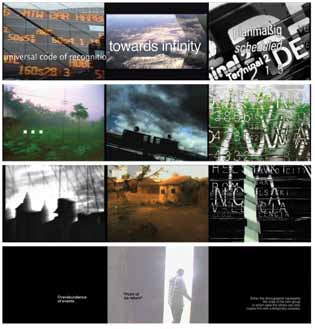
Use of experimental clips, text, and intertitles in the recombinant essay Journeys in Travel, © Christin Bolewski 2010.
Corresponding to Manovich’s Soft Cinema, (11) the cinematic essay provides context from varying sources in a database of multimedia contents (video clips, sound, still images, text, etc.). So far the system navigates through a database of narrative units, which are categorized by different groups: film genre, theme, and location, but also by formal properties and aesthetic qualities of mood, pace, rhythm, camera motion, etc.. Documentary, experimental, and narrative fragments alter the narrative flow as well as sequences with fast or slow pace, or sequences that contain audio commentary, travel narrative, intertitles, or music,. As in interactive narratives, the contents are organized in segments and dramaturgic elements do not presuppose a specific sequential order. The segments provide complex units of information and miniature narrative structures, for example a reflective thought, a philosophical quote, a documentary observation, or an experimental audiovisual stream. They are all self-contained units similar to a sequence or a chapter in a traditional (film) narration. Therefore each narrative unit within the database provides a kind of conclusion that can be read against the content of the following or previous units. This approach mirrors what Marsha Kinder (in opposition to Manovich) defines as “(interactive) database narratives” and refers to(no indent) narratives whose structure exposes the dual processes of selection and combination that lie at the heart of all stories and that are crucial to language: the selection of particular data (characters, images, sounds, events) from a series of databases or paradigms, which are then combined to generate specific tales. (12)
Thus never telling a story from the beginning to its end, but providing a “kaleidoscopic” narrative flow, Journeys in Travel aims to capture the attention of the viewer, to keep them following the discursive argument and alternatively to provide intervals of slow pace for own observation and reflection. Hence, the algorithm is set to generate a rhythmic flow with an alternation of different narrative elements and perceptive qualities.
One of the major challenges of the project is to set the algorithm and narrative flow in such a way as to create a stimulating and intellectual challenging experience for the viewer without causing confusion, boredom, or frustration. It shall keep a balance between well-directed narrative, randomness, and chaos and also adjust rhythm and pace to the condition of human perception so that the timing of the units and the frequency of alternations stimulate the attentive potential of the viewer. This need for balance refers to general problems of pace and timing in film montage, which are commonly understood to be a complicated and so far more or less intuitively handled matter. “Film is always a complex polyphone and polyrhythmic construct, which is experienced individually making it impossible to find a simple formula.”13 Hence the database film allows an exceptional opportunity to vary and test a film in different versions. Simply by changing the computer algorithm a different access to and alignment of the narrative elements can be achieved. For example, one can decide to select only elements that contain documentary observations or travel narratives. In a later version, an interface will allow the viewers to alter the algorithm and to create their own film depending on individual preference for genre, pace, and storytelling.
Use of “PD” Software, Metadata, and Algorithm
Manovich has identified metadata as the key towards structure and control in database narratives. Metadata is invisible information (keywords, for example) that is attached to any data set. What he calls “algorithmic editing,” is an automated system for combining elements according to prescribed rules based on the formal properties or content of video clips. In his installation Texas (2004), each video clip in the database holds ten parameters, including location, subject matter, average brightness, contrast, the type of space, the type of camera motion, and several more. “The software uses these parameters in selecting each clip, finding clips that are all similar in some fashion to the next.” (14)
The database of Journeys in Travel currently holds approximately eighty video and sound clips. So far, three different layers support the narrative structure. These are the genre of film narration, musical leitmotifs (recurring themes), and different narrator voices. “PD” has been selected as the controlling software, firstly because of the artist’s individual preference for open source programming communities, but secondly, and more importantly, “PD” is like “MAX” a common tool for algorithmic and interactive (music) creation. The link between structuring processes and rhythm in musical composition and film narration will be investigated closer in a further stage of development.
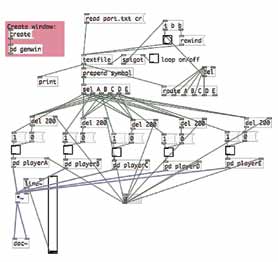
The “PD” control algorythm of the recombinant essay Journeys in Travel contains five video and sound players.
© Christin Bolewski 2010.
Journeys in Travel currently provides five groups of narrative genre elements. They are organized within the structure of “PD” as five separate video and sound players that alternate after a preprogrammed script to generate a rhythmic flow with an alternation of different perceptive qualities and varying intellectual, visual, and auditory stimuli for the viewer. Karen Perlman writes in Cutting Rhythms: Shaping the Film Edit: “The function of rhythm in film is to create cycles of tension and release, which the spectator “rides” physiologically, emotionally, and cognitively. The ride is felt as variations on the pulse of a temporal world that is created in the process of editing the rhythms of the film.” (15)
The five narrative groups of Journeys in Travel are:
- Philosophical and sociological reflections: These are video clips aligned by reflective audio commentary that providie a discursive argument for the intellectual stimulation of the viewer.
- Intertitles: These are video clips combined with intertitles. They are treated as a separate category, because the viewer has to change the perceptive mode while reading the words and letters, and hence the cinematic flow is interrupted and a more active and intellectual mode of participation is required.
- Travel narrations: These are video clips containing travel observation and quotations from travel literature. Often a camera in motion glides through foreign landscapes and cities similar to early “phantom rides” aligned by a narrator’s voice and musical leitmotifs. These clips provide casual, anecdotic, entertaining, and sometimes even stereotypical narrative.
- Experimental film and video art: These are video clips with an experimental treatment and manipulation of image and sound with a high editing frequency or layering of multiple imagery often aligned by musical structures or leitmotifs. They provide high visual and auditory stimuli for the viewer.
- Documentary observations: These are generally video clips with slow pace, static camera position, and less editing which provide the opportunity for the viewer to observe people, place, and action more independently by avoiding additional commentary and interpretation.
Another important layer of structuring the narration is the use of music and experimental sound compositions. This layer supports an additional emotional reading of the content, but it also binds together subplots and themes by using reoccurring “leitmotifs,” a musical term referring to a recurring theme a Lev Manovich and Andreas Kratky, Soft Cinema: Navigating the Database. (Cambridge, MA: MIT Press, 2005), (15). ssociated with a particular person, place, or idea. It is usually a short melody or even a simple rhythm and it can help in music, literature, and cinema to bind a work together into a coherent whole. Journeys in Travel currently has seven different leitmotifs attached to different narrative strands. Additionally the multi-voiced narration and commentary is supported by the use of different narrator voices. Currently there are a male and a female narrator who provide philosophical and sociological comments and two original voices from West Africa who report on their country’s history, culture, and the slave trade.
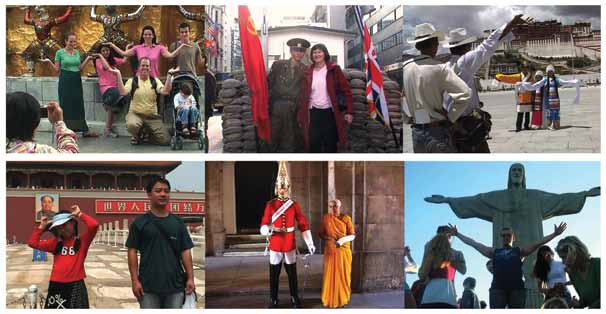
One narrative strand that is accompanied by a musical leitmotif is a series of video clips, which provide various observations
of touristsperforming the ritual of posing for their holiday snapshots worldwide.
Conclusion
Journeys in Travel seeks to position itself amongst the multiple approaches towards nonlinear narratives. It suggests cinematic essay as a film genre that offers a structural relationship to Lev Manovich’s database film and therefore seems to privilege adaption to nonlinear database aesthetics. The experimental episodic form of cinematic essay allows the creation of an open-ended nonlinear narration, which engages the viewer in a varying and stimulating audiovisual flow of associative narrative chains. The main intention of the artist is to create a complex narrative that does not cause boredom or frustration, as can occur in some multimedia applications, which push the narrative content towards annulment. Therefore, Journeys in Travel uses a computer algorithm, which alternates pre-edited sequences with subplots and narrative closure. These are allocated to five different genre groups and mirror the mixed media approach of cinematic essay. Not only do different genre clips provide alternating content and film structure, they also provide different perceptive qualities and varying intellectual, visual, and auditory stimuli for the viewer. Through this method, the artist seeks to control the film rhythm, for it decisively contributes to the film’s overall mood and impression imparted upon the viewer. Film rhythm is an essential feature of a film, but also very complex to analyze, since it is achieved through the final balance of all the elements of a film. In linear film, the filmmaker keeps control of film rhythm, pacing, and timing of single shots and sequences and their combination through the process of montage. In a nonlinear database film, it can be achieved through a combination of the montage process of pre-edited narrative units and the computer algorithm, which alternates these elements. The algorithm of Journeys in Travel operates between random and control. It provides a programmed structure for the alternation of the different genre categories, but the final decision on what clip will be played out of a specific category is left to chance. Journeys in Travel uses additional narrative devices such as narrator voices and musical leitmotifs to establish reoccurring themes, which offer further orientation for the viewer.
Footnotes:
- Canadian artist Stan Douglas uses the term “recombinant narrative” to describe his film installations, which randomly reiterate visual and dialogue sequences thus creating mathematically infinite recombinations of a film.
- Paul Arthur, “Essay Questions,” Film Comment; Jan/Feb 2003; 39, 1; ABI/INFORM Trade & Industry, (2003): 58- 62.
- Michel de Certeau, The Practice of Everyday Life (Berkeley: University of California Press, 1984), 115.
- Noel Burch, Theory of Film Practice (Princeton: Princeton University Press, 1981), 156.
- Jacob Hesler, “Playing with Death. The Aesthetic of Gleaning in Agnes Varda’s Les Glaneurs et la Glaneuse,” in Telling Stories: Countering Narrative in Art, Theory, and Film. Ed. Jane Tormey and Gillean Whitely (Newcastle upon Tyne: Cambridge Scholars Publishing, 2009).
- Lev Manovich, The Language of New Media (Cambridge, MA: MIT Press, 2001), 218.
- Jeffrey Ruoff (ed), Introduction to Virtual Voyages: Cinema and Travel (Durham, NC: Duke University Press Books 2006), 11.
- Laura Rascoroli, “On Fog and Snow: Thought as Movement, or the Journey of the Essay Film,” in Telling Stories: Countering Narrative in Art, Theory and Film. Ed. Jane Tormey and Gillean Whitely (Newcastle upon Tyne: Cambridge Scholars Publishing 2009
- Paul Arthur, “Essay Questions,” Film Comment; Jan/ Feb 2003; 39, 1; ABI/INFORM Trade & Industry, (2003): 58-62.
- Ibid
- Lev Manovich and Andreas Kratky, Soft Cinema: Navigating the Database (Cambridge, MA: MIT Press 2005), 4.
- Marsha Kinder, “Hot Spots, Avatars, and Narrative Fields Forever: Bunuel’s legacy for new digital media and interactive database narrative.”, Film Quarterly 55:4 (2002): 2-15
- Dirk Schreier, Film und Rhytmus(Boizenburg: Verlag Werner Huelsbusch, 2008), 71.
- Lev Manovich and Andreas Kratky, Soft Cinema: Navigating the Database. (Cambridge, MA: MIT Press, 2005), 15.
- Karen Pearlman, Cutting Rhythms: Shaping the Film Edit. (Burlington, MA: Focal Press, 2009), 79.
References
Arthur, Paul. “Essay Questions.” Film Comment. Jan/Feb 2003; 39, 1; ABI/INFORM Trade & Industry, (2003): 58-62..
Burch, Noel. Theory of Film Practice. Princeton: Princeton University Press, 1981.
de Certeau, Michel, The Practice of Everyday Life. Berkeley: University of California Press, 1984.
Hesler, Jacob. “Playing with Death. The Aesthetic of Gleaning in Agnes Varda’s Les Glaneurs et la Glaneuse.” in Telling Stories: Countering Narrative in Art, Theory and Film. Ed. Jane Tormey and Gillean Whitely. Newcastle upon Tyne: Cambridge Scholars Publishing, 2009.
Kinder, Marsha. “Hot Spots, Avatars, and Narrative Fields forever: Bunuel’s legacy for new digital media and interactive database narrative.” Film Quarterly 55:4 (2002): 2-15.
Manovich, Lev. The Language of New Media. Cambridge, MA: MIT Press, 2001.
Manovich, Lev and Kratky, Andreas. Soft Cinema: Navigating the Database. Cambridge, MA: MIT Press, 2005.
Lupton, Catherine. “Who in the World: Essay Film, Transculture and Globality.” in Telling Stories: Countering Narrative in Art, Theory and Film. Ed. Jane Tormey and Gillean Whitely. Newcastle upon Tyne: Cambridge Scholars Publishing, 2009.
Pearlman, Karen. Cutting Rhythms: Shaping the Film Edit. Burlington, MA: Focal Press, 2009.
Rascoroli, Laura. “On Fog and Snow: Thought as Movement, or the Journey of the Essay Film.” in Telling Stories: Countering Narrative in Art, Theory and Film. Ed. Jane Tormey and Gillean Whitely. Newcastle upon Tyne: Cambridge Scholars Publishing, 2009.
Ruoff, Jeffrey (ed). Introduction to Virtual Voyages: Cinema and Travel. Durham, NC: Duke University Press Books, 2006.
Schreier, Dirk. Film und Rhytmus. Boizenburg: Verlag Werner Huelsbusch, 2008.