
V8N2: From Site-specific Comics to Location-based Comics: Ordinary Things, Planting Comics, and GPS Comics
By Özge Samanci | February 28, 2013
Unlike print media, digital media offers a vast amount of canvas. In Reinventing Comics, McCloud (1) imagines the computer monitor as a window that can be scrolled across an infinite canvas. Current location tracking technologies point to the possibility of using the entire surface of the world as a canvas for digital comics. In spite of this, I know of no example of an infinite canvas comic that uses geotagging or GPS technology.
Existing comics narratives, whether on a printed page or on a computer screen, can refer to a particular location in the physical world. However, in both instances, the reader, sitting in a familiar coffee shop or at home, imagines the setting illustrated in the comics’ story. Existing comics’ narratives do not invite the reader to navigate the physical world to explore the comics’ story or to use the world’s surface as a large canvas for comics.
Janet Murray, in Hamlet on the Holodeck, identifies the affordances of digital media as “procedural, participatory, spatial, and encyclopedic.” (2) When the affordances of digital media are fully used, digital media offers the comic artist new meaning making strategies. I propose the idea of location-based comics where the reader turns into a participant and explores the story world by walking through the physical world. In location-based comics, the reader can be one of the characters of the story world and activate the frames of the story in a non-linear way by walking in the city. Similar to the design of an architectural piece, a site-specific or location-based comic story develops in relationship to environmental constraints. The physical world can inform the telling of a location-based comic story.
To understand these concepts, I will define the terms and clarify the differences between location-based and site-specific art. I will then explore the new meaningmaking strategies that could be created with site-specific and location-based comics via my three different comic projects, Ordinary Things, Planting Comics, and GPS Comics: Seeing thru Walls. Each project entails different design problems and exemplifies the affordances of site-specific and location-based comics.
Is Comics a Medium or a Genre?
McCloud defines comics as “juxtaposed pictorial and other images [such as words] in deliberate sequence, intended to convey information and/or to produce an aesthetic response in the viewer.” (3) In his definition, McCloud does not identify comics as either a medium or a genre. Existing genres include Manga, Doujinshi, Philosophical, Super Hero, Autobiographical, etc.
The remediation of the aesthetics of comics in film, animation, painting, and other visual media led to the perception of comics as a genre. For example, a series of contemporary movies remediate the aesthetic of comics in film such as V For Vendetta (2005), Matrix Trilogy (1999, 2003, 2003), SinCity (2005), and Road to Perdition (2002). Another group of contemporary movies appear as adaptations of popular comics such as Hulk (2003), Spiderman (2002), Superman Returns (2006), and Batman Begins (2005). This movement of utilizing the inheritance of comics in contemporary cinema represents an emerging “comics genre” in film. Comics is originally a medium, and it can become a genre once it is encapsulated in another visual medium. Location-based comics has the potential of being a subgenre of GPS games in the future.
Site-specific and Location-based Art
Any artwork inevitably has a relationship with space in the following ways: the space referenced by the artwork, the space in which the artwork is perceived, and the frame that points out the boundaries of the artwork or lack of frame that blends the piece to the environment in which it is presented. An artist designs a site-specific art piece for a chosen location. Richard Serra’s response, in reaction to a suggestion to move his site-specific sculpture explains how location is essential for a site-specific art piece. He said “to move the work is to destroy the work.” (4) The following example illustrates the connection between meaning and site. Antony Gormley explores the relationship between the human body and

Figure 1: Anthony Gormley’s Another Place (1996-1997)
space in Another Place (1996- 1997), (5) a sculptural installation located at Crosby Beach, UK (see Figure 1). Gormley placed some of the cast iron bodyforms in the water and buried some of them in the sand. During low tide the sculptures are completely visible. During high tide only their heads are visible. The visitors’ silhouettes look like the sculptures that they are exploring. Visitors become part of the art piece while they are walking on the beach. This piece blurs the boundary between explorer and explored. Gromley’s piece would have the same impact in another location.
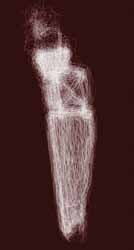
Figure 2: Jeremy Wood’s Lawn (2009)
Different from a site-specific artwork, a location-based artwork has a technological component that tracks the location of the player, performer, or visitor. (6) Lawn (2009), (7) one piece from Jeremy Wood’s GPS drawing series, is an example of location-based art. In this piece, by using his GPS device Wood recorded the traces that he created while mowing the lawn (see Figure 2).
Some of the works fall into both categories, such as Uncle Roy All Around You (2009). (8) Blast Theory and the Mixed Reality Lab collaborated to design this game in London. The street player and online players try to locate Uncle Roy by collaborating with each other. The street player carries a GPRS (General Packet Radio Service) device that enables online players to track the directions of the street player in the city. Uncle Roy All Around You (2009) is both a site-specific and location-based game.
Architecture, sculpture, installation art, land art, performance art, and dance are almost always three-dimensional and emerge in relation to environment. Consequently, there are various site-specific examples of these art forms. Painting in the form of murals and graffiti can also be sitespecific. There are examples of site-specific comic art such as Josh Ellingson’s drawings (9) at Civic Center station at San Francisco Subway (BART) (see Figures 3–4).
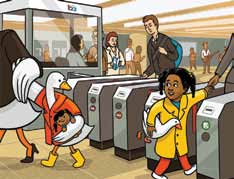
Figure 3: Joshua Ellingson’s comic portraying an imaginary encounter at BART
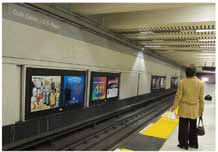
Figure 4: Joshua Ellingson’s comic about BART is installed the wall of metro station.
Some of Banksy’s10 works are site-specific comics as well as examples of graffiti (see Figures 5-8).
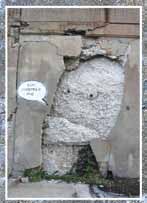
Figure 5: A crack on the wall becomes a comic character’s head saying “You concrete me.”
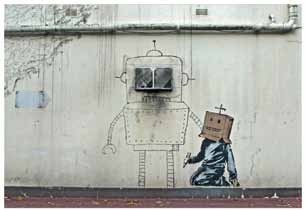
Figure 6: The air conditioning box becomes the eyes of a robot.
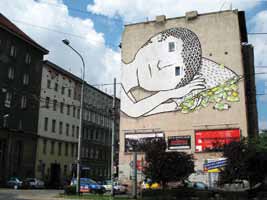
Figure 7: A comic character whose eyes are windows of the building
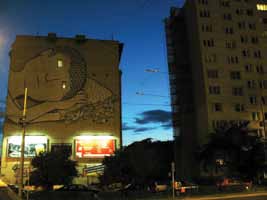
Figure 8: Same image as Figure 7, in the evening.
Even though there are examples of site-specific comics, I am not aware of any current location-based comics.However, the following examples help provide ideas for similar uses for comics narration: GPS based creative projects such as Street with a View by Robin Hewlet and Ben Kinsley, (11) Jeremy Wood’s drawing projects with GPS, (12) Blast Theory and Mixed Reality Lab’s Uncle Roy All Around You, (13) and GPS games such as Perblue Software Company’s Parallel Kingdom (14) and Mapion’s Keitai Kunitori Gassen. (15) In Sketchcrawl, (16) the participants post sketches about a previously chosen location. However, Sketchcrawl does not use a map or tagging features for posting comics and searching the database. GraffyWall (17) is a collaborative painting project based on an infinite canvas on which users can draw by writing screen coordinates such as 2N3W, but these coordinates are not geographic coordinates.
GPS Comics: Seeing thru Walls is the first GPS-based comic story exploring the idea of location-based comics. I will introduce my two site-specific comic projects, Ordinary Things and Planting Comics, which led me to the concept of GPS comics.
Ordinary Things
Ordinary Things (18) is an online journal of my observations in the comics form. I have been posting four to five comics every week since January 2006. In the database, there are more than one thousand observations in comic form. The site operates on WordPress and each comic is tagged with keywords and categorized according to themes and materials. For example, the comic in Figure 9 has the following categorization items.
- Themes: animals, Berkeley, nature, water
- Materials: artline pen, shiny pen or paper, watercolor
- Tags: beautiful, fish, heron, jumping, lake, marina, needy, ocean, river, sea, seabird, white, Berkeley Marina
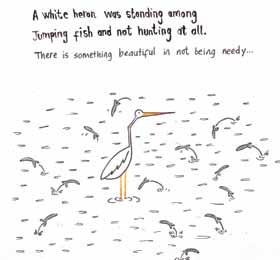
Figure 9: A comic about Berkeley, Marina, from Ordinary Things (13 September 2010)
If a user makes a search with a location name such as Atlanta, Berkeley, Los Angeles, New Orleans or Istanbul, the comics related to these cities will appear as thumbnails. If the user writes Berkeley in the search box, the comic in Figure 9 will appear along with many other comics about Berkeley. The site is based on my lived experience and it includes only those locations where I lived or visited over the last four years (see Figure 10). The readers can post comments about each comic, enabling the community who reads Ordinary Things to share stories and anecdotes.
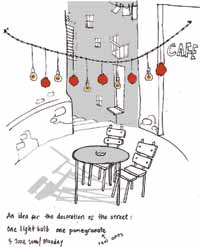
Figure 10: A comic about Istanbul, Taksim, from Ordinary Things (5 June 2006).
Ordinary Things precedes Planting Comics and GPS Comics: Seeing thru Walls and illustrates the possibility of categorizing comics according to their geographic locations. Posting comics about ordinary details of daily life directly onto a map would be the next step. I used the idea of posting comics directly onto a map in another project GPS Comics: Seeing thru Walls. Before I describe GPS Comics, I will describe another site-specific comic installation, Planting Comics, which also derived from Ordinary Things.
Planting Comics
Planting Comics (19) is a comic installation in the University of California Botanical Garden featuring twenty original comics printed on ceramic tiles throughout the garden. Each comic is a site-specific comic and refers to a nearby plant, view, or a detail in the physical environment (see Figures 11–12 on next page). The visitors go on an art hunt in the garden by using a map and try to find all twenty comics and then to create their own comic plant story on the back of the map. This site-specific project can be implemented for a GPS-based environment and can be location-based.
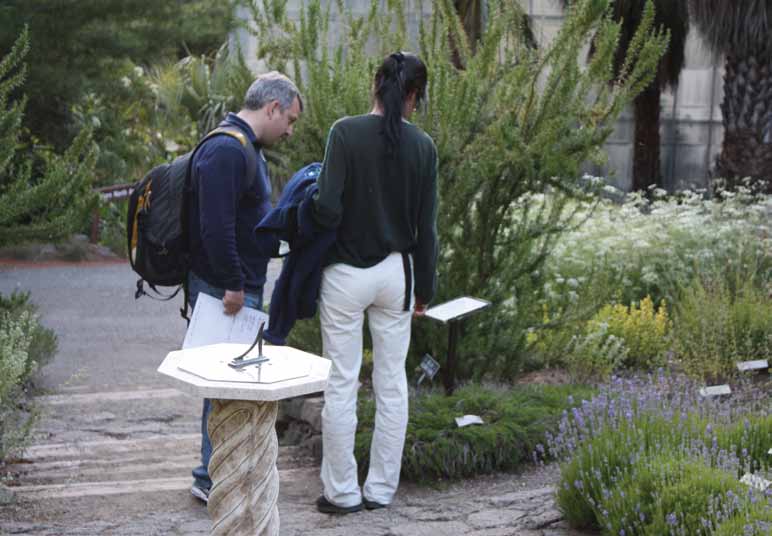
Figure 11: Visitors of the garden are exploring the comic tile next to the sundial.
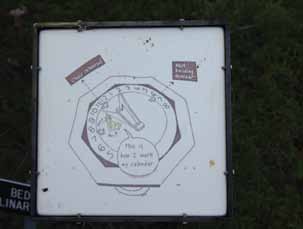
Figure 12: The comic tile is referring to the nearby sundial.
Different from Ordinary Things, in Planting Comics my aim was to place comics outdoors. One design problem for site-specific comics that are outdoors is using durable materials that account for environmental factors such as the impact of cold, water, dust, and public interaction. The need for durable materials motivates the artist to go beyond the typical art materials used in traditional comics production such as pen, paper, and ink. In Planting Comics, I worked with ceramics and metal in order to be coherent with the horticultural environment in the University of California Berkeley Botanical Garden. Sealing the front of the ceramic tiles with glaze and back of the tiles with masonry protected tiles from the decaying effects of water. The metal stands have a 30º incline to enable easier reading and to prevent water accumulation. The hole at the plate of the metal stand releases the rainwater.
In a setting like a botanical garden, the tiles can be covered with debris and require maintenance (see Figures 13–14). However, the leaves and dirt coming onto tiles also blends the work into the environment.
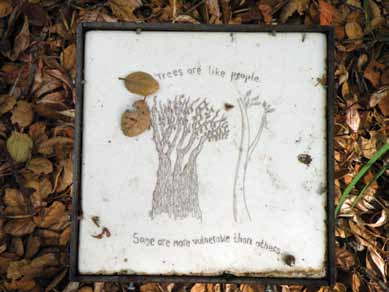
Figure 13: A dirty tile blends into the environment.
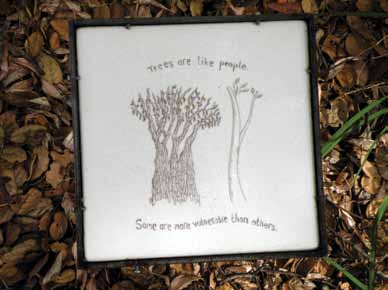
Figure 14: A tile after clean up.
In the design process of outdoor comics, the possibility of vandalism and theft creates another concern for the design process. Gluing the tiles to the metal stands was not a reasonable option because this solution did not include modularity. In the case of permanent gluing, a broken tile is not replaceable and the metal stand becomes unusable. I used eight screws to secure the tile onto the metal stand.
In a garden setting, it is hard to foresee the growth of the plants (see Figure 15). Growing plants can cover the tiles. Moreover, the plants change according to the seasons. They blossom or die. Often references that the tiles are making to the physical environment become invisible in autumn and winter.
If an artist implements a similar idea by using GPS technology, the digital environment will not allow the decaying effects of an outdoor setting, vandalism, and plant growth covering tiles. The procedural and participatory qualities of digital media will allow interactivity and collaboration. Visitors can post their drawings onto a map in a GPS-based version of Planting Comics. In this case, the botanical garden space will convey the voice of various visitors instead of one artist. However, the impacts of the digital divide will be in effect. A visitor who does not have a Smartphone will not be able to share the experience. Moreover, the attention of the visitors will be divided between their GPS devices and the botanical garden.
The next project, GPS Comics: Seeing thru Walls, aims to make the best use of the affordances of location tracking technology for comics storytelling.
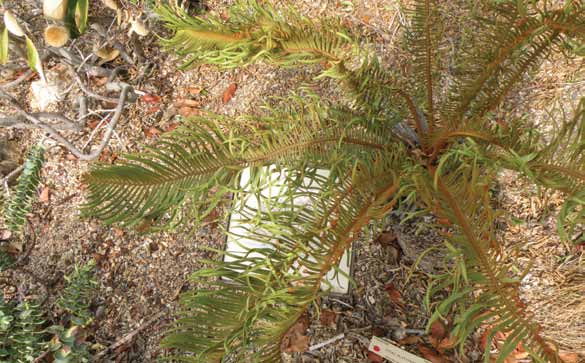
Figure 15: A growing plant covers the ceramic tile underneath.
GPS Comics
GPS Comics: Seeing thru Walls (20) is a GPS-based comic story that expands the comic canvas and explores the idea of location-based comics. In Seeing thru Walls, in order to receive meaning in a comic frame the player must experience a sensory detail (a smell, sound, breeze, or an object) in her surroundings in the physical world.
I developed the concept of GPS comics and designed a story for GPS comics Seeing Thru Walls. Anuj Tewari, my collaborator, is implementing the code. A player can explore Seeing thru Walls with an iPhone or an iPad by walking in the four mile square area around the University of California, Berkeley campus.
The interaction starts when the player physically arrives at the story space, Downtown Berkeley, and hits the start button. When the player hits the start button an animation shows Cupid shooting the player and the player is ready to fall in love (see Figure 16).
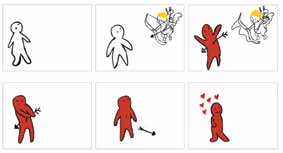
Figure 16: Cupid shoots the player.
After being shot by Cupid the player sees himself located on the map surrounded by three apartments and a set of obstacles in the form of traveling donkeys (see Figure 17).
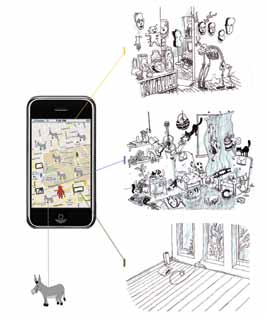
Figure 17: Player is situated in game space trying to reach apartments without bumping into a donkey.
The player’s objective is to gain access to a drawn image of a virtual character’s apartment. In order to gain access to an apartment, the player walks to a hot spot while simultaneously avoiding donkeys put in the player’s path. If the player bumps into a donkey, the player falls in love with a donkey (see Figure 18) and must restart.

Figure 18: Player bumps into a donkey and falls in love.
Successfully avoiding donkeys, the player physically walks to the location of an apartment, activates the hotspot and accesses an indoor view of an apartment. The apartments do not include their residents (profiles) while the player is exploring them. By looking at the items, furniture, and the details in the apartment, the player tries to guess the personality, gender, and social status of the occupant and decides if the player would like to pursue this profile.
For example, the third apartment in Figure 18 is an empty apartment with a hardwood floor. There is only a tiny mat and a little pillow. The occupant of this apartment may be poor, may not be living here anymore, may prefer a minimalist life style, may be regularly practicing meditation, or may be fitting into any other scenario that the player can imagine. Overall, if the apartment creates curiosity about the occupant, the player can choose to interact with him or her later.
After the player has visited three apartments, the player can decide his favorite apartment and meet the resident (profile). In order to interact with the chosen profile, the player physically walks toward that profile. Reaching the chosen profile initiates a scripted conversation (see Figure 19).
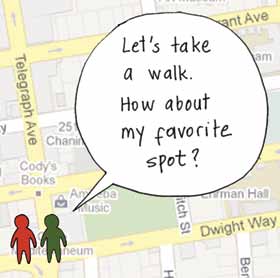
Figure 19: Player interacts with one of the profiles.
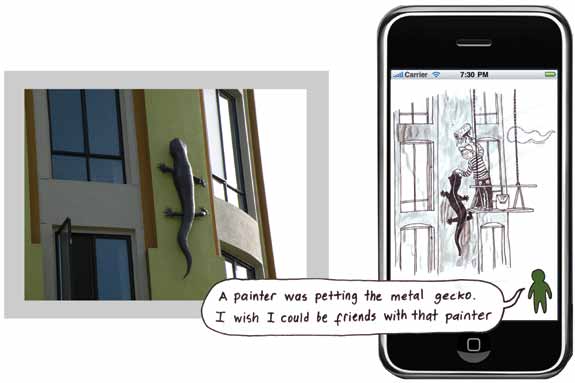
Figure 20: In physical reality, player sees a gecko sculpture on the façade of the building. On the iPhone screen, a location- based comic portrays a previous moment witnessed by one of the virtual characters.
Player and selected profile take a walk to the profile’s favorite destination. Examples could be a building façade decorated with a gecko sculpture (see Figure 20) or a corner that smells of bleach because of a nearby swimming pool.
The player can activate the comic embedded in that location. This comic is a location-based comic and makes sense if the player is at that location. This location-based comic also gives information about the personality and the life style of the selected profile.
After activating the selected profile’s three favorite spots the player receives this question (see Figure 21).

Figure 21 Decision point
If the player chooses “no,” the player returns to the map and meets with a new profile by walking towards a new profile. The new profile invites the player to take a walk to his or her favorite spots in Downtown Berkeley. If the player chooses “yes,” the profile’s identity is revealed and the interaction ends (see Figure 22).
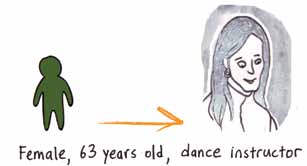
Figure 22: Connecting with a profile reveals the identity
of the profile.
For example, the profile who lives in the empty apartment is a dance instructor (see Figure 22). This information connects back to the beginning of the story. She needs the space to teach dance. Snapshots of the entire journey generate the comic strip (see Figure 23). Player can save the comic strip to his iPhone or iPad.
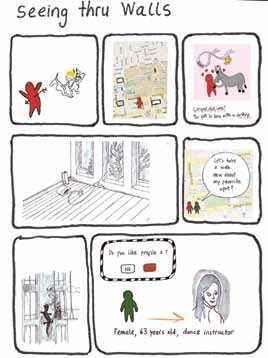
Figure 23 Comic strip generation
In the design process, one concern was to choose locations that will keep their identifiable quality for the long term. For example, an interesting shop window design in the physical world will change. A reference to this shop window in the comic will be meaningless. As a result, sculptures, landmarks, interesting architectural elements in the real world are better reference points in a locationbased comic story.
Conclusion
Site-specific and location-based comics have different meaning-making strategies than those of printed comics. Site-specific and location-based comics require the presence of the participant in the physical world. In most cases, the participant has to move physically in the space in order to experience the story. Site-specific and location based comics refer to the details of the physical world. These referred details of the physical world can address all senses. For example, a location-based comic story can refer to the breeze coming from the grates, chlorine smell coming from a nearby pool, the sound of a water fountain, or a lizard sculpture on a building. Among all senses, the hardest one to include is taste.
In location-based comics the participant turns into one of the characters of the story. The player(s) can explore the story by walking to certain spots, tracing street blocks, carrying items, blocking obstacles, running after or catching story characters or encountering characters. The atmosphere of the story becomes an alternate reality or a parallel world. Concepts such as territory, surveillance, and hypertextuality can become resourceful meaning making devices for location-based comics.
Players can work on separate territories to access the story content and then combine their findings; players can keep each other or the story characters under surveillance; players can visit the texts such as videos, books, or architectural plans to which the comic story may be referring.
A GPS-based application can allow participants to post their images to a map of the space that they are exploring. Since location-based comics use tracking technology, the changing location of the participant is an important meaning-making device. This meaning-making device can be used for content generation and non-linear exploration of the content. Moreover, in location-based comics, decaying effects of weather conditions and vandalism are not a concern for the design process.
The majority of site-specific comics create instantaneous, non-narrative, entertaining, single-gag-based moments around a concept. Telling stories with site-specific comics is an unexplored possibility. Moreover, there are no examples of location-based comics other than Seeing thru Walls. Location tracking technologies offer a vast opportunity to redefine the conventions of comics.
Footnotes:
- Scott McCloud, Reinventing Comics (New York, NY: HarperCollins Books, 2006), 222.
- Janet Murray, Hamlet on the Holodeck: The Future of Narrative in Cyberspace (New York, NY: The Free Press, 1997), 71.
- Scott McCloud, Understanding Comics (New York, NY: HarperCollins Books, 1994), 9.
- Richard Serra, Writings/Interviews (University of Chicago Press, 1994), 194.
- Antony Gormley, Another Place, Antonygormley.com, http://www.antonygormley.com/sculpture/item-view/id/230#p6 (accessed October 20, 2010).
- Drew Hemment, “Locative Arts,” Leonardo 39, no. 4 (August 2006): 348-355. Academic Search Complete, EBSCOhost (accessed October 29, 2010), 349.
- Jeremy Wood, “Lawn,” GPS Drawing, http://www.gpsdrawing.com. (acessed October 20, 2010).
- Blast Theory and Mixed Reality Lab, “Uncle Roy All Around You,” Blast Theory (2003), http://www.blasttheory.co.uk/bt/work_ uncleroy.html. (accessed October 18, 2010).
- Joshua Ellingson, “First Ride 1” Josh Ellingson, http://www.joshuaellingson.com. (accessed October 18, 2010).
- Banksy, “Outdoors” Banksy, http://www.banksy.co.uk/outdoors/outuk/horizontal_1.htm. (accessed October 18, 2010).
- Robin Hewlet and Ben Kinsley, “Street with a View” Street with a View, (May 3, 2008), http://www.streetwithaview.com. (accessed October 10, 2010).
- Jeremy Wood, “Lawn” GPS Drawing, http://www.gpsdrawing.com. (accessed October 20, 2010).
- Blast Theory and Mixed Reality Lab, “Uncle Roy All Around You” Blast Theory (2003), http://www.blasttheory.co.uk/bt/work_uncleroy. html. (accessed October 18, 2010).
- Perblue Software Company, “Parallel Kingdom” Parallelkingdom.com, http://www.parallelkingdom.com. (accessed September 2, 2010).
- Mapion, “Keitai Kunitori Gassen (Battle for the Countries)”, Kntr.jp, http://kntr.jp/pc. (September 10, 2010).
- Enrico Casarosa, “Sketchcrawl” Sketchcrawl.com, (February 2006-present), http://www.sketchcrawl.com. (accessed October 28, 2010).
- Antonio Roldao Lopes, “WebCanvas” Webcanvas.com, http://webcanvas.com. (accessed September 12, 2010).
- Özge Samanci, “Ordinary Things,” Ordinarycomics.com, (2006-present), http://www.ordinarycomics.com. (accessed October 28, 2010).
- Özge Samanci, “Planting Comics” Planting Comics, (June, 2010), http://www.ordinarycomics.com/plantingcomics. (accessed October 25, 2010).
- Özge Samanci andAnuj Tewari, “GPS Comics: Seeing thru Walls” GPS Comics, (2010), http://gpscomics.com. (accessed October 28, 2010).
References:
Blast Theory and Mixed Reality Lab. “Uncle Roy All Around You.” Blast Theory. (2003), http://www.blasttheory.co.uk/bt/work_uncleroy. html. (accessed October 18, 2010).
Banksy. Outdoors. Banksy. http://www.banksy.co.uk/outdoors/outuk/horizontal_1.htm. (accessed October 18, 2010).
Casarosa, Enrico. Sketchcrawl. Sketchcrawl.com. (February 2006-present), http://www.sketchcrawl.com. (accessed October 28, 2010).
Ellingson, Joshua. First Ride 1. Josh Ellingson. http://www.joshuaellingson.com. (accessed October 18, 2010).
Gormley, Antony. “Another Place.” Antonygormley.com. http://www.antonygormley.com/sculpture/item-view/id/230#p6 (accessed October 20, 2010).
Hemment, Drew. “Locative Arts.” Leonardo. 39, no. 4 (August 2006): 348-355. Academic Search Complete, EBSCOhost (accessed October 29, 2010).
Hewlet, Robin, Kinsley, Ben. “Street with a View.” Street with a View. (May 3, 2008), http://www.streetwithaview.com. (accessed October 10, 2010).
Lopes, Antonio Roldao. “WebCanvas.” Webcanvas.com. http://webcanvas.com. (accessed September 12, 2010).
Mapion. “Keitai Kunitori Gassen (Battle for the Countries).” Kntr.jp, http://kntr.jp/pc. (accessed September 10, 2010).
McCloud, Scott. Understanding Comics: How Imagination and Technology Are Revolutionizing an Art Form. 1st ed. Harper Paperbacks, 1994.
McCloud, Scott. Reinventing Comics: How Imagination and Technology Are Revolutionizing an Art Form. 1st ed. Harper Paperbacks, 2000.
Murray, Janet H. Hamlet on the Holodeck: The Future of Narrative in Cyberspace. The MIT Press, 1998.
Perblue Software Company. “Parallel Kingdom.” Parallelkingdom.com, http://www.parallelkingdom.com. (accessed September 2, 2010).
Samanci, Özge. “Ordinary Things.” Ordinarycomics.com. (2006-present), http://www.ordinarycomics.com. (accessed October 28, 2010).
Samanci, Özge. “Planting Comics.” Planting Comics. (June, 2010), http://www.ordinarycomics.com/plantingcomics. (accessed October 25, 2010).
Samanci, Özge. Tewari, Anuj. “GPS Comics: Seeing thru Walls.” in GPS Comics. (2010), http://gpscomics.com. (accessed October 28, 2010).
Serra, Richard. Writings/Interviews. University of Chicago Press, 1994. Wood, Jeremy. “Lawn,” GPS Drawing. http:/¬/www.gpsdrawing.com. (accessed October 20, 2010).