
V7N1: The O Mission
By Mike Fry | March 4, 2013
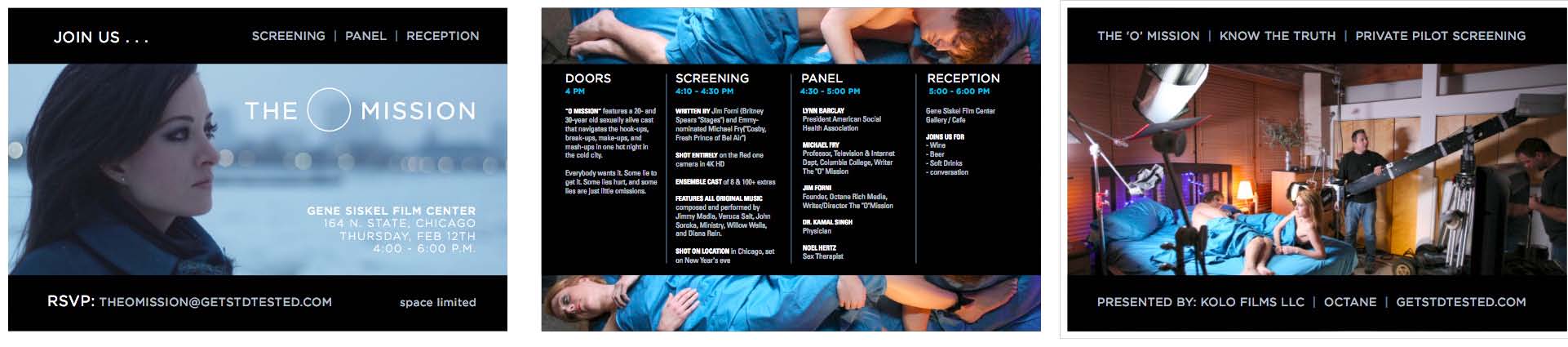
Figure 1: Screen shots of The O Mission
The Omission is a branded entertainment webisode targeted at sexually active 18-25 year olds who are potentially at risk for STDs/HIV and AIDS. The creative goal was to engage the demographic by creating a story and characters that simulated their way of life. The marketing strategy was to involve the audience in the story and characters and to allow the natural use of a product to rise from story organically. The unexpected lessons learned yielded a greater knowledge and understanding of social health advocacy and the hard truth about the financial difficulties associated with online series distribution.
As sponsors struggle to find a way to keep ‘eyeballs’ on their ads in the post-TiVo/DVR world, ‘branded entertainment,’ the introduction of brands into already existing storylines, has become a common media industry experiment across all screens; Film, TV, internet, and mobile. The overt and comical insertion of Verizon phones into the sitcom “30 Rock” is a great example of ‘product placement,’ where products are displayed, often numerous times, during an episode. However, there is a much more subtle and possibly more sustainable type of branded entertainment called ‘brand integration.’
The idea behind brand integration is to create a storyline and characters that are, in themselves, ‘sticky’ or endearing to an audience. As the audience becomes engrossed in the story they will notice that the characters are organically using certain branded products. Electric Farm’s new sci-fi online hit, Gemini Division using the attractive star-power of Rosario Dawson, is one such success. The series uses Cisco devices as an integral part of the storytelling process.
In our original branded web series, The Omission, we were the first to use brand integration to address sensitive topics such as destigmatizing STD/HIV/AIDS. Along with Octane Rich Media and a small boutique digital ad agency called Method Engine, I developed the series for getSTDtested.com.
We were approached by Tracy Powell, CEO of getSTDtested.com, to develop a website for their brand. We were charged with destigmatizing the idea of being tested for STDs while also ‘sexualizing’ the brand and making transparency around sexual history a hot topic. We immediately seized the opportunity to pitch the idea for a branded entertainment web series. I would co-create, co-write, co-produce and be the second unit director as well as help to put together an original pop-punk girl-band and release two original songs. The task was to attract the 18-25 demographic who were known for at-risk behaviors making them extremely vulnerable to STDs.
These consumers are ‘digital-natives,’ living a double life – online and off. They extend themselves on social networking sites like Facebook and MySpace, interacting with strangers and friends moment to moment, around the globe. It occurred to me that the way that one makes new friends on social networking sites is an interesting parallel to the way that STDs are potentially spread. When you ‘friend’ someone on Facebook, you then are exposed to all of their friends just as when you have sex with someone you then are exposed to everyone that they’ve had sex with and possibly to their STDs as well. If you sleep with Jane, you sleep with Bob – who Jane slept with last – but you also sleep with everyone Bob has slept with, etc. The flowchart gets pretty wild. And so we began to develop a story that would address ‘hook-ups’ as having exponential consequences, explored through the using social media as both a framing device and as ‘sexual-networking’ tools.
The challenge now was to find a way to communicate with the ‘digital-natives’ in their own language, with a tone that would inspire them to get tested without chastising them or making them feel that they had done something ‘bad.’ How? By creating characters that not only imitated their way of life but that were ‘aspirational’ to the target demographic. All 18-25 year olds want to be rock stars and quiet as it is kept, most 25-60 year olds, our auxiliary demographic, also have a lust for the fortune and fame of rock stardom.
But rock stars are inaccessible, too large to have the same problems that we have and too rich to care. However aspiring rock stars, twenty-somethings struggling to make it, speak the language of the digital-native. And the risky world of rock and roll with its seedy clubs, hot people, and intoxicated fans is the perfect climate for reckless hook-ups, mash-ups, and break-ups – the stuff of good drama – and the power to make getting tested for STDs cool.
The result of our efforts, a nine page script, seven leads, 100 extras, and a three day shoot using a RED camera, as well as a small HD for webcam confessionals, yielded the web series, The Omission. The Omission is the story of LipTease, a hot female driven punk-pop band on the brink of success. The lead, Indya, hot, young, and looking for lasting love, is constantly tempted by her band and caught in the excesses of rising stardom. They have fans and groupies, lovers and friends, all sharing the same technologically connected web of risky sexual activities. The reviews from ReelChicago.com, The Chronicle and Web Series Magazine have been great and the site, www.getSTDtested.com, has begun testing thousands of new at-risk clients. A screening at the Gene Siskel Film Center, followed by a panel with Lynn Barclay President of American Social Health Association (ASHA), and a Columbia College Chicago screening and free STD/HIV/AIDS testing event helped to kick off The Omission’s release.
The ‘O’ in The O mission is a double entendre – ‘O’ for orgasm and ‘O’ for omit, because we tend to make tiny omissions as we lie about our true and complete sexual histories. In ‘real life’ these omissions lead to 19 million new cases of STD/HIV infections each year in the United States. As I researched the epidemic of STDs in America and globally, I realized that this project was not simply a means by which to tell a hip and exciting, sexually charged story fuelled by technology – but a way to save lives.
As a screenwriter my work usually involves telling stories to entertain and manipulate the emotions of an audience – and at its best, to teach. As a copywriter the ‘work’ usually involves using my creativity to market or ‘sell’ products to a specific demographic, creativity with profit as its end. The Omission, however, had an additional end goal – to encourage sexually active 18-35 year olds to get tested for HIV/AIDS and STDS. The possibility of motivating even one person to be tested could save a life – a powerful charge. Digital media used to prevent the spread of STDs, HIV/AIDS. An ethical motivation inspired the storyline, characters, and distribution. The good news was that we were fully funded, at a cost of $40,000, by getSTDtested.com. The reality, however, was that corporate sponsorship has its price – investors demand a return on their investment. And so the idea of corporate sponsorship and ownership of art, the reality of art as business, was always in play. Within the definition of ‘branded entertainment’ is the concept that entertainment is a marketing tool, a means by which to attract consumers to a product or service. For www.getSTDtested.com the first priority was to make a web series that would drive clients to the website – the creativity and story had to serve this end. The film/series needed to make more money than it cost to make. We quickly learned how to service the client and service the greater ethical needs of the subject matter through research and empathy-we began to view ourselves as advocates creating for a cause.
Never before had I been tasked with researching STDS and HIV/AIDS. I knew what most people know and didn’t really want to know more. The topic, in my mind, had a stigma. I felt uneasy and uncomfortable talking about it – I was afraid to know more, afraid to expose myself to the truth. And so, as a creative and as a teacher, I had to step out of my comfort zone and become an advocate for HIV, AIDs, and STD testing. Along the way I also became a huge advocate for prevention and counseling – not the primary goal of www.getSTDtested.com. The word ‘tested’ is the key – the company makes its money from online testing, not from promoting condom usage, etc. But we realized that the testing message runs hand in hand with the prevention and counseling message. The Omission became a vehicle by which to expand the dialogue about testing, prevention and counseling. And in our early discussions with the CEO of the company, we encouraged more attention, at the website level, to the free counseling links and to the need for prevention.
When Lynn Barclay and American Social Health Association (ASHA) (1) came aboard, I was suddenly on a panel with Lynn and several doctors who were indeed experts in the field. But because of our research, learned sensitivity, and advocacy I was able to speak not only on the topic, but to extend the conversation as it related to the usefulness of digital media to inform about and encourage responsible sexual networking, safe sex, and sexual history transparency.
The impact of social networking sites, IM, and ‘chat,’ on human sexuality and relationships is profound. The troublesome concept of the one night stand, meeting someone in a bar or elsewhere for the first time and then engaging in often unprotected alcohol or drug assisted sex, has become antiquated. Today’s 18-35 year old, and often even younger, sex seeker is ‘hooking up’ with an often anonymous partner online. The true identity of this person can be concealed through various means and the exchange of sexually explicit media – ‘sexting’ or sexual photos and films are often exchanged via these technologies and often – two strangers will meet in ‘real life’ and engage in sexual activity. According to The National Campaign to Prevent Teen and Unplanned Pregnancy, 22 percent of girls and 18 percent of boys say they have electronically sent or posted nude or semi-nude images of themselves. (2) The ‘mystique,’ risk, and trendy nature of activities such as ‘sexting’ has become infectious among this demographic. With technologically assisted sex being the ‘hot’ trend with the digital native, technology is also the key to intervention, to information, and ultimately to a new paradigm of sexual responsibility fueled by sexual history transparency dependent on frequent testing. This new sexual arena, the idea of ‘sexual networking,’ of digital user-driven media as a real aspect of modern human sexuality, is at the core of The Omission. Other online testing sites have digital video, but nothing as innovative or aesthetically vibrant.
There are numerous competitive online testing sites, some of which have also invested in digital video messages. Sites like www.justgettested.com and www.stdtest.com both have videos that speak to the ease and necessity of their testing methods. The messaging here is ‘about the brand’ experience first. They are ‘ads’ or commercials, how to use instructional videos. The Omission takes a risk. It seeks to involve and encourage its audience not only to participate in the dialogue but to make them ‘care’ about characters who look and act like them – and to see the results of irresponsible sexuality dramatized on screen, leading them to examine their own sexual activity and to question the sexual history of those they have sex with.
Did we get the results we were looking for?
Creatively we succeeded. The Omission has been well received and the accolades have been many. However, we do not exist solely as entertainment content, we have an important message and we have the goal of driving commerce to our sponsor’s site, we miss both well defined genres and fall into a sort of entertainment/PSA/Music video void. And so the challenge of online distribution, of getting your message to the demographic en masse, is still preventing the series from being a ‘financial success.’ In short, we have created a remarkable web-film/series that, when viewed, serves all of its creative and marketing goals. The lesson still to be learned is how the film/series can get the hits needed to justify the investment without star power or a minimum of $150,000 to market and distribute via existing online networks with guaranteed hit counts. The content remains relatively ‘unused’ and the corporate sponsor – spending upwards of $40,000 on the show, still desires a much greater return on the investment.
What’s the solution? Spend less on high end production values, and produce the series on a significantly smaller budget, spend more on ‘on the ground’ marketing and extend to ‘digital events’ – virtual concerts at college STD events all over the world. These are in the works along with a unique educational opportunity.
We are now involved, along with www.getSTDtested.com, in getting a grant to create STD UNIVERSITY, a digital education portal for colleges and universities designed to spread the message of STD, HIV/AIDS prevention, testing and counseling. The Omission, its characters and its band Liptease, are included in the proposal. The STDU project will lead to the development of curricula, an immersive online experience and even ‘serious gaming’ around these sensitive topics.
To see the first four episodes of the web series, The Omission, please go to our site: www.omissionthemovie.com.
Footnotes:
- American Social Health Association. http://www.ashastd.org/
- The National Campaign to Prevent Teen and Unplanned Pregnancy, Sex and Tech: Results from a Survey of Teens and Young Adults, http://www.thenationalcampaign.org/sextech/PDF/SexTech_Summary.pdf. (accessed June 17, 2010).
Works Cited:
Omission, The. www.omissionthemovie.com. National Campaign to Prevent Teen and Unplanned Pregnancy,The, Sex and Tech: Results from a Survey of Teens and Young Adults, http://www.thenationalcampaign.org/sextech/PDF/SexTech_Summary.pdf. (accessed June 17, 2010).