
V7N1: Locus Communis: Twitter as Digital Commonplace
By Brian J. McNely | March 4, 2013
Introduction
Commonplace books are staples of western thought; in and through their pages many of the world’s most renowned writers and thinkers cobbled together bits of information gleaned from their studies and observations, from literary quotes to tables and measures. Maintaining a commonplace book was also a practice that fostered invention and creativity – a means by which an individual could make sense of the world around her. Through activities of collecting and cobbling, information gained new meaning by juxtaposition and alternate contextualization, so that connections could be made upon a theme or themes. In terms more congruent with our contemporary, digitally-networked society, the commonplace book was an analog aggregator of external content.
While blogging activities have been loosely related to the practice of commonplacing, the proliferation of microblogging services – most notably Twitter – has fomented writing activity that bears a striking resemblance to the rapid, variegated, and brief entries typical of the commonplace book. This article considers the pedagogical import and application of digital commonplacing practices, seeing Twitter in particular as a way to foster invention and creativity through writing and rhetorical practice which is aggregable, searchable, persistent, and collaborative in ways that the analog commonplace book never could be.
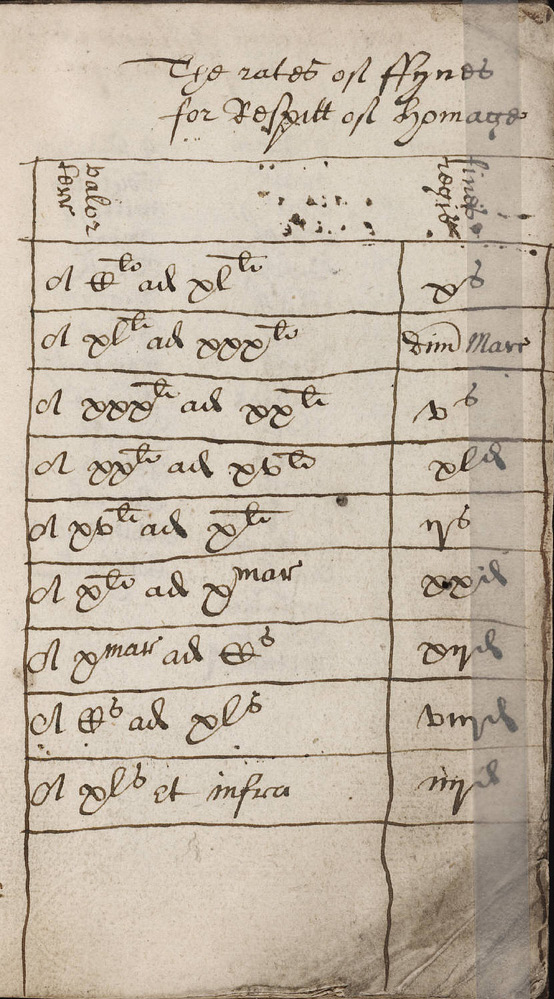
Figure 1: Commonplace Book of Francis Grosvenor, circa 1620. Beinecke Rare Book and Manuscript Library, Yale University. Beinecke Flickr Laboratory, licensed by Creative Commons.
Drawing specifically from research in computer-supported collaborative work, rhetoric and writing studies, and specific use cases which leveraged Twitter to support both student-led thematic inquiry and professional academic research, this article applies long-standing norms of literate meaning-making to a radically misunderstood and emerging platform. While there are several applications that allow for the kinds of commonplacing discussed in this article (most notably, Facebook), Twitter provides interesting affordances for heterogeneous interaction because of its unabashedly public structure and its asymmetric follower model. In other words, while Facebook encourages one-to-one social ties, Twitter’s public and asymmetric model means that anyone can follow and receive updates from any other public user. While Facebook relies on structured homophily, Twitter encourages public heterogeneity. Because of these affordances, Twitter enables something that analog commonplacing could do only marginally: the addition of overlapping publics – a self-selected, real-time, mobile, and constantly shifting integration of thoughts and ideas from distributed participants.
The sociotechnical infrastructure of Twitter as digital commonplace can support rhetorical invention, creativity, and learning activities from individuals around the world, in real-time, giving students an entirely new understanding of “places in common.” Beginning with a review of the traditional practice of commonplacing, this article will examine current information aggregation norms before focusing on Twitter and its application in pedagogical and professional environments for collaborative meaning-making. By examining typical use cases, this article considers implications and best practices for fostering effective digital commonplacing.
The Tradition of Commonplace Books
A practice first enacted in antiquity in conjunction with the formation of classical rhetorical principles, the early modern notion of commonplacing – and its application in the increasingly ubiquitous platform of bound books – is most often attributed to Erasmus in the early 1500s. Moss notes that “it was Erasmus in De copia who gave the first systematic guidelines for commonplace-books”: (2)
Throughout Western Europe in the sixteenth century, schoolboys and grown men educated in the Latin schools of the humanists would recognize the commonplace-book as an indispensable tool for making sense of the books they read, for assimilating the written culture transmitted to them, and for possessing the means of production in their turn. (3)
A commonplace book was analogous to the modern “notebook,” but it was something more. While notebooks, scrapbooks, and journals all represent rough contemporary analogues, none of them really approaches the kind of systematic and functional role that commonplace books provided for sixteenth and seventeenth century learning. In fact, Moss argues that “the commonplace book is central to an understanding of how knowledge was organized in the early modern period.” (4)

Figure 2: John Locke, A New Method of a Common-Place-Book, Beinecke Rare Book and Manuscript Library, Yale University.
In the middle 1600s, John Locke began developing a “particular system for indexing the entries of a notebook that became popular in the eighteenth century.” (5) By the time that Locke’s new method was introduced, the practice of commonplacing systematized by Erasmus was well established. Dacome notes that
Throughout the early modern period, commonplace books provided repositories for arranging notes, excerpts, drawings, and objects. Regarded as aids to memory and storehouses of knowledge, they were part of a pedagogic tradition related to rhetoric and the art of memory that dated back to the classical period. Reducing vast amounts of knowledge to a manageable form, they instantiated a special relationship between the accumulation of knowledge and the organization of space. (6)
Locke’s “new method” relied on a system of shorthand techniques that allowed practitioners to compile, retain, and recall more information within the space of one commonplace book. Dacome argues that “Locke’s new method promised to facilitate the compilers’ task by providing a new way of accumulating multum in parvo [“much in little”] at a time of increasing concern for the uncontrollable growth of the ‘Stock of Knowledge.’” (7) Blair’s “Reading Strategies for Coping with Information Overload ca. 1550-1700” draws obvious parallels to our contemporary lament concerning the difficulties of corralling the flow of information. (8) Such research – and the systematic approach to commonplacing indicative in Locke’s work – reveals how the challenges of compiling and contextualizing increasing amounts of knowledge are congruent with the rise and spread of literate meaning-making, and certainly not unique to our current networked and digital situatedness.
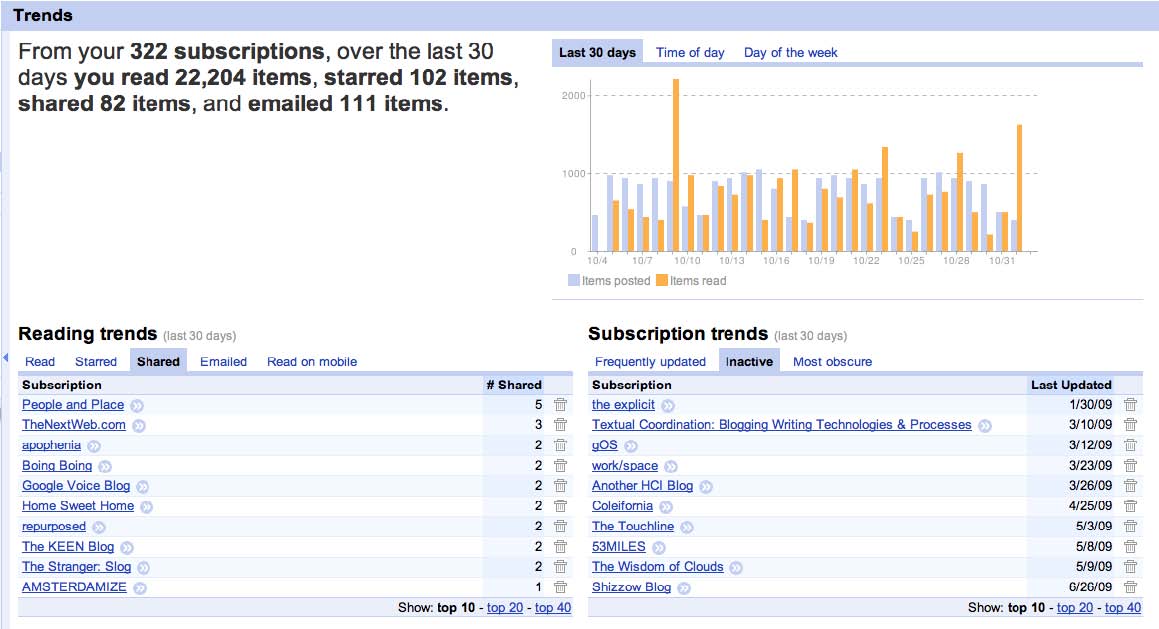
Figure 3: Screen capture of author’s Google Reader activity, November 1, 2009
Among the most essential purposes of commonplacing, therefore, is the attempt to contextualize ever increasing amounts of information; in this sense, the commonplace books of the seventeenth and eighteenth century have much to teach us about contemporary content and knowledge-acquisition practices. Dacome suggests that “commonplace books were meant to help students and scholars to manage substantial amounts of knowledge.” (9) More importantly, commonplacing had very public, very rhetorical implications, as they fostered “the memorization of sentences and arguments, [and] they provided a means to enhance performance in public situations.” (10) Commonplace books acted as a storehouse of “arguments and topics to those who wanted to show inventive genius by elaborating upon them.” (11) In this sense, commonplace books were places to memorize, contextualize, and repurpose information for the purposes of rhetorical invention and creativity. They acted as both record and heuristic – a repository of previous knowledge expressly directed toward the creation of new knowledge.
To that end, the classical definition of commonplace – locus communis – “referred to a general argument capable of being used in different situations.” (12) As a heuristic compilation, the commonplace book fostered rhetorical practices that aggregated relevant content for specific yet shifting reuse; storing information in a common place created affordances for juxtaposition and contextualization – a move that allowed information to be applied to a variety of contexts. Commonplace books, then, served many functions and many ends.
Contemporary Information Aggregation
In just the last few years, applications and platforms for information aggregation have become increasingly sophisticated. Really Simple Syndication (RSS) – especially as manifested in a feed reader such as NewsGator or Google Reader – enabled easy aggregation of disparate content. Any site with an RSS feed – from blogs, to traditional news outlets, to anything in between – could be imported into a feed reader, giving users an easy means for aggregating content. Moreover, applications like Google Reader have made that aggregation marginally social by enabling the sharing of content with friends and the general public.
Services such as Facebook and FriendFeed have expanded the social aspects of aggregation, allowing users to syndicate, collect, share, and discuss any number of digital artifacts or ideas in the same space.

Figure 4: Screen capture of author’s FriendFeed stream,
November 1, 2009
The primary difference between these kinds of aggregators is the measure of social interaction afforded by each application. While feed readers technically afford sharing and discussion (for example, through Google Reader’s comment function), they are used primarily as aggregators only among most users, despite Google’s recent (2010) integration of its Buzz application with Reader. In other words, feed readers are used primarily to collect and consume information. Moreover, feed readers do not explicitly promote distance, separation, or distinction among items and content streams. While items in Google Reader may certainly be “starred” and tagged (and in this way distinguished from the rest), material is not explicitly exported away from the application in the sense fostered by commonplacing, where ideas were physically excerpted from books or lectures and recontextualized in a different place, in a new common place. A feed reader only seems to do so, but since it pulls all content from a given site, the act of commonplacing is largely absent.
FriendFeed suffers from a similar flaw, though the platform is much more conversational, dialogic, and explicitly social than the typical feed reader. What we see in these kinds of platforms generally are varying levels of purposeful user contextualization. In Google Reader, for example, the primary activity is reading – interaction with the application is about consuming content. In FriendFeed, where social streams from across the web can be aggregated (from one’s blog, Facebook profile, Delicious page, etc.), discussion is more robust, but the activity is ultimately about centralization. This clearly echoes the practices of commonplacing discussed above, with one important exception: users often do not write or otherwise produce content in FriendFeed. Instead, they write on their blog, on Twitter, or on Facebook, and that content is then imported and aggregated in FriendFeed’s user interface, where it can be further parsed, or simply left alone (as is often the case).
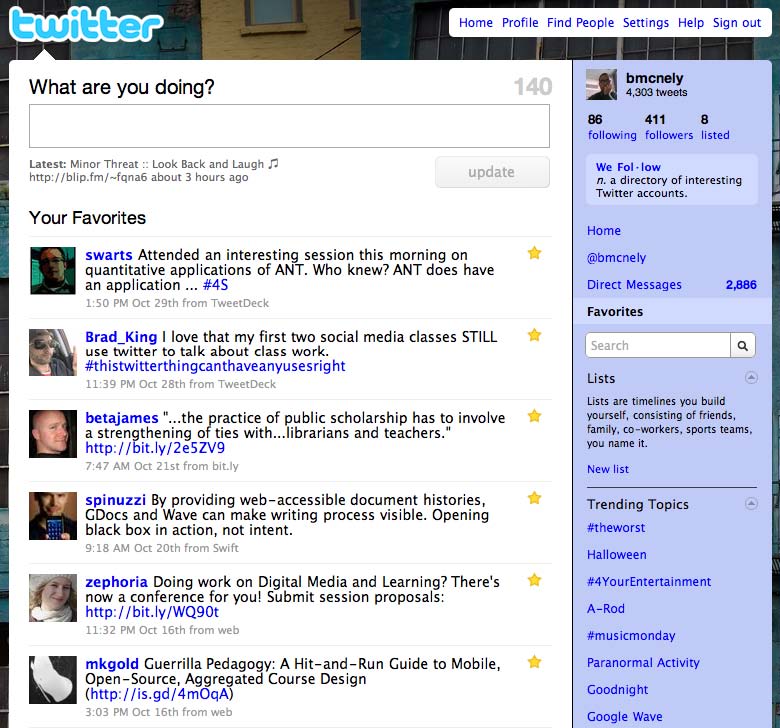
Figure 5: Screen capture of author’s Twitter favorites,
November 1, 2009
Interactions on Twitter, however, are explicitly enacted in and through rhetorical activities: writing, linking, repositioning, and exporting all manner of content – photos, videos, alphabetic text, etc. Since Twitter does not aggregate content in the same ways that a feed reader or FriendFeed does, interactions become both passive and active – both readerly and writerly – in much the same fashion as the practice of commonplacing. And yet, because Twitter allows one to follow the content produced by others of interest, it ultimately aggregates the rhetorical work of these others. Finally, because one of the more common activities prevalent on Twitter is the sharing of hyperlinks to other content, the social aggregation, consumption, contextualization, and recontextualization of content most clearly mirrors the knowledge work of commonplacing. The key in both scenarios – both traditional and contemporary – is the continual instantiation of rhetorical work (most often instantiated in writing activity) in the process of meaning-making. (13)
Writing and Knowledge Acquisition
While commonplacing surely enacts multiple rhetorical practices (visual, oral, associational), an overarching characteristic of effective commonplacing in any era is the practice of writing as a key mediator in the construction of meaning. Dautermann argues that “writing can be thought of as mediation among the perspectives of those who generate, regulate, and use the discourse produced” in a given communication environment. (14) Following LeFevre, (15) Bruffee, (16) and several other researchers in writing studies, Dautermann saw collaborative writing activity as a key driver of social meaning-making. Her work reinforces that of Emig (17) and Lauer, (18) who argued for the central role of writing to knowledge acquisition.
Similarly, Swarts notes that “knowledge is negotiated and negotiation requires a different kind of cognitive effort than simple sharing.” (19) In forms of coordinative online activity mediated in and through writing production – such as the creation, aggregation, and contextualization of content on Twitter – meaning-making is built “through back and forth writing, editing, and revising, through periods of negotiation.” (20) These periods of negotiation may be seen as tests in the development and ongoing configuration of provisional knowledge. They act as a means through which inputs can be contextualized and new approaches can be ventured; they are heuristic writing practices that foster invention.
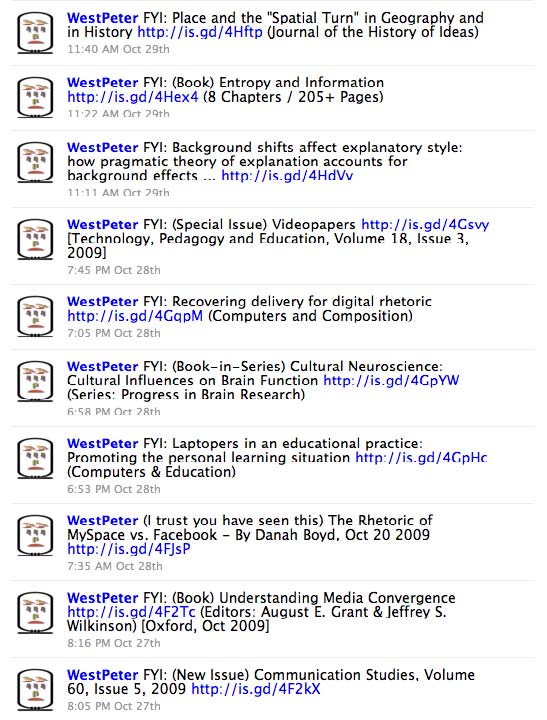
Figure 6: Screen capture of author’s recent Twitter Direct Messages, November 1, 2009
The kinds of negotiated meaning-making that take place through platforms like Twitter actually mirror that of commonplacing, with the crucial addition of overlapping publics. Here, writing activity is not enacted in isolation or predicated upon a static target (as in an individual excerpting information from a book, for example). In discussing weblogs, Shirky suggests a continuum of audience size and communication pattern that varies from “broadcast” to “tight conversation,” with a nebulous construct of “loose conversation” that falls somewhere in between. (21) Microblogging on Twitter, for most users, tends toward loosely formed, potentially coordinative networks mediated most often in and through writing activity, where meaning-making can be negotiated collaboratively within a broad public space, where the sense of “public” dissolves and is replaced by “publics.” (22)
In short, Twitter gives users access to conversational and informational aggregation in the same space, with networked publics comprised of individuals from disparate disciplinary and professional domains. Here expertise overlaps, ideas collide, and users are left to make sense of the collision through their writing and rhetorical practices. In organizational and educational settings, such loosely formed collaborative networks may be ideal, as they afford both tight conversation (with co-workers or classmates) and interaction with a public community through direct and informal addressivity. (23)
Twitter Use Cases
Among the simplest and most common professional uses of Twitter in the commonplacing tradition of the collection and sharing of hyperlinks. Figure 6 details a series of recent Direct Messages from a key Twitter contact, illustrating the sharing of several peer-reviewed academic journal articles and volumes in rhetoric and communication. McNely detailed the practices of this Twitter power user, who shares research prolifically with others interested in knowledge work, knowledge management, and organizational communication. (24) For Twitter users following the updates

Figure 7: Screen capture of Direct Messages on Twitter, November 1, 2009
Because of the professional relationship I have developed with Peter West, and because of our mutual and overlapping interests, we often share research with one another that we feel may be of use. Here, Peter sent along a link to a peer-reviewed article on the rhetorical canon of delivery, published in Computers and Composition. After following the link, I determined that it was not only an article that I should read, but one that others on Twitter might benefit by seeing as well, others whose interests may not overlap with Peter’s the way that mine do. So after reading the content, I contextualized it anew and placed it in my Twitter stream, which functions as my digital commonplace (see Figure 8):
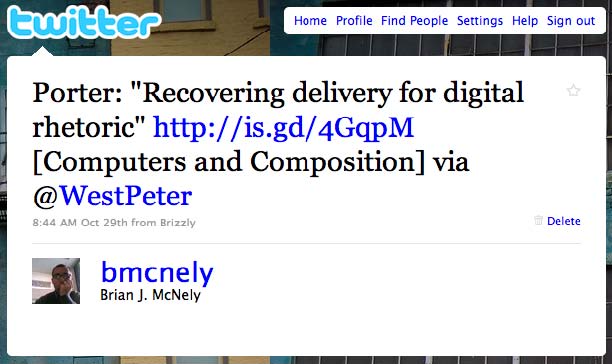
Figure 8: Screen capture of author’s tweet, November 1, 2009
By commonplacing this information through Twitter, I am enacting my understanding of the material through writing, while also re-aggregating the information in my own digital commonplace. Yet even as I do so, because of the highly integrated social affordances of the platform, my commonplacing effectively broadcasts this information to a new audience which can also make use of the article that Peter shared (see Figure 9):

Figure 9: Screen capture of tweet marked “favorite” by other users, November 1, 2009
Here, my commonplacing of the article originally shared by Peter becomes favorited by two other users that follow my updates. The commonplacing in this sense serves multiple aims simultaneously: first, content is consumed via the platform’s penchant for social sharing; second, that content is contextualized, excerpted, and recontextualized by the act of commonplacing; third, by the very act of commonplacing in a public forum (rather than in a private book), the sharing of information continues to other publics which overlap through my writing activity; finally, the original information is in some sense re-commonplaced by some of those who follow my tweets, as they have chosen to set aside that article by employing the “favorite” function.
While this is one limited use case in a professional setting, the potential benefits to students in a given content area are many. In the fall of 2008, four undergraduate Professional and Organizational Communication students and I used Twitter to aggregate and share content in concert with a research project that culminated in a conference presentation for those students. As this use case will show, the pedagogical implications for commonplacing with Twitter are potentially significant.
Because we were studying corporate brand-management in and through social media platforms, commonplacing on Twitter offered numerous and tangible benefits for content acquisition and creation. Initially, the chief benefit was aggregating content from key sources in our respective Twitter streams. We followed professionals like Daniela Barbosa from Dow Jones and Jeremiah Owyang (formerly) of Forrester Research. In doing so, we received insights and links pertaining directly to our topic of study. Undergraduate student researchers were given a real-time immersive feed of information from professionals working directly in our field of study.
Moreover, students were able to share information by commonplacing on Twitter, so that when they encountered an article related to our topic in a feed reader, for example, they recontextualized and shared that information through their own writing and rhetorical practices on Twitter. This form of sharing led directly to conversation online, and more discussion and recontextualization of content – again, an activity both closely related to the traditional norms of commonplacing yet vastly more social, interactive, and responsive.
Most importantly, however, is Twitter’s integration with the SMS messaging capabilities of standard mobile phones. I was able to continue research conversations with students beyond the classroom and beyond the campus, checking in from time to time, commonplacing new hyperlinks or discussing developing approaches. In like fashion, we continued to trace the conversation and sharing activities of the professionals we were following, so that knowledge acquisition in our research area continued, provoking repeated thinking in the content area beyond the confines of typical classroom-based learning situations. This is perhaps the single most important pedagogical affordance of Twitter as digital commonplace: it is mobile, and it can extend the classroom and student thinking in the core content area, all through brief but frequent student writing activities.
Implications and Best Practices
While the comparison between Twitter and traditional approaches to commonplace books will never be a perfect one, the reality is that both practices aggregate information from other sources, recontextualize that information through writing and rhetorical practices, and potentially serve as heuristic material for new knowledge making. In fact, platforms such as Twitter add the crucial characteristics of mobility, social interaction, and overlapping publics, attributes that can potentially increase the very effectiveness of commonplacing for knowledge acquisition. An effectively structured pedagogical approach to Twitter can enable the best of traditional commonplacing and contemporary networked information sharing.
Some best practices for using Twitter as a pedagogical enhancement include frequent instructor interaction and modeling behavior, a robust framework of strategic overlapping publics, and an organic culture of student adoption.
The first of these considerations is relatively self-evident. Locke’s improvement on commonplacing practices was predicated upon his own long-standing trial and error in systematization and use. Instructors need to work with Twitter extensively, learning how to cultivate contacts in their content area, how to effectively share and recontextualize information, and how to use Twitter as their own digital commonplace first. Such facility with the platform will go a long way in determining effective pedagogical use.
By exploring Twitter, instructors will get a strong sense of the kinds of publics that will most benefit their students. The key is to establish a strategic framework that begins with homophily (a network of contacts and professionals working in the same area as the instructor) but that also fosters social heterogeneity. Following Burt, such networks can help students bridge “structural holes” in social capital, helping them to see affinities across disciplinary and professional domains, to see where publics overlap and inform one another. (25)
Finally, social networks are spaces often resistant to encroaching pedagogies. Twitter works best when interaction is organic, just as commonplacing is most effective when aggregation and contextualization is self-directed. The most effective Twitter experiences, in terms of pedagogy, have often resulted from voluntary participation. Students who choose to commonplace through Twitter will be more likely to sustain an interest in the platform, and more likely to contribute items of substance. Students who feel forced to participate may not see the need for self-directed inquiry and for robust interaction.
Footnotes:
- E.M. Forster, Commonplace Book (Palo Alto: Stanford University Press, 1988), 1.
- Ann Moss, “The Politica of Justus Lipsius and the Commonplace-Book,” Journal of the History of Ideas 59 (1998): 421-436.
- Ibid. 422.
- Ibid. 421.
- Lucia Dacome, “Noting the Mind: Commonplace Books and the Pursuit of the Self in Eighteenth-Century Britain,” Journal of the History of Ideas 65 (2004): 603-625.
- Ibid., 603-604.
- Ibid., 604.
- Ann Blair, “Reading Strategies for Coping with Information Overload ca. 1550-1700,” Journal of the History of Ideas 64 (2003): 11-28.
- Lucia Dacome, “Noting the Mind: Commonplace Books and the Pursuit of the Self in Eighteenth-Century Britain,” Journal of the History of Ideas 65 (2004): 603-625.
- Ibid., 610.
- Ibid., 610.
- Richard R. Yeo, “Ephraim Chambers’s Cyclopeadia (1728) and the Tradition of Commonplaces,” Journal of the History of Ideas 57 (1996): 157-175.
- As a platform, Twitter is entirely use agnostic. While it is certainly used for public expressions of the quotidian or banal (“I’m eating an apple!”), it can also be used to quickly share timely information to mass audiences (as in the contested Iranian presidential elections of 2009) or to share peer-reviewed academic research. This article, while focusing on professional and pedagogical applications of Twitter, simultaneously acknowledges (and embraces) quotidian use.
- Jennie Dautermann, “Negotiating Meaning in a Hospital Discourse Community,” in Writing in the Workplace: New Research Perspectives, ed. Rachel Spilka (Carbondale, IL: SIU Press, 1993), 99.
- Karen LeFevre, Invention as a Social Act. (Carbondale, IL: SIU Press, 1986).
- Kenneth Bruffee, “Social Construction, Language, and the Authority of Knowledge: A Bibliographical Essay,” College English 48 (1986): 773-790.
- Janet Emig, “Writing as a Mode of Learning,” College Composition and Communication 28 (1977): 122-128.
- Janice Lauer, “Writing as Inquiry,” College Composition and Communication 33 (1982): 89-93.
- Jason Swarts, “The Collaborative Construction of ‘Fact’ on Wikipedia,” Proceedings of the 27th ACM international Conference on Design of Communication (2009): 281-288.
- Ibid., 282.
- Clay Shirky, Here Comes Everybody. (New York: Penguin, 2008).
- Brian McNely, “Backchannel Persistence and Collaborative Meaning-Making,” Proceedings of the 27th ACM international Conference on Design of Communication (2009): 297-304.
- Courtenay Honeycutt and Susan Herring, “Beyond microblogging: Conversation and collaboration on Twitter,” Proceedings of the 42nd Hawaii International Conference on Systems Sciences (2009): 1-10.
- Brian McNely, “Tweet Research: Aggregating and Disseminating Organizational Knowledge Work Through Twitter,” (paper presented at Computers and Writing, University of California Davis, June 18-21, 2009).
- Ronald Burt, “Social origins of good ideas.” MIT. http://web.mit.edu/sorensen/www/SOGI.pdf (accessed October 16, 2009).
Bibliography:
Blair, Ann. “Reading Strategies for Coping with Information Overload ca. 1550-1700.” Journal of the History of Ideas 64 (2003): 11-28.
Bruffee, Kenneth. “Social Construction, Language, and the Authority of Knowledge: A Bibliographical Essay.” College English 48 (1986): 773-790.
Burt, Ronald. “Social origins of good ideas.” MIT. http://web.mit.edu/sorensen/www/SOGI.pdf (accessed October 16, 2009).
Dacome, Lucia. “Noting the Mind: Commonplace Books and the Pursuit of the Self in Eighteenth-Century Britain.” Journal of the History of Ideas 65 (2004): 603-625.
Dautermann, Jennie. 1993. “Negotiating Meaning in a Hospital Discourse Community.” In Writing in the Workplace: New Research Perspectives, ed. Rachel Spilka. Carbondale, IL: SIU Press, 1993.
Emig, Janet. “Writing as a Mode of Learning.” College Composition and Communication 28 (1977): 122-128.
Forster, E.M. Commonplace Book. Palo Alto: Stanford University Press, 1988.
Honeycutt, Courtenay and Susan Herring. “Beyond microblogging: Conversation and collaboration on Twitter.” Proceedings of the 42nd Hawaii International Conference on Systems Sciences (2009): 1-10.
Lauer, Janice. “Writing as Inquiry.” College Composition and Communication 33 (1982): 89-93.
LeFevre, Karen B. Invention as a Social Act. Carbondale, IL: SIU Press, 1986.
McNely, Brian. “Backchannel Persistence and Collaborative Meaning-Making.” Proceedings of the 27th ACM International Conference on Design of Communication (2009): 297-304.
McNely, Brian. “Tweet Research: Aggregating and Disseminating Organizational Knowledge Work Through Twitter.” Paper presented at Computers and Writing, University of California Davis, June 18-21, 2009.
Moss, Ann. “The Politica of Justus Lipsius and the Commonplace-Book.” Journal of the History of Ideas 59 (1998): 421-436.
Shirky, Clay. Here Comes Everybody. New York: Penguin, 2008.
Swarts, Jason. “The Collaborative Construction of ‘Fact’ on Wikipedia.” Proceedings of the 27th ACM international conference on Design of communication (2009): 281-288.
Yeo, Richard. “Ephraim Chambers’s Cyclopeadia (1728) and the Tradition of Commonplaces.” Journal of the History of Ideas 57 (1996): 157-175.