
V4N2:Humanizing the Machine: Women Artists and the Shifting Praxis and Criticism in Computer Art
By Grant D. Taylor | July 18, 2013
A new kind of renaissance is beginning. All those now working visually with the computer are Giottos announcing the coming of a new visual age.
Collette Bangert, 1976
A computer is never lifeless. It hums as if it were cogitating some primordial secret that it will tell us only if we nurture it.
Jillian Schwartz, 1992
 As soon as the computer’s graphic capabilities were reached in the early 1960s, scientists and technologists became fascinated with the visual by-products of what was ground-breaking research. In these bewitching geometric patterns that emerged from the computer’s peripheral machines they saw a wholly new kind of creativity. In these rather rudimentary vector lines the technologists relished the mathematical grandeur of harmony, order, and symmetry (Figure 1).
These perfectly executed lines seemed to find continuity with the ancient Pythagorean tradition and its poetics of geometry. Sensitive to the history of 20th century art, these technologists also believed that the new abstract forms had echoes of the Constructivists and other early abstract Modernist movements. In these early abstract movements, the scientists and technologists saw their kindred spirit. After all the constructivists’ utilitarian doctrine for extending the formal language of abstract art into practical design found resonance in the technologists own research pursuits. Meanwhile in Northern Europe—where the Constructivist movement first emerged—the technologists naturally saw in
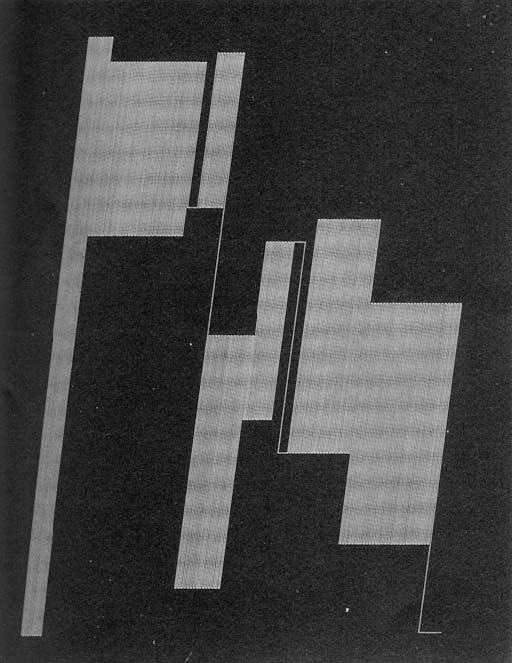
Figure 2 Auro Lecci, Slant, 1969
there computer art a continuation with modernist abstraction (Figure 2). Abstraction composition dominated both sides of the Atlantic. However, Europeans technologists differed in that they placed importance on what the early computer art theorist and historian, Herbert Franke, called the “mathematization of art.” The technologists and mathematicians envisaged the power of the computer as an experimental tool, an instrument to transform complex mathematical information into visual phenomena. Beyond making the abstract visible, there is an attempt to submit art to the powers of mathematics— in effect to demystify art. For these exponents, mathematical formalization could finally purge art of the taint of mystery by unlocking the secrets of how beauty and artistic creativity were created. Of course, this pursuit appeared abhorrent to the mainstream art-world intent on protecting the romantic myth of the “genius” artist.
Outlining a computer art discourse infused with mathematical mysticism and associations to early abstract art provides important context to the significant shift in aesthetics and theorisation that takes place in the early 1970s. Thus far I’ve been talking about a rather small group of male technologists attempting to create static graphic works. This was a small and peripheral subset of the larger art-and-technology movement in the United States, a movement that had gained popularity in the 1960s for its collaborative and progressive spirit. To add further context to the changing shape of computer art, it’s worth briefly commenting on the state of the art-and-technology movement in the early 1970s. By the early 1970s, the momentum that computer art had harnessed from the art-and-technology movement was rapidly dissipating as the movement disintegrated. The demise of the art-and-technology project was relatively swift. Two significant events in the early 1970s spelt the movement’s end: first, the closure of the Howard Wise Gallery in New York, which for eleven years had been the primary promoter and sponsor of new technological art forms; and second, the closure of the ambitious Software exhibition at the Jewish Museum in New York, as a result of a number of “technical disasters.” In the short-term, computer art’s fate seemed tied to the art-and-technology movement. After reaching the height of popularity with the international exhibition Cybernetic Serendipity, computer art saw its public support begin to wane. Many artists retreated from collaborative efforts and from the “difficulties of operating in the no-man’s land where art overlaps with science and technology.” However, harnessed to an ever-evolving technology, computer art found support in a number of nascent industries, most notably the rapidly growing computer graphics industry. More importantly to the changing nature of computer art was that trained artists showed increasing interest in the computer.
Perhaps the most significant reason for the “resurgence” was the artist, who, avoiding the crippling effects of collaboration, began learning computer programming. This resulted in a shift away from the dominant position held by scientists and technologists. The original computer art exhibitions were made up entirely of scientists and technologists. When the major international exhibition Cybernetic Serendipity was held, there were very few trained artists engaging with the computer. As the curator, Jasia Reichardt, noted “only three artists [had] actually produced computer graphics, while the rest to date had been made by scientists.”10 In the 1970s, scientists were no longer the primary practitioners and artists were no longer dependent on their expertise.
By the early 1970s, the “artist-programmer” began to materialize,11 and, in contrast to the declining art-and-technology movement, computer art expanded in the 1970s. By 1975 Computers and People (formerly Computers and Automation),12 a journal for computer scientists and enthusiasts, featured the work of forty-one artists from eleven countries in its annual exposition. By 1978, there were thirty times more computer art practitioners than a decade earlier.13 Once exhibited in isolation, and within “modest settings,”14 computer art began to be shown in larger venues. A considerable portion of venues included university and polytechnics that had recently built computer science and engineering departments. Subsequently, there was an expansion of computer courses, including, for the first time, computer art classes.15
Beyond the appearance of the trained artist, the most invigorating factor within the computer art project was the influx of women artists, writers, and critics. In the 1970s and beyond, women became primary agents in the theorisation and criticism of computer art. Besides her curatorial work on the landmark Cybernetic Serendipity, which initiated much of the worldwide interest in computer art, Jasia Reichardt’s publications, The Computer in Art (1971) and Cybernetics, Art and Ideas (1971), marked her as the most astute commentator of the computer art phenomenon. Furthermore, in the 1970s, women computer artists became prolific writers. Grace Hertlein wrote extensively on computer art, and Ruth Leavitt gave voice to a range of computer artists in her seminal publication Computer and Artist (1976). In addition, the visionary works and writings of Lillian Schwartz, Vera Molnar, and Collette Bangert shaped computer art discourse. In the following decade, women would also take the key role in criticism through the work of Cynthia Goodman, Margaret Lovejoy, Patric Prince, and Anne M. Spalter. Furthermore, in the 1980s there emerged an ever-increasing group of successful computer-based women artists.16
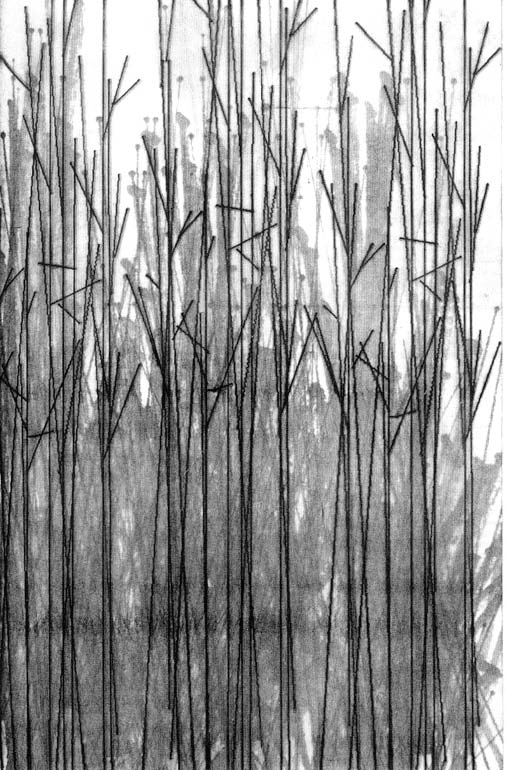
Figure 3 Grace C. Hertlein, The Field, 1970. 11×14, Grey Pastel Paper.
The movement of trained artists into the field meant that computer art evolved more humanist sensibilities. Intuition, subjectivity, and poetics began to replace the omnipresent rhetoric of abstraction, which was the overwhelming instrumental view of a depersonalized art. While much of the computer art of the 1960s evoked an organic quality through the generation of symmetrical geometric figures, the artist of the 1970s were looking to redefine their relationship to nature through such features as the landscape motif.17 For example, in the early 1970s, Grace Hertlein completed the naturalistic work The Field (Figure 3), which employed different kinds of traditional drawing mediums such as paper, pens, and inks to produce highly individual and natural effects.18
The symmetry and precision that gave 1960s computer art a “mechanistic” appearance shifted towards in-exactness and disorder, as the artist worked against the accuracy of the computer.19 The husband and wife team of Collette and Charles Bangert produced landscapes such as Large Landscape (Figure 4)20 that simulated chaotic patterns through random generators.21
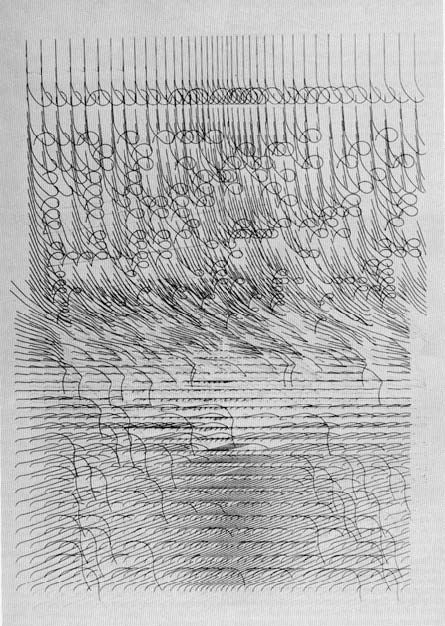
Figure 4 CS & CJ Bangert, Large Landscape, 1, Computer-plotter, Orchre and Black ink on paper, 1970. Spencer Museum of Art, University of Kansas.
While these critics, writers, and artists made more than significant contributions, women computer artists are absent from art and gender studies covering the 1970s. This is surprising considering the dominance of women in computer art. Even in computer art discourse, women’s role in computer art has only recently been acknowledged.22 Although these accounts are crucial first steps in mapping the impact of women on computer art, they do not deal with the complex relationship between gender and technology.
Many have noted the gender politics of twentieth century science and technology, especially in engineering, which is traditionally associated with men and masculinist ideology.23 Likewise, computer culture, which emerges from engineering and militaristic domains, privileges masculinity. Computer programming, which interestingly had been the domain of women before and during the war,24 became increasingly male-orientated in the 1950s as its prestige as a “challenging and creative intellectual enterprise” grew.25 Beyond the computer industry’s links to militarism, traditionally a resolute masculine domain, computer science was allied with mathematical and cognitive rationalism, which has a long history of masculine association (from Aristotle, to Descartes, to Locke).26 These factors and others meant that culturally the computer was deemed masculine.27 Contemporary gender mythologies have followed this trend, especially in the arts where anti-computer sentiment has reinforced gender stereotypes.28 A strong negative response to the computer in the humanities is one key reason why computer art—and importantly women’s contribution—was ignored. Many cultural critics promote a measured scepticism towards computer technology and its perceived modes of control. Dystopianism gained popularity in the 1970s within the reactive counter-culture and avant-garde movements.29 Influenced by the pessimistic and cynical sentiment of anti-humanist writings, many within the arts, such as artists and critics, viewed the computer as an emblem of rationalisation, a powerful instrument in the overall subordination of the individual to the emerging technocracy and associated its military industrial complex.
It seems surprising in the face of the counter-culture’s technophobia and the feminist critique of industrialisation, that woman artists were able to move with relative ease into the masculine world of computing. While there were exceptions, as Sue Gollifer has pointed out,30 women tended not to be excluded as they had been in engineering prior to the 1970s. Lillian Schwartz was invited to work at Bell Labs by technologist Ken Knowlton. For Schwartz, there were no gender issues.31 The shift was relatively straightforward because she had always worked with the latest technologies; and she had no concern over how her computer work would be received because her pre-computer art was already successful.32 Schwartz was not actively seeking equal rights within a male domain. This corresponds with Cynthia Rubin’s account of her transition to computer-based art. Beyond the aesthetic flexibility of the computer, Rubin remained in the computer art field because it was “open.” According to Rubin, “any one who had a new idea was welcome” as gender, race, and position within the computer community were not a central concern.33
Historically, the gender shift parallels the increased participation of women in engineering and computing fields in the 1970s.34 Another facilitating factor was the “women’s movement” and the resulting influx of women into the visual arts.35 Moreover, other creative fields once dominated by men were witnessing a shift; for example, at the same time, a generation of female science-fiction writers came to prominence.36 Feminism was a major issue in the visual arts during the 1970s. For many feminist artists, painting was considered too masculinist or at least too closely associated with a very masculinist history of Western art. Hence they were particularly attracted to non-mainstream media which they felt were suited to feminist subject matter, such as textiles and performance. On the other hand, Spalter suggests that females were attracted to the computer for similar reasons, because “unlike traditional fine art media, [the computer] does not have a history of primarily male practitioners.”37 While this is true, feminist themes are not common amongst female computer artists (unlike textiles, performance, video, and photography), and male scientistsand technologists did dominate computer art production in the 1960s, (as would be expected given science and engineering’s long masculine bias). However, computer art was such a new medium that male practitioners were yet to construct a history that favoured them.
Early women computer artists seem not to have raised gender issues in their work or collaborative efforts, unlike their feminist contemporaries in video and performance art. This is one major factor in women artists slipping underneath the radar. There was no overt polemics involved in the use of the computer by women in the early 1970s. This contrasts with artists using video, which became an “alternative, progressive, and flexible medium for expressing their political and cultural objectives.”38 Like their male counterparts, female computer artists were devoted to the potential of the computer and its processes, rather than its potential as a political tool. Nevertheless, women artists overcame the fallacy that computer technology was inherently masculine. It became clear that computers did not embody masculinity; rather, the medium had in the very early years been “culturally constructed” as a male preserve.39
One of the significant factors that drew women to the computer was the artist’s belief that the computer was a mysterious and untouched frontier fit for exploration. This has historical precedence. Some of the most insightful and passionate writings on mechanical calculation have been made by the nineteenth-century mathematician Lady Lovelace, Augusta Ada King-Byron.40 In the computer world, gender issues in the 1970s appear to be eclipsed by the absorption in, and enthralment of, the computer’s innate potentiality. The computer itself was equally seductive to both genders. Sherry Turkle has noted how “engrossing” the computational medium can become for users, and how that interaction with the machine “offers the illusion of companionship.”41 Computer artists such as Grace Hertlein, who invoked the idea of the “joyous machine,” followed the highly reflective relationship that others (including male technologists and artists) entered into.42
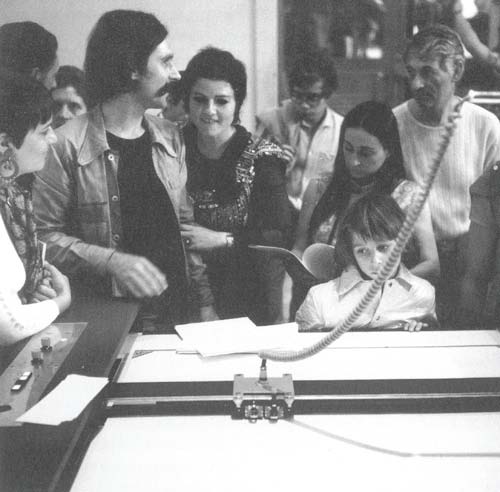
Figure 5 Manfred Mohr in front of the flatbed plotter explaining his technique, 1971. ARC, Musée d’Art Moderne, Paris Exposition.
Ever since the 1950s when the computer first entered the cultural psyche, it had evoked a special kind of wonderment. The tendency to both anthropomorphize and mythologize the machine was part of the general public’s, and indeed the artist’s, inability to comprehend the logical complexities of the machine.43 As Philip Davis and Reuben Hersh describe, “in the passage from symbolic and programmatic to the visual, [the artist] cannot anticipate all aspects of what the machine will create.”4444 The computer’s metaphorical link to the mind and its descent from the mysterious Enlightenment automaton meant that computers were seen as strangely sentient.45 In effect, the spectacle of seeing a computer, apparently operating autonomously as it drew complex images, was a major attraction for a fascinated public (Figure 5). For both male and female computer artists, the appeal of the computer lay in its ability to configure new visual worlds through Cartesian spatial logic.4646 This creationist mythology was ever present in computer art and often all consuming, as recorded in artist writings. From the beginning, computer artists were captivated by the power of becoming an “omnipotent creator,” creating a “new universe” with its “its own physical laws.”47 This belief would sustain the artist in what would become difficult times for the genre as it sought validation from an art world hostile and distrustful of the computer and its future place in the visual arts.
Footnotes
- Collette Bangert and Charles Bangert, “Computer Grass Is Natural Grass,” in Artist and Computer, ed. Ruth Leavitt (New York: Harmony Books, 1976), 23.
- Lillian Schwartz and Laurens Schwartz, The Computer Artist’s Handbook (New York: W. W. Norton & Company, 1992), 3.
- The new computer artists also shared with the constructivists the utilitarian doctrine for extending the formal language of abstract art into practical design. The Modernist schools of criticism, such as Constructivism, Bauhaus and the De Stijl Group, analysed composition in terms of design elements and principles. Corresponding to the age of efficient industrialisation, these modernist groups also were interested in producing art mechanically as a way to increase functionality and avoid embellishment and artistic idiosyncrasies.
- Herbert, Franke, Computer Graphics—Computer Art. trans. Gustav Metzger. (New York: Phaidon, 1971), 8.
- For convenience, I employ Edward Shanken’s descriptor “art-and-technology.” Likewise I describe art-and-technology as a broad artistic phenomena that emerged in the US in the 1960s through a number of exhibition and where exponents focused their “inquiry on the materials and/or concepts of technology and science.” They also sought, through a “meta-critical process,” to challenge the “systems of knowledge that structure scientific methods and conventional aesthetic values.”
- Edward Shanken, “Art in the Information Age: Technology and Conceptual Art,” Leonardo 35, no. 4 (2002): 434.
- Edward Shanken, “Art in the Information Age: Technology and Conceptual Art,” Leonardo 35, no. 4 (2002): 435. Edward Shanken, “The House That Jack Built: Jack Burnham’s Concept of ‘Software’ as a Metaphor for Art,” in Reframing Consciousness: Art and Consciousness in the Post-Biological Era, ed. Roy Ascott (Exeter: Intellect, 1999), 145-196.
- K. Loewengart, Computer Genesis: A Vision of the 70s (New York: Joe and Emily Lowe Art Gallery, 1977).
- Jonathan Benthall, Science and Technology in Art Today (New York: Praeger Publishers, 1972), 11.
- Jasia Reichardt, ed., Cybernetic Serendipity: The Computer and Art (New York: Praeger, 1968), 71.
- Ken Knowlton, “Collaborations with Artists: A Programmer’s Reflection,” in Graphic Languages, ed. Frieder Nake and Azriel Rosenfeld (Amsterdam: North-Holland Publishing Company, 1972).
- The journal was first published in 1951 with the title The Computing Machinery Field. In 1953, it changed to Computers & Automation, then to Computers and People in 1974 when it began to publish material relating to the social effects of computers and information systems. For example, it tackled, in relation to computers, the ethical, social, and global issues of the day.
- Grace Hertlein, “Computer Art: Review,1968; Survey, 1978; Predictions, 1988,” Computers and People August-September (1978).
- Herbert W Franke, Computer Graphics—Computer Art, trans.Gustav Metzger (New York: Phaidon) 72.
- Grace Hertlein, “Computer Art: Review,1968; Survey, 1978; Predictions, 1988.”
- Rebecca Allen, Eudice Feder, Darcy Gerberg, Cooper Giloth, Barabara Nessim, Sonia Landy Sheridan, Vibeke Sorensen, Joan Truckenbrod, Jane Veeder, Donna Cox, Diane Fenster, Sue Gollifer, Cynthia Rubin, Darcy Gerbarg, Nicole Stenger, and many more.
- Beyond the Bangerts, there were artist such as Grace C. Hertlein, Mutsuko K. Sasaki, Harold Hedelman, Duane M. Palyka, and Petar Milojevic who explored computerized natural forms.
- Grace Hertlein, “An Artist Views Discovery through Computer-Aided Graphics.” Computers and Automation August (1970): 25-26.
- The artists attempt to “avoid making computer drawings that have a computer-made appearance.” See both Bangert and Bangert, “Experiences in Making Drawings by Computer and by Hand”; Bangert and Bangert, “Computer Grass Is Natural Grass,” 18.
- Gift of Colette Stuebe Bangert and Charles Jeffries Bangert, 1999.0232. © Collette Stuebe Bangert and Charles Jeffries Bangert.
- Bangert and Bangert, “Computer Grass Is Natural Grass,” 20.
- Anne Spalter, in her wide-ranging publication The Computer in the Visual Arts. (Reading, Massachusetts: Addison-Wesley, 1999) was the first to formally acknowledge the role of women in the emergence of computer art. More recently, Patric D. Prince has written an important descriptive account. Patric Prince, “Women and the Search for Visual Intelligence,” in Women, Art & Technology, ed. Judy Molloy (London: The MIT Press, 2003).
- Angela Creager, Elizabeth Lunbeck, and Londa Schiebinger, eds., Feminism in Twentieth-Century Science, Technology, and Medicine (Chicago: The University of Chicago Press, 2001).
- Prior to the 1950s the term computer denoted a person, usually a woman, who “carried out calculations by hand or with a mechanical calculator.” Michael Mahoney, “Boy’s Toys and Women’s Work: Feminism Engages Software,” in Gender & Technology, ed. Nina Lerman, Ruth Oldenziel, and Arwen Mohun. (Baltimore: The Johns Hopkins University, 2003). 171.
- Ibid., 171.
- Paul Edwards, “Industrial Genders: Soft/Hard,” in Gender & Technology, ed. Nina Lerman, Ruth Oldenziel, and Arwen Mohun (Baltimore: The Johns Hopkins University, 2003), 177.
- Mahoney remarked that studies, even as late as the 1980s when PCs had become widespread, found that “children of both sexes from kindergarten on identify the personal computer as masculine: it is something for the boys.” Mahoney, “Boy’s Toys and Women’s Work: Feminism Engages Software,” 171.
- When I mention computer art to my colleagues in art history, many are surprised to discover the existence of female practitioners. They were astounded when I outlined the crucial role women played in shaping computer art. The stereotypical view of a computer artist is still male, which goes well with many who persist in combining outmoded gender identities with anti-technology sentiment. The women computer artists I’ve contacted have also confirmed this bias.
- In 1964, the same year that computer art first entered the cultural sphere, influential cultural theorists, Jacques Ellul, Herbert Marcuse and Marshall McLuhan produced influential publications that in different ways were critical of technology. Jacque Ellul, The Technological Society, trans. J. Wilkinson (New York: Vintage, 1964); Herbert Marcuse, One-Dimensional Man (Boston: Beacon Press, 1964); Marshall. McLuhan, Understanding Media (New York: McGraw Hill, 1964).
- While Lillian Schwartz had few problems, the celebrated print maker, Sue Gollifer, found that computing in the late 1960s was not “deemed a woman/art area.” Sue Gollifer, e-mail message to author, June 1st 2004.
- Lillian Schwartz, e-mail message to author, 25th May 2004.
- Lillian Schwartz, e-mail message to author, 25th May 2004.
- Cynthia Rubin, e-mail message to author, 25th May 2004.
- Creager, Lunbeck, and Schiebinger, eds., Feminism in Twentieth-Century Science, Technology, and Medicine; Edwards, “Industrial Genders: Soft/Hard,” 179.
- Lawrence Alloway, “Women’s Art in the ‘70s,” Art in America May-June (1976).
- Charlie Gere in Digital Culture. (London: Reaktion Books, 2002) 163, mentions Ursula LeGuin, Anne McCaffrey, Joanna Russ, Kate Wilhelm, C.J. Cherryh, and Joan Vinge.
- Anne Spalter, The Computer in the Visual Arts (Reading, Massachusetts: Addison-Wesley, 1999), 11.
- Margot Lovejoy, Postmodernist Currents: Art and Artists in the Age of Electronic Media, (Ann Arbor: UMI Research Press, 1989) 105.
- Edwards, “Industrial Genders: Soft/Hard,” 196.
- Joan Baum, The Calculating Passion of Ada Byron (Hamden, Conn: Archon Books, 1986).
- Sherry Turkle, Life on the Screen: Identity in the Age of the Internet (New York: Simon and Schuster, 1995), 31.
- Grace Hertlein, “An Artist Views Discovery through Computer-Aided Graphics” Computers and Automation August (1970): 26.
- The digital mythology, as Richard Wright suggest, was a way to “compensate and account for the dimly apprehended events seen on the screen.” Richard Wright, “Computer Graphics as Allegorical Knowledge: Electronic Imagery in the Sciences.” Leonardo Supplemental Issue, 3 (1990): 68.
- Philip Davis, and Reuben Hersh. Descartes’ Dream: The World According to Mathematics. (Sussex: The Harvester Press, 1986), 52.
- These mechanical marvels known as automata (from Greek automatos, acting of one’s own will, self-moving’) inspired a whole spectrum of emotions, from wonderment at the machine’s lifelike motion, to extreme indignation over the Promethean powers it seemed to engender. Automata reached the height of popularity in the eighteenth century largely due to the lifelike flute player, drummer and duck built by Jacques de Vaucanson, whose creations amazed both the general public and privileged elite up until the nineteenth century.
- A three-dimensional coordinate system developed by Rene Descartes to plot objects along three, graduated axes: X, Y, and Z. This geometric system became the foundation of computer graphics and later became a key element in the theorization of virtuality.
- Frank Dietrich, “Visual Intelligence: The First Decade of Computer Art (1965-1975).” Leonardo 19, 2 (1986): 161.
Bibliography
Alloway, Lawrence. “Women’s Art in the ‘70s,” Art in America May-June (1976): 65-72.
Bangert, Collette, and Charles Bangert, “Computer Grass Is Natural Grass,” in Artist and Computer, ed. Ruth Leavitt. New York: Harmony Books, 1976.
Bangert, Collette, and Charles Bangert. “Experiences in Making Drawings by Computer and by Hand.” Leonardo 7 (1974): 289-96.
Baum, Joan. The Calculating Passion of Ada Byron. Hamden, Conn: Archon Books, 1986.
Benthall, Jonathan. Science and Technology in Art Today. New York: Praeger Publishers, 1972.
Creager, Angela, Elizabeth Lunbeck, and Londa Schiebinger, eds., Feminism in Twentieth-Century Science, Technology, and Medicine. Chicago: The University of Chicago Press, 2001.
Davis, Philip, and Reuben Hersh. Descartes’ Dream: The World According to Mathematics. Sussex: The Harvester Press, 1986.
Dietrich, Frank. “Visual Intelligence: The First Decade of Computer Art (1965-1975).” Leonardo 19, no. 2 (1986): 159-69.
Edwards, Paul. “Industrial Genders: Soft/Hard,” in Gender & Technology, ed. Nina Lerman, Ruth Oldenziel, and Arwen Mohun. Baltimore: The Johns Hopkins University, 2003.
Franke, Herbert. Computer Graphics—Computer Art. trans. Gustav Metzger. New York: Phaidon, 1971.
Gere, Charlie. Digital Culture. London: Reaktion Books, 2002.
Hertlein, Grace. “Computer Art: Review,1968; Survey, 1978; Predictions, 1988,” Computers and People August-September (1978). 8-9. Hertlein, Grace. “An Artist Views Discovery through Computer-Aided Graphics.” Computers and Automation August (1970): 25-26.
Leavitt, Ruth. Artist and Computer. New York: Harmony Books, 1976.
Lillian Schwartz and Laurens Schwartz, The Computer Artist’s Handbook. New York: W. W. Norton & Company, 1992.
Loewengart, K. Computer Genesis: A Vision of the 70s. New York: Joe and Emily Lowe Art Gallery, 1977.
Lovejoy, Margot. Postmodernist Currents: Art and Artists in the Age of Electronic Media. Ann Arbor: UMI Research Press, 1989.
Mahoney, Michael. “Boy’s Toys and Women’s Work: Feminism Engages Software,” in Gender & Technology, ed. Nina Lerman, Ruth Oldenziel, and Arwen Mohun. Baltimore: The Johns Hopkins University, 2003.
Knowlton, Ken. “Collaborations with Artists: A Programmer’s Reflection,” in Graphic Languages, ed. Frieder Nake and Azriel Rosenfeld. Amsterdam: North-Holland Publishing Company, 1972.
Prince, Patric. “Women and the Search for Visual Intelligence,” in Women, Art & Technology, ed. Judy Molloy. London: The MIT Press, 2003.
Reichardt, Jasia. ed., Cybernetic Serendipity: The Computer and Art. New York: Praeger, 1968.
Reichardt, Jasia. The Computer in Art. London: Studio Vista Limited, 1971.
Reichardt, Jasia. ed. Cybernetics, Art and Ideas. London: Studio Vista, 1971.
Shanken, Edward. “Art in the Information Age: Technology and Conceptual Art,” Leonardo 35, no. 4 (2002): 433-38.
“The House That Jack Built: Jack Burnham’s Concept of ‘Software’ as a Metaphor for Art,” in Reframing Consciousness: Art and Consciousness in the Post-Biological Era, ed. Roy Ascott. Exeter: Intellect, 1999.
Spalter, Anne. The Computer in the Visual Arts. Reading, Massachusetts: Addison-Wesley, 1999.
Turkle, Sherry. Life on the Screen: Identity in the Age of the Internet. New York: Simon andSchuster, 1995.
Wright, Richard. “Computer Graphics as Allegorical Knowledge: Electronic Imagery in the Sciences.” Leonardo Supplemental Issue, 3 (1990): 65-73.