
V4N2: Web Journalism: From the Inverted Pyramid to the Tumbled Pyramid
By João Manuel Messias Canavilhas | July 18, 2013
Introduction
Media development is quick to register improvements in the distribution channels. The American press, for instance, grew considerably along with the railway system as the latter began to expand, since newspapers could now reach farther. In radio and television, dramatic changes were equally brought on by technical developments in signal distribution, which generated larger audiences and higher profits. These in turn allowed new types of content and further technical improvements.
As with the traditional media, the development of web journalism is closely linked to the spread of the Internet. According to Internet World Stats, between 2000 and 2005 the number of users had risen 186% and in June of 2006 there were already 1.043 billion Internet users worldwide. Regrettably, a good part of these users still do not have broadband access, which conditions the types of contents conveyed by web journalism. According to the World Broadband Statistics, in the third quarter of 2006, North America and Western Europe had the highest broadband penetration rates, only 19.3% and 18.3% respectively. This low level is one of the reasons why text remains the most widely used element of journalism on the web, since even with low speed access downloading this type of page is relatively fast.
The type of access is important, but it is not the sole reason for online newspapers to have thus privileged the written text. Towards the late 80s, electronic publishing had already spread within the sphere of the written press. Across the world, newspapers began to invest in IT equipment and publishing software, which allowed them to work faster and to close editions later. As a result, when the Internet boom happened, newspapers had already digitized their news organizations, moving on to online editions at virtually no extra cost and making available the same news as in the printed versions. Indeed, web journalism developed spontaneously in a fashion quite similar to that of written journalism, using the same news writing techniques as those of its printed counterpart. However, web journalism can benefit from an emerging element, hypertext, which does not require larger bandwidth and allows the reader a more personalized reading experience, moving from text to text using the links created by the journalist. A discussion of hypertext news writing techniques is clearly in order.
Literature Review
In the teaching of journalism at university level, news writing techniques are paramount. Since the second half of the 20th century, American university degrees in journalism have emphasized the importance of written practice and pagination. Today, the news writing techniques course remains one of the few core courses in media studies degrees and is described as a theoretical-practical introduction to news writing and to journalistic styles and genres. The “inverted pyramid” technique is one of the cornerstones of this discipline. Briefly, it consists of writing the news by beginning with the most relevant information. The answer to the interrogatives What, Who, Where, How, When, and Why is followed by supplementary information organized in blocks of decreasing relevance (Figure 1 Inverted Pyramid).
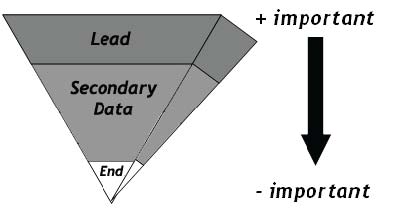
Figure 1 Inverted pyramid
This news writing architecture emerged during the US Civil War. A groundbreaking technical invention of the time, the telegraph allowed journalists to send their war reports daily. However, the technology was not wholly reliable, and to make matters worse telegraph posts were the favorite targets of troops, a tactic that frequently rendered the system inoperable. In order to ensure equitable transmission conditions, journalists and telegraph operators agreed on a rule that protected the work of the professionals: each journalist would transmit the first paragraph of their text, then following a second round of transmissions when each journalist would telegraph their second paragraph, and successively. This rule forced journalists to change what had hitherto been the main news writing technique. Instead of the conventional chronological report of events, journalists began to organize facts according to their perception of the worth of the news. They began to relate the most important facts at the beginning of the text, thus ensuring that their newspapers would receive the most essential information. Later labeled the “inverted pyramid” technique by Edwin L. Shuman in his book Practical Journalism , this practice went on to become one of the better known rules in the field. However, despite efficiency in fast and concise news transmission, the use of this technique can turn news work into a routine. Allowing little room for creativity, it can make reading less appealing, which might help to explain why it has so long been the object of controversy. The emergence of web journalism has intensified the debate. Authors like Jacob Nielsen, Rosental Alves, or José Álvarez Marcos underscore the importance of the inverted pyramid on the web. Others, like Ramón Salaverria,10 while acknowledging the importance of this technique in breaking news, hold that it can become a hindrance to other journalistic genres, which may benefit from the possibilities of hypertext.
I second the latter opinion, considering that this technique is associated with a kind of journalism severely restricted by the characteristics of its physical support: paper. To use the inverted pyramid technique on-line is to divest web journalism of one of its most interesting potentials: the implementation of an open news writing architecture, enabling unrestricted online navigation. Further, to have a new medium other than the printed press, but not to take benefit from its features, is to condemn its contents to failure. Because every medium has its own characteristics, success is directly connected with the exploration of this potential.11 Doing journalism on the Internet requires exploring the characteristics of hypertexts, multimedia, and interactivity, characteristics that cannot be found in the printed press.
Given space limitations in paper editions, the organization of information follows a model that aims to optimize the space available. Journalists use techniques that seek a perfect balance between what they mean to say and the available space in which to say it. For obvious reasons, the inverted pyramid technique is fitting in this context. The editor may always cut one of the final paragraphs without compromising the meaning of the news article.
By contrast, space in online editions is virtually unlimited. Cuts may happen for stylistic reasons, but not for space-saving reasons. Instead of news framed by four page margins, journalists are able to provide new and immediate reading horizons by creating links between short texts and other multimedia components that can be organized into layers of information.
In hypertext news writing, the author must manage a complex network of texts and links, but the number of combinations is virtually infinite.12 One of the major obstacles to the use of hypertext in online news is a tradition of linear reading dating back four thousand years. According to Sperber and Wilson, reading a text is a comprehension exercise in which readers continually seek the connection between what they are reading and what they have previously read.13 They try to assess the relevance of a given fragment of the text by contrast with linearly previous parts. In the case of hypertext, Landow maintains that the information “appears to break up or atomize its components and these reading units take on a life of their own and become more autonomous, since they are less dependent on what precedes or follows them.”14 We will likely be faced, then, with a problem of coherence, here understood by Engebretsen as the “the total of the mechanisms which make a text a logical unit.”15 The structuring of the text in decreasingly relevant paragraphs, for instance, is in itself understood by the reader as a rule of coherence. Coherence may be local, where there is a direct relation between the current text and the immediately preceding paragraphs; or global, where the relation between the paragraphs is granted either by the overall theme of the news or by its global nature.16
In the case of web journalism, coherence exists on a global level, as the existence of external links may lead users to pages that are external to the news. Stylistic elements that confer such coherence must therefore be considered, especially concerning titles and the ordering of related links, i.e., the way that the user becomes aware of the existence of additional information on the theme of the news article.
Another challenge posed to hypertext news writing is the possibility of users drifting in the course of reading.17 In other words, by moving from text to text, readers tend to wander and quit reading. Nonetheless, an opportunity may actually lurk behind this apparent liability. As Ko and Rubin note,18 readers are ostensibly drawn to texts where they are afforded the possibility of exploring the news. This would imply that a news article composed of different texts connected by links would originate different reading paths. This in fact is the assessment underlying the research query of this paper:
Is there a reading pattern in hypertext news or do readers choose individual reading paths?
For the purpose of this research, a news article was written following Robert Darnton’s suggestion, which underscores the potentials of the online environment as an alternative for publications that cannot find their way into print. Darnton’s view is that online publishing implies a new architecture, and he proposes a layered, pyramid structure. The architecture he recommends builds into six layers of information. The first layer consists of a summary of the subject; the second layer includes extended versions of the main elements, but which are organized as autonomous components; a third information level contains further documentation on the different issues at stake; a fourth level provides a frame, including additional insights from the research field; a fifth pedagogical level comprises proposals for debates in the classroom; and the sixth and final layer consists of readers’ responses to and discussions with the author. “A new book of this kind would elicit a new kind of reading. Some readers might be satisfied with a study of the upper narrative. Others might also want to read vertically, pursuing certain themes deeper and deeper into the supporting essays and documentation.”19
Although this model was originally suggested for academic papers, its adjustment to journalistic ends is entirely apt. Accordingly, a news article with this type of architecture was written for analysis.
Methodology
A news article was prepared consisting of ten web pages linked up by both menu links and in-text links.20 The organization of the news was based on an architecture of layered information (Fig. 2).
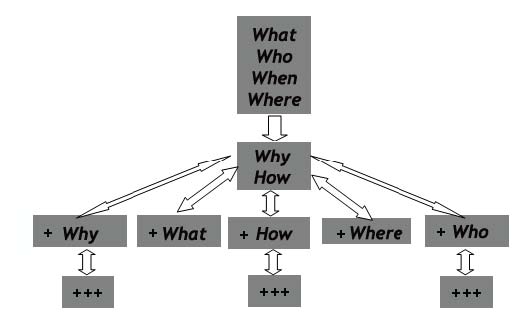
Figure 2 Architecture of layered information
In the opening text,21 five in-text links led to a second information level. Three out of five second-level texts included an in-text link leading to a third level, and a navigation menu with links to all remaining texts of the same or previous level. In-text links invariably led to the following information level. (Figure 3)
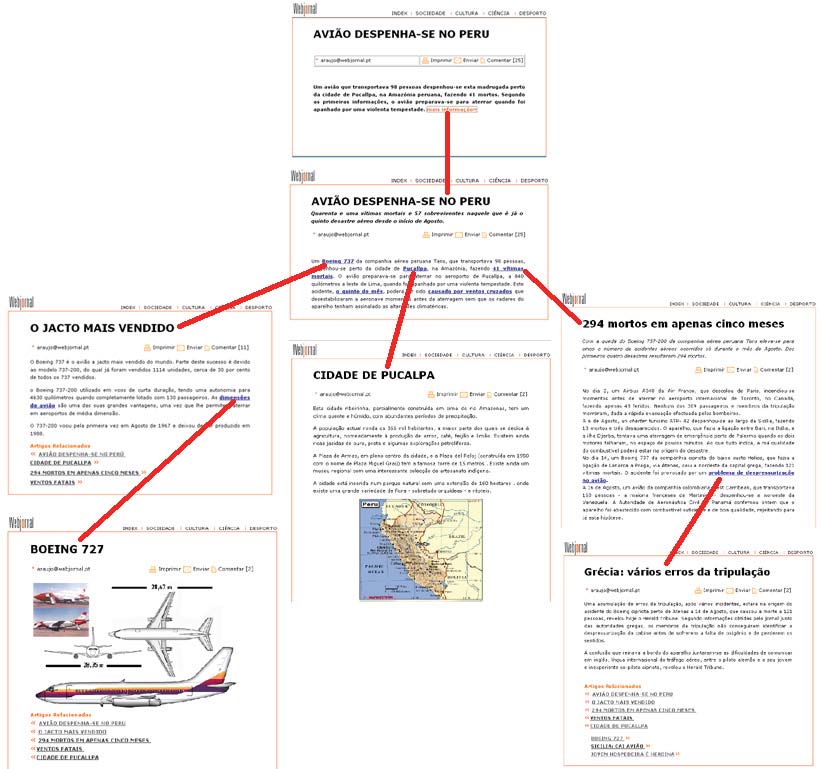
Figure 3 News Architecture
The subjects (thirty nine students from the University of Beira Interior) were told to read the news as they would ordinarily, and no time limit was set. Camtasia Software was used to record every mouse movement, thus tracking reading paths.
Results
From the data analysis the following conclusions are drawn:
Users who clicked onto the second level, following the first in-text link in the text amounted to 76.5%. From this group, 57.7% went on to the third level of the news, following the only in-text link in this second text. On the other second-level text with an in-text link, used the link to proceed to a third level.
23% of readers follow a routine of reading by levels: they click on the in-text link and afterwards return to the initial text.
77% follow an individual reading path.
The first time readers were faced with several links (five), five different paths were identified; on the following step, the variety of paths rose to eleven; on the third stage, twenty two reading paths were followed, out of a possible fifty five.
11.1% of readers followed a similar reading path, taking eleven equal steps.
Discussion and Results
News writing entails considering two variables: “dimension” (data amount: such as how many texts, pictures, or videos) and “structure” (news architecture: the way these elements are organized). A correct management of the variables forces journalists to choose the writing techniques best applicable to the features of the medium, necessarily privileging one of the two variables. It is therefore understood that the priorities of the printed press journalist are distinct from those of the web journalist: while the former must bear in mind the length of the text, resorting to stylistic devices that help them make the text “fit” the allotted space, the latter, space being virtually unlimited, tends to focus on the structure of the news.
a) Web news structure
The structuring of online news implies the creation of a script that allows users to grasp its architecture, and specifically the hierarchical organization of the multimedia elements and their external links. “Flexibility in online media allows the organisation of information according to hypertext structures. Each news article requires its own structure, according to its specificities and to the multimedia elements available.”22
These structures can be linear, reticular, or mixed.23 In the case of a linear structure, the simplest one, blocks of text are linked by one or more axes. The level of navigability is restricted, since the reader cannot shift from one axis to the other.
Where only one axis is found, the structure is unilinear. (Figure 4)
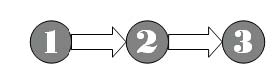
Figure 4 Unilinear Hypertext Structure
Where there are several axes, the structure is multilinear, with different stories told across different, unrelated axes. (Figure 5)
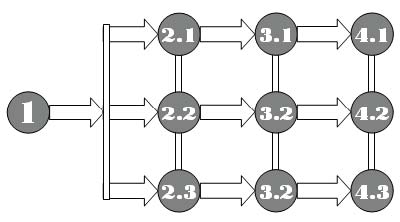
Figure 5 Multilinear Hypertext Structure
As the name implies, a reticular (Figure 6) structure has no predefined development axes. Rather it consists of a network of freely navigable texts, opening up several possible reading paths. Finally, mixed structures present both linear and reticular type levels. Reading possibilities are somewhat restricted in comparison to the previous model, but this one offers the advantage of well-defined “reading clues.”
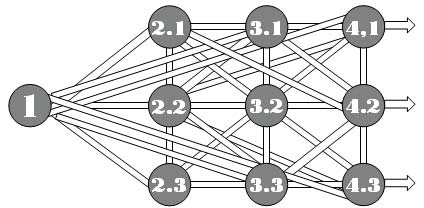
Figure 6 Reticular Hypertext Structure
Regardless of the type of hypertext structure, these data architectures imply moving away from the inverted pyramid model. This move is where researchers disagree. Indeed, despite championing a new language for web journalism, many insist it make use of the inverted pyramid model, reinforcing an organizing configuration whereby the most relevant data appear at the beginning and the less relevant at the bottom of the news.
The data collected in this research suggest otherwise. Despite the news having been composed by hierarchically organized layers of information, defined by a level of relevance, readers chose to follow certain topics through to the limit of available information, by clicking on the in-text links and accessing other information levels (Figure 7). From the group of 76.5% that clicked onto the second level, 57.7% jumped to the third, and final, level, and only 23.5% returned to the previous level to make a level reading, following all the links on this second level.
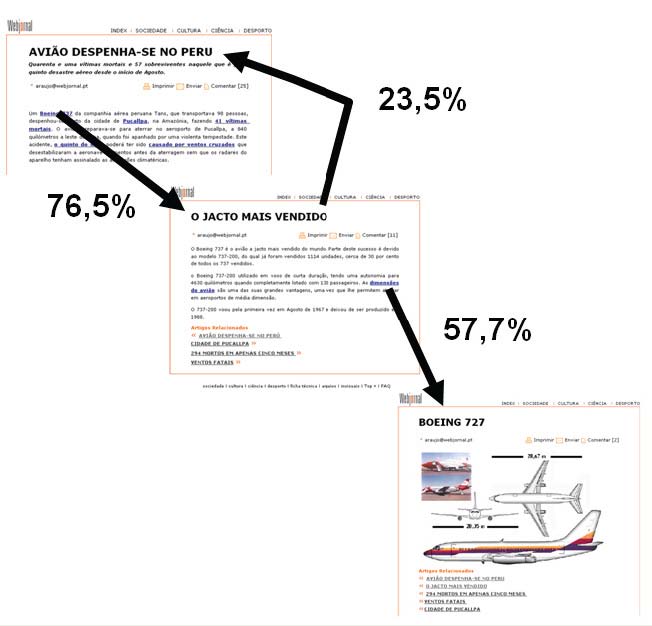
Figure 7 Readers’ Choice
This behavior suggests that web news writing elicits a shift from the paradigm of printed press techniques. While data organization in print progresses towards contents deemed the least relevant by the journalist, on-line the readers define their own reading paths. The inverted pyramid technique, while appropriate for breaking news, proves less efficient when it comes to more elaborate web news, since it conditions readers to reading routines similar to those of the printed press.
b) An emerging paradigm
The identification of twenty two reading paths as early as the third stage of interaction raises an important question: is the use of a technique whereby input is arranged according to estimated relevance advisable for a kind of journalism pertaining to an active medium? I am convinced otherwise. The data collected throughout this study advise that web journalism embrace a paradigm different to the one underlying the inverted pyramid technique.
To an organizing logic based on the relevance of facts, another must follow based now on the amount of information available to the readers. If the vertical axis ranging from the vertex to the base means that the top is more important than the base, then the pyramid must shift its position, to avoid a hierarchization of news based on the relevance of related facts. Research data further indicate that the journalist’s criteria in arranging information did not necessarily match those of readers, which may suggest that the use of the inverted pyramid technique in web journalism might actually result in a loss of readers.
In web journalism the amount (and variety) of available information is the reference variable. The news builds from a level of less information to increasingly deeper and varied information levels on the theme (Figure 8).
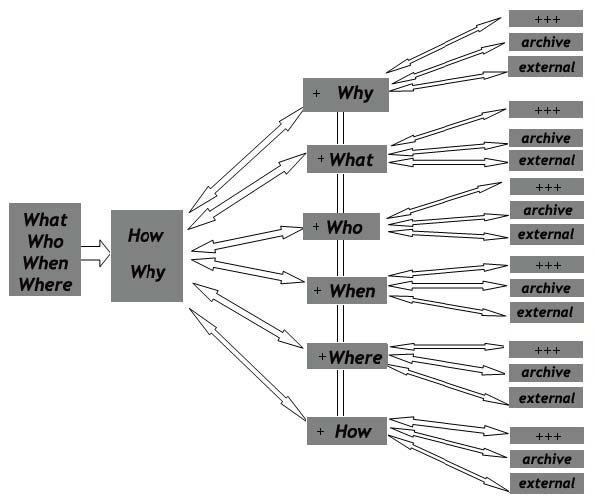
Figure 8 Web News Architecture
Though information levels are clearly defined, texts are not organized according to relevance. Instead, there is an attempt to highlight reading clues. Usually, readers follow a link and afterwards return to the previous webpage. In this case, it was found that the readers jump linearly from level to level, finding more information about a topic that they consider interesting.
By contrast with the inverted pyramid model, a graphical representation of this architecture (Figure 8) seems to suggest a tumbled pyramid (Figure 9). As in the case of the inverted pyramid, readers may abandon reading at any point without missing the meaning of the story. However, this model offers the possibility either of following through only one of the available reading axes or of freely navigating the news.
The results from this research lead us to propose the following four-leveled, tumbled-pyramid structure
Base Unit (lead): Here the key questions are answered:
What, When, Who, and Where. This first text may be breaking news, which depending on developments may or may not develop into a more elaborate format.
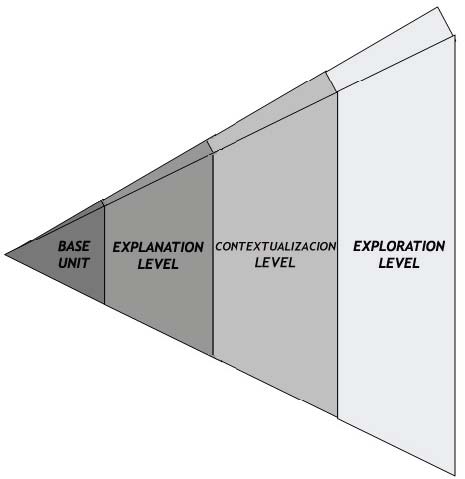
Figure 9 Tumbled Pyramid
Explanation Level: This level answers Why and How, completing the essentials on the event.
Contextualization Level: Further information is provided on each of the previous key questions, whether in text format, video, sound, or animated infography.
Exploration Level: At this level, the news is linked to the publication’s archives or to external ones.
As Marcos Palácios and Elias Machado state, “The same way that the web’s ‘rupture from physical constraints’ allows use of virtually unlimited space to make available news matter in a variety of (multi-)media formats, it is now possible to make available all the information previously generated and stored, using digital archives with sophisticated data indexing and retrieval systems.”24 This architecture implies “a new kind of journalist–a professional in this type of work must be capable of handling vast amounts of documentation, and of effectively presenting the events and commentary which stem from the different kinds of supports available behind a computer screen.”25
In short, the tumbled pyramid is a liberating technique for users as well as journalists. If users can navigate the news, following their own reading paths, journalists should in turn rely on a set of stylistic devices, which combined with new multimedia contents allow a reinvention of web journalism.
Recommendations for future research
The fact that in-text links and menu links were used may have conditioned the readings. In future research it is recommended that analysis of reading-paths uses news that include only one type of link, since a tendency to immediately follow the first link of the text was noted.
Footnotes
- Internet Word Stats http://www.internetworldstats.com/stats.htm (accessed February 3, 2007).
- World Broadband Statistics: Q3 2006”, Point Topic Ltd, (accessed December 2006).
- Concha Edo, Del papel a la pantalla: la prensa en Internet (Sevilla: Comunicación Social Ediciones y Publicaciones, 2002), 103.
- Nelsonnn Traquina, Jornalismo (Lisboa: Quimera, 2002)
- Mar de Fontcuberta, A Notícia: pistas para compreender o mundo. (Lisboa: Editorial Notícias, 1999), 58 and following pages.
- Ramón Salaverria, Redacción Periodística en Internet (Pamplona: EUNSA, 2005), 109,
- Jakob Nielsen, “Inverted Pyramids in Cyberspace.” Alertbox (1996), http://www.useit.com/alertbox/9606.html. (August 24, 2006).
- See interview by Carlos Castilho “Uma linguagem em construção” (Interview to Rosental Calmon Alves). no 311, (January, 2005) http://observatorio.ultimosegundo.ig.com.br/artigos.asp?cod=311ENO002 (June 30, 2006).
- José Alvarez Marcos”El periodismo ante la tecnología hipertextual,” in Manual de Redacción Ciberperiodística. Edited by Noci, Javier Díaz and Salaverria, Ramón, (Barcelona: Ariel Comunicación, 2003), 246-248.
- Ramón Salaverria, Redacción Periodística en Internet (Pamplona: EUNSA, 2005
- Francis Pisan, ¿Y ahora qué? (México: CECSA, 2002).
- Y.L. Theng, et al, “Improved Conceptual Design for Better Hypertext.” Paper presented at HCI’96–Human Computer Interaction Conference, London, England, August 20-23, 1996. http://citeseer.ist.psu.edu/326566.html. (accessed February 3, 2007)
- D. Sperber and D. Wilson, Relevance. Communication and Cognition (Oxford: Blackwell, 1986).
- George P. Landow, Hipertexto. La convergencia de la teoría crítica contemporánea,(Barcelona: Ediciones Paidós, 1995), 73.
- Martin Engebretsen, “Hypernews and Coherence.” Journal of Digital Information. 1, no. 7 (2000) , http://jodi.tamu.edu/Articles/v01/i07/Engebretsen/. (September 12 2006).
- Angelika Storrer, “Coherence in text and hypertext,” In Document Design 3 (2002):, 156 – 168.
- S. Batra, R.R. Bishu, and B. Donohue, “Effect of Hypertext Topology on Navigation Performance.” Advances in Human Factors and Ergonomics 19 (1993); N. Hammond, “Hypermedia and Learning: Who Guides Whom.” En Maurer, H. (eds) Computer Assisted Learning. Lecture Notes in Computer Science, 360 (1989): 167-181.
- Hanjun Ko, “A Structural Equation Model of the Uses and Gratifications Theory: Ritualized and Instrumental Internet Usage.” Association for Education in Journalism and Mass Communication Conference Papers. no. 151 (2002). https://listserv.cmich.edu/cgi-bin/wa.exe?A2=ind0209&L=aejmc&T=0&O=D&P=22182. (August 27, 2006)., 67-77.
- Robert Darnton, “The New Age of the Book.” New York Times Review of Books. 46, no. 5 (March 18, 1999). http://www.nybooks.com/articles/546. (August 19, 2006).
- “In-text links” are links created within the body of text.
- The text here referred to as “first one” was in fact the second. However, having only one link for “more information,” it was disregarded in this study and used solely to assess whether users were familiar with the workings of hypertext or not. This strategy excluded five users who did not take any action beyond reading this text.
- Ramón Salaverria, Redacción Periodística en Internet (Pamplona: EUNSA, 2005), 108.
- Javier Díaz Noci, and Ramón Salaverria, coord., Manual de Redacción Ciberperiodística (Barcelona: Ariel Comunicación, 2003), 125 -132.
- Marcos Palácios and Elias Machado, Modelos de Jornalismo Digital (S. Salvador: ed.
- Concha Edo, Del papel a la pantalla: la prensa en Internet (Sevilla: Comunicación Social Ediciones y Publicaciones, 2002), 70.
Bibliography
Albertos, José Luís Martinez. Curso General de Redacción Periodística. Madrid: Thomson Editores Spain Paraninfo, 2004.
Batra, S., Bishu, R.R and Donohue, B. “Effect of Hypertext Topology on Navigation Performance.” Advances in Human Factors and Ergonomics 19 (1993):175-180.
Canavilhas, João. “Webjornalismo: considerações gerais sobre o jornalismo na web.” In http://www.bocc.ubi.pt/pag/canavilhas-joao-webjornal.pdf. (2001) (September 1, 2006).
Castilho, Carlos “Uma linguagem em construção” (Interview to Rosental Calmon Alves). no 311, (January, 2005) http://observatorio.ultimosegundo.ig.com.br/artigos.asp?cod=311ENO002 (June 30, 2006).
Darnton, Robert. “The New Age of the Book.” New York Times Review of Books. 46, no. 5 (March 18, 1999). http://www.nybooks.com/articles/546. (August 19, 2006).
Edo, Concha. Del papel a la pantalla: la prensa en Internet. Sevilla: Comunicación Social Ediciones y Publicaciones, 2002.
Engebretsen, Martin. “Hypernews and Coherence.” Journal of Digital Information. 1, no. 7 (2000), http://jodi.tamu.edu/Articles/v01/i07/Engebretsen/. (September 12 2006).
Fontcuberta, Mar de. A Notícia: pistas para compreender o mundo. Lisboa: Editorial Notícias, 1999.
Hammond, N. “Hypermedia and Learning: Who Guides Whom.” En Maurer, H. (eds) Computer Assisted Learning. Lecture Notes in Computer Science, 360 (1989): 167-181.
Internet World Stats http://www.internetworldstats.com/stats.htm (27 November, 2006)
Ko, Hanjun. “A Structural Equation Model of the Uses and Gratifications Theory: Ritualized and Instrumental Internet Usage.” Association for Education in Journalism and Mass Communication Conference Papers. no. 151 (2002). https://listserv.cmich.edu/cgi-bin/wa.exe?A2=ind0209&L=aejmc&T=0&O=D&P=22182. (August 27, 2006).
Landow, George P. Hipertexto. La convergencia de la teoría crítica contemporánea y la tecnologia. Barcelona: Ediciones Paidós, 1995.
Marco, Sonia Pérez. El concepto de hipertexto en el periodismo digital: análisis de la aplicación del hipertexto en la estructuración de las noticias de las ediciones digitales de tres periodicos españoles. PhD. Diss. Universidad Complutense de Madrid, 2003. Also in http://www.ucm.es/BUCM/tesis/inf/ucm-t26795.pdf (August 29, 2006).
Marcos, José Alvarez “El periodismo ante la tecnología hipertextual,” in Manual de Redacción Ciberperiodística. Edited by Noci, Javier Díaz and Salaverria, Ramón, Barcelona: Ariel Comunicación, 2003.
Nielsen, Jakob. “Inverted Pyramids in Cyberspace.” Alertbox (1996), http://www.useit.com/alertbox/9606.html. (August 24, 2006).
Noci, Javier Dias. La escritura digital: hipertexto y construcción del discurso informativo en el periodismo electrónico, 2001.
Noci, Javier Díaz and Salaverria, Ramón, coord. Manual de Redacción Ciberperiodística. Barcelona: Ariel Comunicación, 2003.
Palácios, Marcos and Machado, Elias, org. Modelos de Jornalismo Digital. S. Salvador: ed. GJOL, 2003.
Pinho, J. P. Jornalismo na Internet: Planejamento e Produção da Informação On-line. S. Paulo: Summus Editorial, 2003.
Pisani, Francis¿Y ahora qué?. México: CECSA, 2002.
Point Topic. “World Broadband Statistics: Q3 2006.” https://point-topic.com/cgi-bin/register.asp?act=signin&comp_id=2393&red=/content/dslanalysis/world%20broadband%20statistics%20q3%202006.pdf. (March 9, 2007).
Rubin, Alan M. “Ritualized and Instrumental Television Viewing.” Journal of Communication. 34, no. 3 (1984): 67-77.
Salaverria, Ramón. “De la Pirámide Invertida al Hipertexto.” Revista Novática 142 (1984): 12-15. Also in http://www.unav.es/fcom/mmlab/mmlab/investig/piram.htm (August 16, 2006).
Salaverria, Ramón. Redacción Periodística en Internet. Pamplona: EUNSA, 2005.
Sperber, D. and Wilson, D. Relevance, Communication and Cognition. Oxford: Blackwell, 1986.
Storrer, Angelika. “Coherence in text and hypertext,” In Document Design 3 (2002):, 156 - 168. Also available online at http://coli.lili.uni-bielefeld.de/Texttechnologie/Forschergruppe/pdfs/as-paper.pdf (September 10, 2006).
Theng, Y.L., Rigny, C., Thimbleby, H. and Jones, M. “Improved Conceptual Design for Better Hypertext.” Paper presented at HCI’96–Human Computer Interaction Conference, London, England, August 20-23, 1996. http://citeseer.ist.psu.edu/326566.html. (accessed February 3, 2007).
Traquina, Nelson. Jornalismo, Lisboa: Quimera, 2002.
Valcarce, David and Marcos, José. Ciberperiodismo. Madrid, Sintesis, 2004.