
V4N2: Visual Literacy in the Vertical Age: The semiotic implications of nonlinear and vertical structures in contemporary narratives
By Brigid Maher | July 18, 2013
Introduction
In recent years the shift and embracement of ‘achronological’ or nonlinear narratives has become pervasive within mainstream television and cinema. Televisions shows such as Lost play with the narrative’s chronology by jumping back and forth in time through flashbacks. 24, a drama set in real time, uses ‘vertical layering’ or the use of layered superimposition. The show mirrors real time and uses multiple images on the screen at the same time to show where all the characters are in that moment. In this examination, I will explore the implications of the nonlinear style and use of superimpositions in the past and present, how early film theorists examined this innovation in film language, and draw a correlation between the two techniques. This article is the first of five articles planned on the subject matter. The second will be an introduction to the origins of the visual dialect, the third and fourth address the two narrative strategies with more depth, and the fifth will demonstrate how these techniques will change 21st century moving image making.
My original interest in the use of superimposition, or what I will refer to as vertical montage and nonlinear narratives, stems from teaching a variety of different editing courses over the past several years. My thesis in many of my editing classes is that editing is the grammar of film language and, much like in writing, visual editing requires a logical structure. However, as Christian Metz states, the variations of visual syntax are “indefinite” and therefore so are the possibilities of understanding. And this is where visual language diverts from aural or written language. To understand how to make editing choices, an editor must understand the semiotic implications of the visual dialectic.
The editing of film language itself could be used to reflect one’s personal experience or cultural experience. Visual attempts are reflected in seminal works such as Marlon Rigg’s Tongues Untied and Trinh Minh Ha’s varied work such as Sur Name Viet Given Name Nam or Reassemblage. In Reassemblage, Min Ha specifically uses jump cuts—spatial and temporal discontinuity to break the traditional documentary form of “talking about” a subject—and what she refers to as “talking near by,” meaning she is sharing the experiences of the people she’s filming rather than describing the people with authority. Discontinuity,or what I specifically refer to as achronological narratives, as well as the pervasiveness of split screen, now produce the possibility of such devices existing beyond the art or intellectual film and seep into the realm of mainstream understanding. Now the possibility exists for mainstream American audiences to be exposed to more complex messages and narratives than in any other time in film and video history.
I will outline in this article a variety of ideas that appear unrelated (reflecting the dialectic nature of my content), but when examined closely have an apparent logic or at least connection to one another. Some of the questions or issues that I will raise do not have clear or obvious answers, as the language of cinema remains a work-in-progress and its syntax continues to expand.
Use of Nonlinear and Superimposition in Contemporary Narratives
Before examining the roots of the techniques and motivations for nonlinearity and superimpositions within cinematic narratives, the question of why to address both techniques within the context of this paper must be addressed. The rapid adaptation of both techniques derives from digital software developments in recent years. Desktop software such as Adobe After Effects and Final Cut Pro replaced traditional analog techniques, such as the optical printing process, which required a significant amount of time in shooting and reshooting the negative to manually create a composite. Layered images, which used to take weeks, are now created in a matter of seconds. Techniques that used to take a filmmaker several weeks to produce can now be produced in a matter of minutes. As a result, previously traditional avant-garde techniques have exploded into the narrative environment and the most pervasive of the techniques is the experimentation with the effects of time manipulation, such as, time key-framed “time remapping” where the editor can intricately increase or decrease the speed of the footage. Whether narratives are constructed to exist simultaneously within a single moment through the use of split screen or superimposition, or to break the traditional rules of continuity to reflect a nonlinear structure, these techniques have to be addressed simultaneously as they are further adapted within the mainstream consciousness of an everyday visual spectator.
Vertical (Spatial) Montage
Editor and author Walter Murch in his critical educational book, In the Blink of an Eye: A Perspective on Film Editing, discusses how to approach editing a narrative from the point of view of an editor. Specifically, he states that prior to digital editing tools, the picture editor worked primarily in the horizontal direction–or one cut after another. This assumption reflects earlier examinations of montage dating to D. W. Griffith and the Soviet Montage filmmakers.
Murch asserts that in the future editors will need to think vertically, or “What can I edit within the frame?” This question informs the discussion regarding the future of narrative and the use of this technique as editors shift from their concerns with traditional montage to the semiotic implications of multiple images on the screen at the same time.
New Media theorist Lev Manovich addresses vertical montage or as he says “spatial montage” in The Language of New Media. He sees the technological possibility of spatial montage in contemporary media making as a new alternative to mainstream cinema and an event pushed by the graphic user interface (GUI). “[S]patial montage can also be seen as an aesthetic appropriate to the user experience of multitasking and multiple windows of GUI.” He states that as vertical/spatial montage worked against technology, it was therefore rarely explored until now. I agree that technology has freed this vertical montage to evolve in to its full form, however assert that its roots lie in the semiotic study of the original montage experimentation of the early 20th century, prior to the invention of the GUI, which perhaps facilitates the semiotic understanding of the vertical montage by audiences.
It must also be noted that in two articles he released this year on motion graphics and After Effects, Lev Manovich also provides a unique discussion of the recent development of new software tools and possible implications regarding the change in the medium. His articles so far (although many more are planned as they will be part of his book Info-Aesthetics) are focused on these language implications on the hybrid of mixed media. I am currently concerned with how spatial and temporal relationships within the context of narratives further evolve with this technology and how it pushes and at the same time reflects earlier theories in film language.
Roots of Vertical Montage
Andre Bazin examined Kuleshov and early montage closely as a way of explaining his embracement of “invisible” montage. He clearly enunciates that Kuleshov, Eisenstein, and Gance alluded to events rather than providing us with the literal moments. This is particularly appropriate when we later examine the use of split screen in Gance’s Napoleon. Kuleshov took a single shot of the famous actor Mozhukin, whose smile seemed to change meaning according to viewers based upon the following shot—be it soup, a coffin, or a young girl. The details of Kuleshov’s experiments illustrated to filmmakers then and now the ability to manipulate spatial relationships through films. Viewers can make an association between two pieces of footage even if they do not share the same time and space—known as the Kuleshov effect. Bazin’s assertion however, is that the experiments went beyond the traditional understanding of spatial relationships bridged through two consecutive shots, to suggest that “[t]he meaning is not in the image, it is in the shadow of the image projected by montage onto the field of consciousness of the spectator.” Ultimately, applying this idea within a narrative can translate an emotion.
Influenced by Griffith’s success in parallel editing and Kuleshov’s experiments, Eisenstein saw montage as a dialectic, which could serve not just a narrative purpose but as a wider Marxist dialect. For the purposes of this discussion, the analysis of Eisenstein’s thought regarding syntax will focus specifically on his discussion of the Chinese characters as ideogram. In Film Form, Eisenstein draws a parallel between montage and Japanese (or Chinese) ideograms. He discusses how hieroglyphs were fused and read together as a product, “the picture for water and the picture of an eye signify ‘to weep’.” He states that this is montage:
Is this not exactly what we of the cinema do temporally, just as Sharaku in simultaneity, when we cause a monstrous disproportion of the parts of a normally flowering event, and suddenly dismember the event into “close-up” of the clutching hands, “medium shots of the struggle,” and “extreme close-up of bulging eyes,” in making a montage disintegration of the event in various planes? In making an eye twice as large as a man’s full figure?! By combining his monstrous incongruities we newly collect the disintegrated event into one whole, but in our aspect. According to the treatment of our relation to the event.
But, this is where we are now, creating ideograms through the simultaneous events of the multiplicity of images. Although superimposition has existed since Méliès first optically experimented with visual effects, the ease by which we can make these manipulations will permanently alter our reading of visual language as more information can be introduced and understood by the viewer, creating a more sophisticated film language.
Gance’s Napoleon
In examining the notion of simultaneous ideograms, it seems appropriate to re-examine Abel Gance’s epic, Napoleon. Gance directed Napoleon in 1927 and was interested in similar issues in montage as Eisenstein. In fact, he saw the use of quick cutting, handheld camerawork, and superimposition as a means to demonstrate the significance of Napoleon’s impact on France. He also utilized the “triptych,” where the film utilized three simultaneous projector’s running for the last twenty-five minutes of the film. The varied screen sizes and aspect ratios helped to generate a psychologically and physiologically dramatic experience for the viewer.
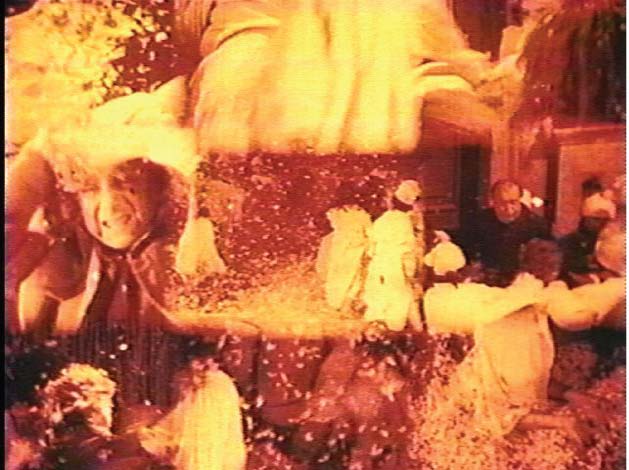
Image 1 Napoleon
Napoleon was the first extensive use of split screen in cinema. One prominent example in the film is when Napoleon is young. He becomes irate when he discovers possible betrayal by a peer and confronts students bed by bed before exclaiming, “Then, you’re all guilty” and engaging in a pillow fight.
Following the break up of the fight, one of his teachers insists that “[Napoleon] will go far. He is made of granite heated in a volcano.” The entire scene of the fight is tinted in red and the image splits from one image to four then to twelve before the fight is broken up. Gance’s use of multiple images creates an allusion to Napoleon’s greatness in the future as a leader and a man without compromise.
This use of multiple images reaches its climax in the last twenty minutes of the film, where it was originally screened as an optical triptych during the final battle, symbolically demonstrating his superior leadership and rise to power.
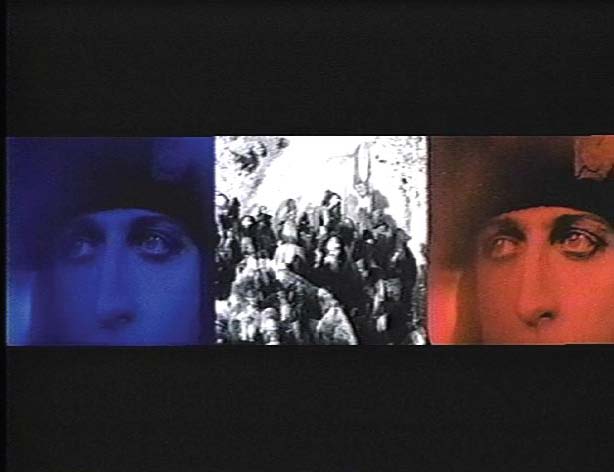
Image 2 Napoleon
Gance’s use of split screen to imply a future prediction plays upon Eisenstein’s analysis of the ideogram. Gance essentially attempts to create a future prediction within the narrative predicated on the audience’s ability to understand the context, and to imply that Napoleon’s rise can be predicted through his actions in youth and as a young officer. What we cannot forget with this initial example is Gance’s attempt to create a spatial relationship between the multiple images on the screen—a vertical Kuleshov experiment if you will.
Manipulation of Space and Time: At Land
Kuleshov’s experiments also presented filmmakers, and in particular editors, with the literacy to create apparent spatial relationships. Beyond the “allusion” to a relationship between two shots, two shots also could share a spatial relationship. This notion not only became a foundation for continuity editing with the advent of sound, but also remained a tenet to experiment with when understanding the assumption that viewers will always seek a spatial relationship between two images. Whether it’s as simple as an eye-line match, a cut from a shot of people looking to what they are looking at even if the next shot exists in a different time and space, to more blatant manipulations of time and space such as seen in Maya Deren’s film At Land.
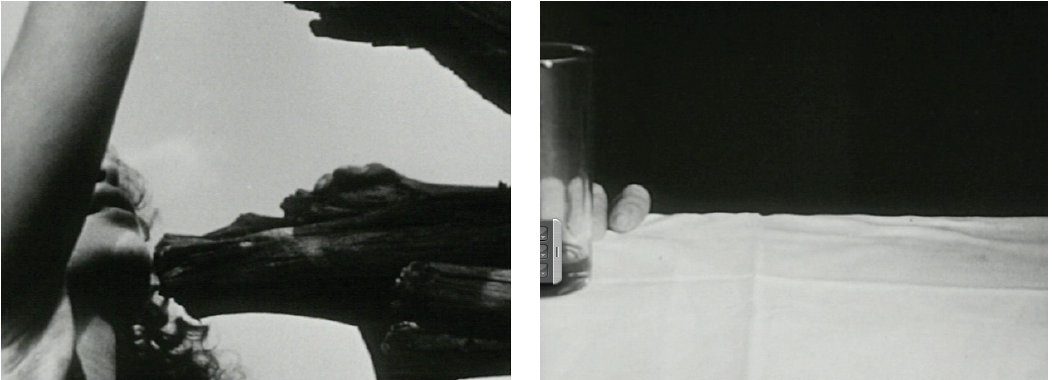
Image 3 At Land
Maya Deren’s work reflects an understanding of how cinematography and editing can manipulate the visual dialectic. She states:
One can film different people at different times and even in different places performing approximately the same gesture or movement, and by a judicious joining of the shots in such a manner as to preserve the continuity of the movement, the action itself becomes the dominant dynamic, which unifies all separateness.
Deren relied on spatial relationships and continuity to break linear progression in At Land. Her character washes ashore and as she climbs up driftwood, she finds herself at the edge of a table and begins to climb across the table, passing seemingly unaware attendees of a dinner party.
As she treks across the table, the film then cuts to her moving through a jungle or forest of sorts, creating a metaphor and commentary on the position of the feminine self. For this discussion, what is notable is that the Kuleshov effect is used to guide both vertical and nonlinear constructions.
Implications of Accidental Vertical Montage
We cannot forget the dialectical aspects of montage that Eisenstein brings up as conflict. Jan Uhde, in his article “Film’s Illusions: Kuleshov Revisited,” discusses the implication of accidental conflicts of montage when examining television and print. Uhde discusses that the Kuleshov effect, while usually used to explain a creative intention, can also occur without premeditation. One of the examples that he cites is a broadcast in the late 1970s of a popular serial, Holocaust. During a commercial break, viewers watched as the segment cut to an oven cleaner commercial with a housewife complaining about the foul smell in her oven. If audiences create a dialectical connection between oven cleaner and that of the holocaust, Uhde concludes that the contextual associations can exist everywhere whether in motion pictures or in static advertisements.
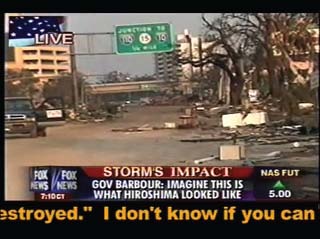
Image 4 Fox News
As a media-maker, I became concerned with the contemporary implications of split screen use in both narratives and news reporting. Viewers can now be exposed to a barrage of information from the news anchor, the lower third headlines and symbols as well as through experts or “in the field reporters” all sharing the same temporal and visual space. In developing the installation, Katrina Deconstructed, I examined the apparent narratives weaved by both news anchors and reporters during the aftermath of the disaster and attempted to push the vertical arrangement further through the medium of an installation. Multiple screens pushed multiple images to further push audiences’ recognition of possible ironic connections in the multiple images. And, like Uhde’s observations, I also became aware of “accidental” Kuleshov effects. For instance, during a report on Fox news about the devastation in New Orleans, a stock market symbol in the lower-third of the screen10 indicated that the stock market is up. Whether audiences noticed the ironic imagery of the improved stock market amidst devastation is difficult to determine, however the possibilities were obvious and ‘indefinite.’
Revisiting Eisenstein’s objective for examining ideograms was to provide a foundation and context for the visual dialectic.11 For as he states in A Dialectic Approach to Film Form, “art is always in conflict.”12 For Eisenstein, the accidental Kuleshov effect in the Katrina footage could just as easily serve as an ironic commentary on the disaster itself, yet with the contemporary twists of a moving dialectic existing simultaneously in the same time and space.
Contemporary Examples Of Vertical Montage
The use of vertical images is now an accepted technique used in both cinema and television. Pillow Book by Peter Greenaway was one of the earlier recent examples of vertical imagery, followed by Vincent Gallo’s Buffalo 66. For this discussion, I will focus on how the use of vertical imagery helps to push and condense the narratives in the films Buffalo 66, Time Code, and 24.
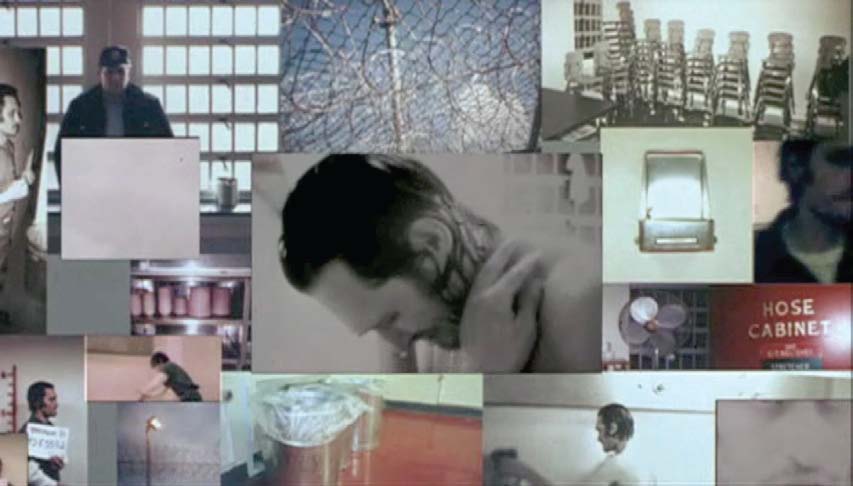
Image 5 Buffalo 66
Buffalo 66
Vincent Gallo’s Buffalo 66 (1998) harks back to older genres, such as the French New Wave, yet creates a critically important example of a contemporary vertical dialectic. He uses multiple images on the screen at the same time to create an overall narrative meaning. After the main character, Billy Brown, is released from jail within the first few minutes of the film, we see his life flash before us through a series of layered images that break traditional cinematic aspect ratios and provide the audience with a barrage of narrative information within the same time and space. The audience quickly understands Billy Brown’s emotional state upon his release from jail and are further provided with a short visual summary of his experiences in jail. This method firmly establishes the context for the narrative conflict, which will enfold through the rest of the narrative. Although this example is eight years old, it demonstrates a more sophisticated contemporary example of superimposition.
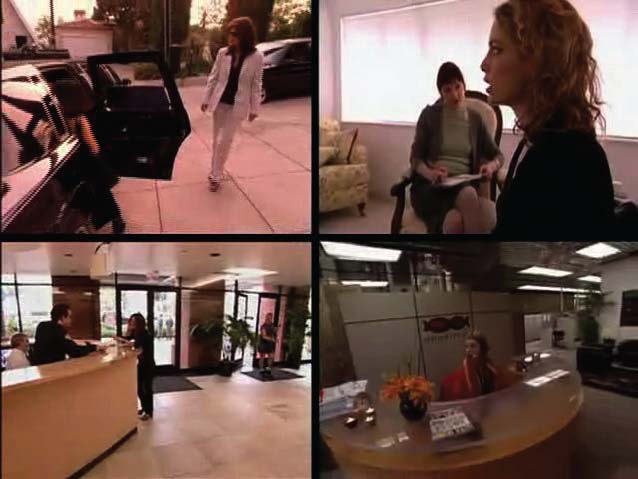
Image 6 Time Code
Time Code
Mike Figgis in 2000 released Time Code, which was shot using digital video cameras and in seemingly real time provided an example of parallel storytelling through the use of parallel split screens. Mike Figgis, similar to silent filmmakers of the past, would mix the audio live during screenings and the audio itself dictated on which quadrant the viewer must focus.
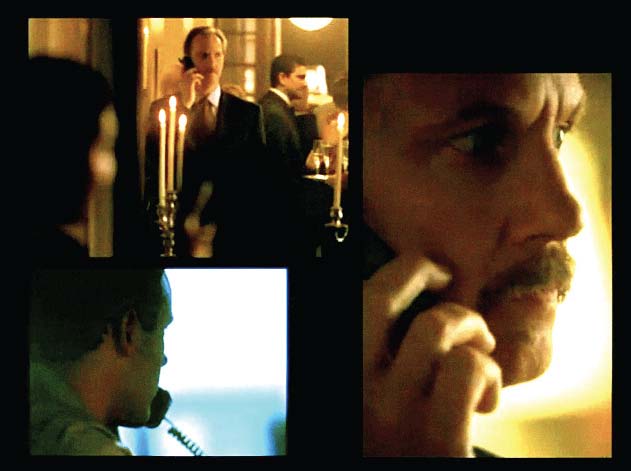
Image 7 24
24
The most mainstream example of split-screen is in the television show 24. Similar to Timecode the show functions in real time and uses the split screen as a device to show simultaneous narrative action.
In fact, the visual style of the typography is almost identical to that of Timecode. However similar to Buffalo 66, the show breaks traditional cinematic aspect ratios through its use of split screen.
Contemporary Nonlinear Storytelling
In looking at previous examples of ‘achronological’ narratives such as Christopher Nolan’s Memento (2000), which used the structure to mirror a the protagonist’s disability and, in a sense, the struggle this character faced in hunting down his wife’s killer despite his inability to store new memories. Christopher Nolan uses shifts from black and white to color to lead the audience between the breaks in chronology. What is interesting is that the film demonstrates that the challenges of editing shifts in chronology versus traditional ‘cross cutting’13 are similar. The editor cannot cut to an image too visually similar when moving to the next scene or the viewer will quickly become confused or disengaged. Nolan globally addresses this problem through his shifts between color and black and white.
In the television series Lost, the entire concept is based on an achronological structure. A plane crashes on a deserted island and we find out about the characters through flashbacks from their lives before the crash. Now, in its third season, the chronological shifts have moved from flashbacks to before the crash, to flashbacks within the days, weeks, and months spent on the island(s) and parallel cuts to different characters’ stories. Although such an extensive use of nonlinear structure was groundbreaking for television, Lost still depends on traditional transitions to direct the viewers through the breaks temporal continuity. Heavy sound effects cue the transition from one point of time to another as well as utilizing the commercial breaks. Yet the ‘achronological’ structure enables the narrative to continue to expand and rewrite itself from episode to episode through providing the viewer with additional information.
I wrote the short film AWOL, about an African American soldier who for inexplicable reasons deserts her company in the desert and finds herself saved by a Bedouin family. In AWOL, I wanted to use an achronological structure to mirror the psychological state of Keisha, an American soldier who is dehydrated, confused, and lost. We are unclear when her experiences have occurred or whether they have occurred at all. The structure intimately reflects her psychological state and breaks traditional objective narrative storytelling. The film breaks time and space to become closer to the character’s experience within the constructs of a fictional narrative. The approach however remains rooted in traditional working methods. The transitions in achronology serve as narrative dialectics and the clash creates an emotional and political message, which enables the personal experience of a soldier to become a subtle political message and further demonstrates the indefinite possibilities of syntax.
Conclusion
Audiences are now actively exposed to a new evolution in our understanding of film language. The use of achronology and simultaneous dialectics formed through vertical or spatial montage push the ‘indefinite’ syntax of film language. At this moment in time, conventional devices still drive or serve to motivate the vertical and nonlinear structures. However, like the transformation into the digital age, which Manovich compares to the Velvet Revolution, we are at a precipice of sorts. We are at a new phase in a dialectical transformation for media-makers to further exploit whether through interactive storytelling made possible through mobile phones, web, and multiple running streams in Blu-Ray DVDs, or through more traditional media such as television and cinema.
Footnotes
- Christian Metz, “Some Points in the Semiotics of Cinema,” in Film Language: A Semiotics of the Cinema, 3rd ed., ed. Michael Taylor, (Chicago: Oxford University Press Inc, 1991), 100.
- Walter Murch, In the Blink of an Eye: A Perspective on Film Editing, 1st ed., (Los Angeles: Silman-James Press, 1995), 130.
- Lev Manovich, The Language of New Media, 1st ed., (Cambridge: MIT Press, 2001), 325.
- Andre Bazin, “The Evolution of the Language of Cinema,” in What Is Cinema? 5th ed., ed. Hughes Gray, (Berkley Los Angeles and London: University of California press, 1967), 24.
- Andre Bazin, “The Evolution of the Language of Cinema,” in What is Cinema? 5th ed., ed. Hughes Gray, (Berkley Los Angeles and London: University of California press, 1967), 26.
- Sergei Eisenstein, “The Cinematographic Principle and the Ideogram,” in Film Form, 1st ed., ed. Jay Leda, (New York: Harcourt, Brace & World, Inc, 1949), 29.
- Ibid., 34.
- Maya Deren, “Cinematography: The Creative Use of Reality,” in The Art of Cinema, 2nd ed., ed George Amberg, (New York: Arno Press & the New York Times, 1972), 169.
- Jan Uhde, Film’s Illusions: Kuleshov Revisted, Kinema, Fall 1995. http://www.kinema.uwaterloo.ca/ju-952.htm. (February 3, 2007)
- A lower third graphic or symbol is placed at the bottom of the television screen and is typically used in newscast to provide the viewer with up to the second news and information.
- Visual dialectic can be defined as two images or shot, which appear unrelated until edited together.
- Sergei Eisenstein, “The Dramaturgy of Film Form,” in Writings, 1922-1934, 1st ed., ed. Richard Taylor, (Bloomington and Indianapolis: Indiana University Press, 1988), 161.
- Also known as parallel editing.
Bibliography
Bazin, Andre. “The Evolution of the Language of Cinema.” In What Is Cinema?. 5th ed. Edited by Hughes Gray. Berkley Los Angeles and London: University of California press, 1967.
Deren, Maya. “Cinematography: the Creative Use of Reality.” In The Art of Cinema. 2nd ed. Edited by George Amberg. New York: Arno Press & the New York Times, 1972.
Eisenstein, Sergei. “The Cinematographic Principle and the Ideogram.” In Film Form. 1st ed. Edited by Jay Leda. New York: Harcourt, Brace & World, Inc, 1949.
—. “The Dramaturgy of Film Form.” In Writings, 1922-1934. 1st ed. Edited by Richard Taylor. Bloomington and Indianapolis: Indiana University Press, 1988.
Metz, Christian. “Some Points in the Semiotics of Cinema.” In Film Language: A Semiotics of the Cinema. 3rd ed. Edited by Michael Taylor. Chicago: Oxford University Press Inc, 1991.
Manovich, Lev. The Language of New Media. 1st ed. Cambridge: MIT Press, 2001.
Murch, Walter. In the Blink of an Eye: a Perspective on Film Editing. 1st ed. Los Angeles: Silman-James Press, 1995.
Uhde, Jan. Film’s Illusions: Kuleshov Revisted. Kinema. Fall 2005. http://www.kinema.uwaterloo.ca/ju-952.htm. (February 3, 2007).
Article Authors
Brigid Maher
Brigid Maher is an associate professor in the School of Communication at American University where she is the Associate Division Director for the Film and Media Arts Division and Program Director for Digital Media Skills Graduate Certificate. She is also a film and new media-maker and her work is shown internationally in conferences and festivals. Brigid Maher is a full-time professor of Film and Media Arts. She is a filmmaker and writer who heads the Emerging Media concentration in SOC’s Film and Media Arts Division. Her scholarly writing focuses on the interplay between traditional film and new media theories. Her award-winning narrative and documentary films have shown in festivals in the U.S. and abroad. Her latest documentary, Veiled Voices, focuses on the phenomenon of Muslim women religious leaders in Islam. Veiled Voices is distributed by Typecast Releasing in the United States and has screened on over 150 public television stations and three national networks. Al Jazeera Network recently acquired the film for broadcast in the Middle East and North Africa. The film has additional international distribution through TVF International and has screened in numerous international festivals in the United States and abroad. Maher won a Fulbright Senior Award to teach broadcast media in Lebanon in the spring of 2005. She teaches digital media and editing courses for SOC. Brigid's degrees include a BA in Philosophy/International Affairs with a minor in Cinema Studies from Colorado College; and a MFA in Radio/Television/Film Department, Northwestern University.