
V4N2: Teaching Creative Collaboration through Teams: Concept, Communication, and Conflict in Team Instruction
By John S. Dahlberg, Ben Dunkle | July 18, 2013
Students and practitioners of the creative process demonstrate Guilford’s assertion that we all have creative potential; however we develop that potential in very different ways. Artists, poets, and composers variously create. Yet, their creations are not always accessible or understandable. For instance, in February 2005, Central Park in New York City was adorned or cluttered (depending on your perspective) with hundreds of gates wrapped in saffron colored fabric and bearing flowing saffron panels. Some found these bright and beautiful, while others found them an eyesore. The artist Christo, who created the panels, was unapologetic. He was satisfied with his work and that was reward enough. Were these gates artistic? Were they creative? Maybe.
Creativity has been described as both novelty and usefulness; effective surprise; as recognized and endorsed by society, and simultaneously original and appropriate. It seems that one of the goals of any creator is to make known a surprising and original concept that is meaningful not only to the creator but also to a targeted group of others. Clearly, that creative process involves effective communication between the creator and an audience.
However, of greater interest to the authors of this paper is the communication between creators working together in collaboration. How do individuals combine to create effective communication through their conjoined and creative efforts? Some research has suggested that varying cognitive processes and associative, divergent thinking foster creativity. Others have found a multidimensional aspect to the development of creativity fostered by cognitive, social, family, societal, and historical factors that can affect both individuals and individuals in a group context. Smith and Amnér recognized the impact of one sense or media on another; e.g., a poem might inspire a painting. Jock Abra wrote about “horizontal” vs. “hierarchical” manifestations of collaboration. Collaboration between writers and designers may be a manifestation of these kinds of phenomena, with each team member representing a critical element in a dynamic relationship. These seeming conflicts and diverse perspectives may enhance the creative product, providing new associations and multiple ideas and concepts that lead to more original ideas.10
Today, organizations often look beyond the individual for a creative result and research has affirmed the value of working in creative teams11 and supports the notion that creative ability and production can be and have been enhanced by certain kinds of teamwork and creative collaboration.12
Beyond the research validating creative productivity through teamwork, there is a longstanding precedent for creative collaboration based on the team approach embraced by advertising and marketing communication companies around the world. Advertising agencies assign work to a team of creative people because communication end products (such as ads, commercials, brochures, web pages, etc.) require both a written component and a design component. Since the early days of advertising, those components and concomitant roles have always been considered separate yet interdependent.13 The model of a team consisting of a writer and an art director/designer was initiated by advertising legend Bill Bernbach, back in the early 1960’s and has been an industry standard ever since.14In fact, the contemporary trend in Europe is to hire only creative teams, rather than creative individuals. These teams consist of an art director and a writer. Industry watchers have noted, for example, that 90% of the creative staffs of London agencies have been hired as teams.15
Despite this reliance on creative teamwork, Abra found that with only a few exceptions and anecdotal mentions, creative collaboration, including creative collaboration in the advertising field, has received little scholarly attention.16 Additional research needs to be completed to understand better the differences in the creative thought process between copywriters and designers. The fact that this model is so common in the advertising workplace, coupled with the apparent lack of curriculum addressing this dynamic, demonstrates a clear need for an emergent genre of course offerings. This genre should extend beyond simply organizing students into teams, into actively pairing student writers and student designers. Furthermore, there may be additional dimensions or factors that may work better than others in determining the best way to assign team members. With this in mind, the authors created an experimental classroom situation that allowed for advanced design students and advertising writing students to work together to complete two major projects. Writers would be exposed to the visual insights of designers. They would see, first-hand, how graphics can enhance and control a message. Designers would experience some of the thought processes of writers. Writers generally help craft the creative platform and meld it into positioning statements, concepts, headlines, and copy. Here, in this classroom, the designers would be able to watch that process evolve. This purpose led to our first hypothesis:
Hypothesis 1 (H1): Students will come to understand the different contributions of the writer and designer in a collaborative creative project.
This study was an opportunity to convene a series of teams that might not always avoid conflict, but would come away with a more original creative product. On a practical level, these teams would replicate the creative and collaborative process found in marketing communication companies around the world, one that many of them will need to deal with as they begin their careers. We wondered if the creative interaction and ultimate product would be perceived as better because of the team involvement. Hence:
Hypothesis 2 (H2): Students will find the creative collaborative process will positively affect a creative effort/product.
Much in the authors’ previous experience, as well as reports in the literature (above) suggested that creative minds may collide and disagree. The authors wanted to learn how team members might interact, in the midst of disagreement. Would this atmosphere affect the level of communication and would it have a positive or negative effect? Therefore:
Hypothesis 3 (H3): The communication between and among team members, although occasionally bumpy, will lead toward an improved collaborative environment.
Method
The authors began the process of developing a model for this curriculum. Based on the typical advertising agency paradigm of collaborative creative teams constructed of a writer and a designer/art director, two undergraduate creative classes, offered at a small Northeastern college, were offered at the same time and on the same days. One class was an advertising writing/copywriting class; the other was an advanced digital design class. This model was repeated so that two sections of the writing course were offered and paired with two sections of the design course. An overwhelming number of the students in each of the classes came to these projects with previous coursework and background in the advertising/design process. Nonetheless, both courses reinforced foundational instruction in the advertising and creative conceptual process. Both instructors had previous significant practical experience in the collaborative creative process and brought their own previous creative, conceptual, and agency experience to the courses.
This pedagogical model allowed instructors to spend separate instructional time on either writing or design skills, with subsequent related work on advertising concept and collaboration. In addition, this model provided the opportunity for collaborative sessions and joint creative projects. Formal skills instruction composed nearly 60% of the classes, with about 40% of the time devoted to group and collaborative work. Students worked outside the class as needed. Enrollment in the classes varied. The total number of students in writing section A consisted of 22 students; the accompanying design section A had an enrollment of 11, allowing for creative teams of three (one designer and two writers). For the second pair of classes, enrollment for the writing section B numbered 18 and the accompanying design section B numbered 12. In all cases, each student had an opportunity to work in a team of three at least once.
It should be noted that throughout each of these teamed courses, there were more writers than designers. That brought about a theoretical and practical dilemma: Who does what? Can two writers overwhelm a designer? Should only two be on the team? Kirton stressed the role of the “bridger” in teamwork; this is a person who might fall in the middle of any team’s range of creative styles. Kirton17 suggested this person could “translate” the ideas of team members with different styles.18 During this study, the instructors had one member would act as a “bridger” to help facilitate a three-person team.
There were two major collaborative projects assigned during the semester. Students were assigned to a team for the first project and then were shuffled into different teams for the second assignment. The instructors set up teams based on their knowledge of student skill levels, attitude, aptitude, and projected productivity. Broadly speaking, teams were constructed with the hope for optimal success within teams and across the classes. This process was done much as teams in agencies are developed, from an admittedly subjective yet experienced creative management viewpoint. Instructors offered personal insights into the collaborative process and specific expectations for each project.
The first assignment was a print and point-of-purchase campaign for a fictitious snack or dessert food company. The second was an electronic web/email campaign for a cellular phone service. Teams were asked to collaborate on the marketing/creative strategy, creative concepts, and finished executions, based on real-world situations where the creative team is often largely responsible for creative platform, concepts, and executions. The writers were then responsible for finished copy platform, headlines, and full body copy. Designers were responsible for design and finished print layouts, web-based banner ads, and rich e-mails. Throughout the group sessions, both instructors floated and worked directly with teams to facilitate the collaborative effort, operating as creative directors would function in the advertising agency environment. At the conclusion of each project, teams presented their creative solutions to the class. Although the process encouraged a collaborative environment, the majority of the grade emphasis was on the contributions of the individual. The team received a grade that was equal to about a third of the individual student’s total grade. This was one deviation from the traditional team model found in advertising agencies, where you succeed or fail as a team.
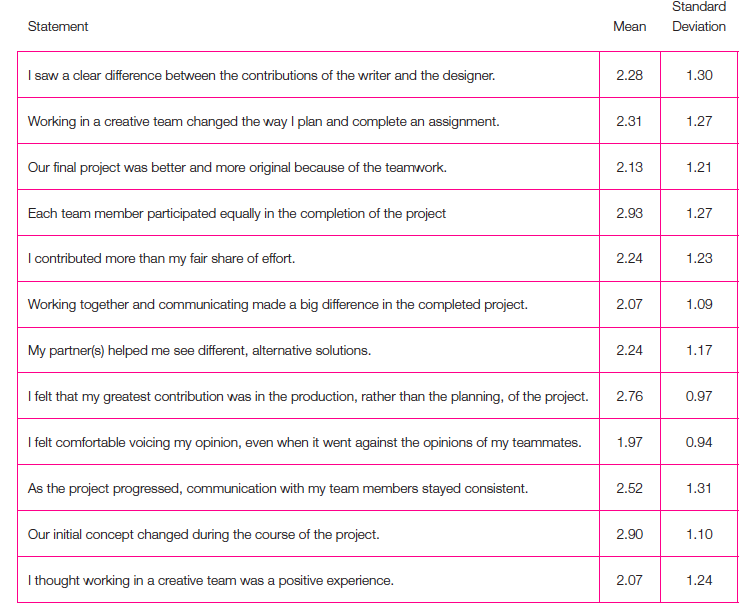
Table 1 Responses to Creative Team Interactions Note: 1=Strongly agree and 5=Strongly disagree
During presentations, students were asked to describe their concept and present their finished work (in PDF or html format on screen, or on mounted boards for print). Teams generally shared the presentation of explaining the process and approach, including discussion of conceptual issues. Only when there were specific questions about word choice or production or layout issues, did one’s role as writer or designer become apparent. Critiques ensued, with team members answering questions and responding to observations from their instructors and classmates.
A series of survey questions was generated and administered after the classes had ended. The survey consisted of 12 questions, employing a 5-point Likert scale (1 being strongly agree to 5 strongly disagree). The intent of the survey was to gather data about the students’ perceptions of the collaboration, the quality of the subsequent work, and their communication and contributions during the project.
Results
Both classes were asked to volunteer responses to surveys for each of the projects. Results were gathered from 29 students completing surveys for both of their different project teams, yielding a sample response of 58 (N=58, four surveys were not returned).
As far as the process and their perceptions of the collaboration, data indicated that students did perceive a difference between the contributions of the writer and designer with a mean of 2.28 (M = 2.28), felt their partner(s) helped them see alternative solutions (M = 2.24), and the experience changed the way individual members plan and complete an assignment (M =2.31). Respondents disagreed that they just executed/produced the work (M = 2.76), lending credibility to the idea that the team was involved in the planning and concept, throughout. These responses led us to accept H1.
According to survey results, students felt the work was better and more original (M = 2.13), working together and communicating made a difference in the completed project (M = 2.07); however, respondents slightly disagreed that the concept changed during the process (M = 2.90). This last result didn’t affect the conclusion that students found their ideas were better for the process, and H2 was accepted.
Finally, the communication wasn’t always smooth. Conflict did arise, but respondents strongly agreed that they were comfortable voicing an opinion, even if it went against the opinions of the team (M = 1.97). Respondents were neutral on the issue of whether communication stayed consistent throughout the project (M = 2.52). Those surveyed felt that working in a creative team was a positive experience (M = 2.07). With that in mind, H3 was accepted.
In an effort to assess work contributions, two additional questions asked about individual effort, within the team. Responses were slightly negative about whether all members participated equally (M =2.93), and individuals agreed that he or she contributed more than their fair share to the project (M = 2.24).
Discussion
The sample for this study is admittedly small, but large enough to offer useful results. From this limited data, individuals participating in this study reported (in survey question #1) that they found clear differences between the contributions of writers and designers, and that experience affected the way they would plan and implement a project(survey questions #2 and #3). Clearly, then, the varied perspectives altered the dynamic in these teams, and team members saw new alternatives through the interaction of the team. Creativity often results when initially intended processes go awry and unpredictable results are achieved.19 The survey asked, “Did the initial concept change during the course of the project?” The answers were mixed in addressing this phenomenon and showed that there was slight disagreement that the creative concept changed during the interaction, but little doubt other team members brought forth good alternative ideas and that the process resulted in a better and more original product. That result also addresses the importance for the ability to recognize superior ideas in team members as a basis for effective creativity.20
The majority of the teams indicated that they found value in the collaborative process. Conflict did arise, but it didn’t seem to collapse the process. As was suggested by Kurtzberg and Amabile, conflict is not necessarily a negative factor in the process.21 Some personality issues arose, and that is unfortunately not always avoidable in any team process. Still, students felt comfortable voicing contrary opinions, and that may have contributed to a better and more original product. Part of the disparity may come simply because the skills training for writing for advertising doesn’t always involve a design element and design skills training doesn’t directly involve a writing component. Radio scripts and logo design are perfect examples. Second, although students were encouraged to collaborate, more direct instruction on the value and the process of creative collaboration should be incorporated, not only at the beginning of the courses, but throughout. Much of this was done on an informal basis, with interaction between one or both of the instructors and individual teams. Finally, since students from one class were not penalized for a lack of effort or skill in the other, there was a possibility that some team members simply felt obliged to ignore the contributions of others. A student’s grade was contingent largely on what he or she developed, so some might not have felt they had to accept the input of others. Future classes may have more of the grade determined by the collaborative product.
Conclusion
Much can be learned by further investigating relationships between professional writers and designers. Understanding why certain kinds of writers work best with certain kinds of designers will prove valuable in assigning teams. Common work habits and behavior patterns that become evident upon further research can be implemented in the classroom. Previous studies on team creativity may offer other suggestions for assigning teams. For example, teams consisting of students with divergent backgrounds may produce better work.22 The presence and defense of multiple viewpoints among group members serves to make conflict productive for creative outcomes.23 An application of these hypotheses to this team learning approach could include an early-semester survey asking students to describe their backgrounds, skills, and interests; team assignments could be based on those results.
This study and preliminary model will certainly improve and evolve as the classes are conjoined in the future. At the very least, students left this experience with a clearer idea of the contributions of others in the process. They showed an appreciation of the value of others’ skills in the preparation of commercial communication pieces. Though some reported that the team creative process, with divergent personalities, led to conflict they found harmful to the project, most left this having had a positive experience. Future studies may want also to compare responses between writers and designers. Our goal will be to follow this study with subsequent collaborative classroom replications, and larger sample sizes, in order to better understand and improve this model.
Footnotes
- Joy Paul Guilford, “Creativity,” American Psychologist 5 no. 9 (1950): 444-54.
- Raymond S. Nickerson, “Enhancing Creativity.” In Handbook of Creativity, ed. Robert J. Steinberg, 392-430 (New York: Cambridge University Press, 1999).
- Edward Necka, “Creative Interaction: A Conceptual Schema for the Process of Producing Ideas and Judging the Outcomes.” In Critical Creative Processes, ed. Mark A. Runco (Cresskill, NJ: Hampton Press, 2003).
- Jerome Bruner, On Knowing: Essays for the Left Hand, (Cambridge: Harvard University Press, 1962).
- Mihaly Csikszentmihalyi, “Society, Culture, Person: A Systems View of Creativity.” In The Nature of Creativity, ed.Robert J. Sternberg. 325-339 (New York: Cambridge University Press, 1988); Arthur J.Cropley, “Fostering Creativity in the Classroom: General Principles.” In The Creativity Research Handbook, ed. Mark A. Runco. 83 - 114 (Cresskill, N.J.: Hampton Press,1997).
- Robert J. Sternberg & Todd I. Lubart, “Investing in Creativity,” Psychological Inquiry 4, no. 3 (1993): 229-232.
- David Henry Feldman, “The Development of Creativity,” In Handbook of Creativity, ed. Robert J. Steinberg, 169-186 (New York: Cambridge University Press, 1999); Mihaly Csikszentmihalyi, “Society, Culture, Person: A Systems View of Creativity.” In Nature of Creativity, 325-339.
- Gudmund J.W. Smith and Gunilla Amner, “Creativity and Perception.” In Creativity Research Handbook. Edited by Mark A. Runco. (Cresskill, New Jersey: Hampton Press, 1997): 62-82.
- Jock Abra, “Collaboration in Creative Work: An Initiative for Investigation,” Creativity Research Journal 7, no. 1 (1994): 1-20.
- Terri R. Kurtzberg, and Teresa M. Amabile, “From Guilford to Creative Synergy: Opening the Black Box of Team-Level Creativity,” Creativity Research Journal 13, no. 3/4 (2000): 285-294.
- Gita V. Johar, Morris B. Holbrook & Barbara B. Stern, “The Role of Myth in Creative Advertising Design: Theory, Process and Outcome,” Journal of Advertising 30, no. 2 (2001): 1-25; Cele Otnes, Arlo A. Oviatt and Deborah M. Treise, “Views on Advertising Curricula from Experienced ‘Creatives.’” Journalism Educator (2005): 21-30.
- Howard E. Gruber and Doris B. Wallace, “The Case Study Method and Evolving Systems Approach for Understanding Unique Creative People at Work.” In Handbook, 93-115; Paul B. Paulus, “Teams, Groups and Creativity: The Creative Potential of Idea-Generating Groups,” Applied Psychology: An International Review 49, no. 2 (2000): 237-262.
- Bruce Bendinger, Advertising and the Business of Brands. (Chicago: The Copy Workshop, 2004).
- Jerry Della Famina, From Those Wonderful Folks Who Brought You Pearl Harbor. (New York: Simon & Schuster, 1988); Charles E. Young, “Creative Differences Between Copywriters and Art Directors,” Journal of Advertising Research 40, no. 3 (2000):19-26.
- Edward White, “To Make Your Pitch at U.K. Ad Agencies, You’ll Need a Partner.” The Wall Street Journal, September 3, 2004.
- Abra, “Collaboration.”
- Michael Kirton, Adaptors and Innovators: Styles of Creativity and Problem-Solving. (New York: Routledge:1989).
- Kurzberg and Amabile, “From Guilford.”
- Necka, “Creative Interaction.”
- Abra, “Collaboration.”
- Kurtzberg and Amabile, “From Guilford.”
- Charlan J.Nemeth, “Dissent as Driving Cognition, Attitudes, and Judgments,” Social Cognition 13 (1995): 273–291.
- Kurtzberg and Amabile, “From Guilford.”
Works Cited
Abra, Jock. “Collaboration in Creative Work: An Initiative for Investigation,” Creativity Research Journal 7, no. 1 (1994):1 – 20.
Amabile, Teresa M. Creativity in Context. Boulder, CO: Westview Press, 1996.
Bendinger, Bruce. Advertising and the Business of Brands. Chicago: The Copy Workshop, 2004.
Bruner, Jerome. On Knowing: Essays for the Left Hand. Cambridge: Harvard University Press, 1962.
Cropley, Arthur J. “Fostering Creativity in the Classroom: General Principles.” In The Creativity Research Handbook. Edited by Mark A. Runco. Cresskill, N.J.:Hampton Press ,1997.
Csikszentmihalyi, Mihaly. “Society, Culture, Person: A Systems View of Creativity.” In The Nature of Creativity. Edited by Robert J. Sternberg. New York: Cambridge University Press, 1988.
Della Famina, Jerry. From Those Wonderful Folks Who Brought You Pearl Harbor. New York: Simon & Schuster, 1988.
Dollinger, Stephen J., Urban, Klaus K., & James, Troy A. “Creativity and Openness: Further Validation of Two Creative Product Measures.” Creativity Research Journal 16, no. 1 (2004):35-47.
Feldman, David Henry. “The Development of Creativity,” In Handbook of Creativity. Edited by Robert J. Sternberg. New York: Cambridge University Press, 1999.
Gruber, Howard E. and Wallace, Doris B. “The Case Study Method and Evolving Systems Approach for Understanding Unique Creative People at Work.” In Handbook of Creativity. Edited by Robert J. Sternberg. New York: Cambridge University Press, 1999.
Guilford, Joy P., “Creativity,” American Psychologist 5, no. 9 (1950):444-54.
Hirschman, Elizabeth C., “Role-Based Models of Advertising Creation and Production,” Journal of Advertising 18, no. 4 (1989): 42-53.
Johar, Gita V., Holbrook, Morris B., & Stern, Barbara B. “The Role of Myth in Creative Advertising Design: Theory, Process and Outcome,” Journal of Advertising 30, no. 2 (2001): 1-25.
Kirton, Michael. Adaptors and Innovators: Styles of Creativity and Problem-Solving. New York: Routledge,1989.
Koslow, Scott, Sasser, Sheila L. and Riordan, Edward A. “What Is Creative to Whom and Why? Perceptions in Advertising Agencies,” Journal of Advertising Research 43 no. 2 (2003):96-110.
Kurtzberg, Terri R. and Amabile, Teresa M., “From Guilford To Creative Synergy: Opening the Black Box of Team-Level Creativity,” Creativity Research Journal 13 no. 3/4 (2000): 285-294.
Necka, Edward. “Creative Interaction: A Conceptual Schema for the Process of Producing Ideas and Judging the Outcomes.” Critical Creative Processes, Edited by Mark A. Runco. Hampton Press, USA, 2003.
Nemeth, Charlan J., “Dissent as Driving Cognition, Attitudes, and Judgments,” Social Cognition 13 (1995): 273–291.
Nickerson, Raymond S. “Enhancing Creativity.” In Handbook of Creativity. Edited by Robert J. Steinberg. New York: Cambridge University Press, 1999.
Otnes, Cele, Oviatt, Arlo A. and Treise, Deborah M., “Views on Advertising Curricula from Experienced ‘Creatives.’” Journalism Educator (2005): 21-30.
Paulus, Paul B. “Teams, Groups and Creativity: The Creative Potential of Idea-Generating Groups,” Applied Psychology: An International Review 49, no. 2 (2000): 237-262. Runco, Mark A. & Charles, Robyn E. “Judgments of Originality and Appropriateness as Predictors of Creativity,” Personality and Individual Differences 15, no. 5 (2003): 537-546.
Runco, Mark A. & Charles, Robyn E. “Developmental Trends in Creative Potential and Creative Performance.” In The Creativity Research Handbook. Edited by Mark A.
Runco. Cresskill, New Jersey: Hampton Press, 1997.
Smith, Gudmund J.W. & Amner, Gunilla. “Creativity and Perception. In The Creativity Research Handbook. Edited by Mark A. Runco. Cresskill, New Jersey: Hampton Press, 1997.
Sternberg, Robert J. & Lubart, Todd I., “Investing in Creativity,” Psychological Inquiry 4 no. 3 (1993): 229 – 232.
White, Edward. “To Make Your Pitch at U.K. Ad Agencies, You’ll Need a Partner.” The Wall Street Journal, September 3, 2004.
Young, Charles E. “Creative Differences Between Copywriters and Art Directors,” Journal of Advertising Research 40, no. 3 (2000):19-26.