
V4N2: Exembellishment: Using the eXtensible Markup Language as a Tool for Storytelling
By Natalie Underberg, Rudy McDaniel | July 18, 2013
Background: XML and DTDs
Metadata is data about data, or descriptive data that is intended to describe or represent preexisting data from another source. Such data does not need to be visible to the user; in fact, metadata is often invisible and works behind the scenes in much the same fashion as hypertext markup language, or HTML. XML is one such metadata classification system that is derived from SGML (the same parent language of HTML) and is intended to eventually replace the HTML 4+ specification as XHTML 1.0. It is no surprise that the next generation Semantic Web is being created based on the foundational elements of XML. Using XML as a metadata system on the Internet can lead to more relevant searches and substantially improved online experiences for a user.
For example, an online recipe database can be annotated with metadata in order to differentiate between text describing ingredients (e.g., apples, cinnamon, and butter) and text describing necessary preparatory procedures (e.g., mixing the ingredients and preheating the oven). Such differentiation allows for a more meaningful interaction between a computer and a human; for instance, a person searching for an apple pie recipe on the Internet can fine-tune their search query based on their reason for searching. If this person were heading to the grocery store to buy necessary food items, they could use metadata to determine which ingredients to purchase. If this person were actually baking the pie, they might instead choose to access additional information that reveals different methods for creating the latticework for the crust. Rather than simply performing a search for matching keywords, a search engine would be able to perform the additional task of seeking out content based on semantic anchors. This process involves looking for examples of the usage of the words in the context in which they were originally intended.
An example recipe can be represented using XML in the following fashion (though the authors take no responsibility for the inedibility of any product produced using this recipe) (See figure 1).
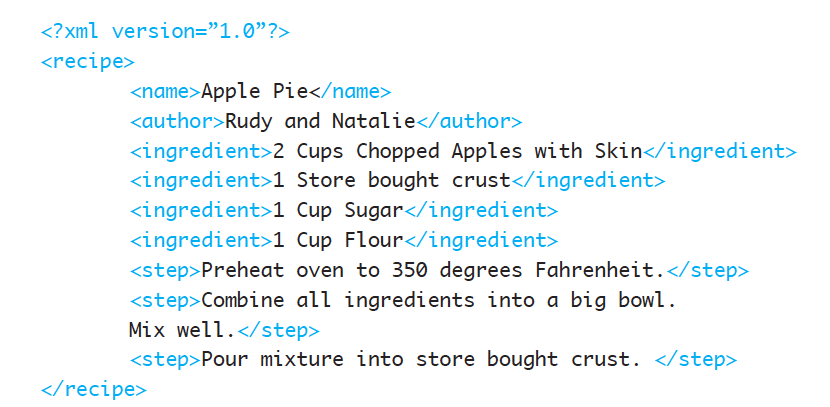
Figure 1 Recipe
While using XML to create organized recipes to store on the Internet is already more useful than simply marking up the recipes in HTML, an additional level of usefulness can be attained by enforcing the structure of the XML recipes using a document type definition (DTD). XML is generally assessed based on two metrics: well-formedness and validity. Well-formedness refers to the syntactical correctness of the XML code (e.g., the proper XML syntax for a nonpaired, empty tag such as the break tag would be <br /> rather than the HTML version of <br>). DTDs allow a developer of markup content to ensure that future information patterned on the developer’s template is also valid, or that it adheres to the original specifications of the author’s template. In other words, if an online recipe administrator determines that all recipes should include at least three ingredients and at least three steps, this information can be included within a DTD that specifies how any new recipes seeking inclusion in the collection should be constructed.
Constructing a document type definition for our XML recipe above might add the following information to the header of our XML document:
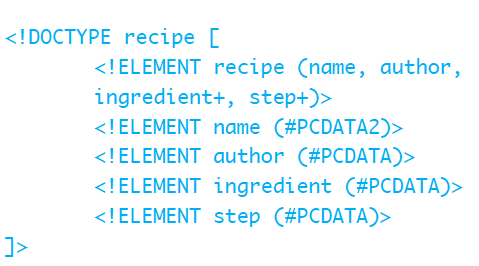
Figure 2 Header
Using this particular document type definition, then, would enforce a recipe model in which all recipes must include one name and one author. In addition, the plus symbol appended to the ingredient and step elements ensures that each recipe contains one or more ingredients and one or more steps, which reflect actions required by the user in order to prepare the food. Additional conditions can be used to enforce a variety of flexible XML patterns; these pattern-building symbols are available within the syntax of the language.
Why Use Metadata for Stories?
In addition to baking apple pies, many humans also enjoy telling stories. In fact, storytelling is often a critical tool for an individual who hopes to build new knowledge in an unfamiliar field or who has a desire to share unfamiliar experiences with audiences from different backgrounds and with different life experiences. One of the lovely things about stories is their somewhat predictable structure; stories from the fairy tales told to children to the occupational “war-stories” traded by Xerox technicians have all been found to have predictable elements and story structures. Indeed, literary theorists such as Mieke Bal wrote entire books defining the essential components of narrative and discussing the various aspects and elements of different types of stories. Others compiled similar types of narratives into databases such as Aarne’s tale-type index, developed in 1910, which was later extended by folk-tale scholar Stith Thompson and recreated as the Aarne-Thompson system of classification.
While the precise definition of story itself can be debated, for the purposes of this paper we define a story to be an expression (whether written, oral, or multimodal) of a central character’s experiences. These experiences recount the overcoming of some obstacle within some environment during some period of time, along with the causal experiences and relationships associated with this struggle. Such a definition is more precise than the Aristotelian notion of all stories having a beginning, middle, and end, but is not so precise that it excludes certain forms of expression that do not meet certain criteria (e.g., a given number of characters must be present, or a specific type of event-chain must be observable). In this paper, we use the terms “narrative” and “story” interchangeably, though we recognize such a distinction could be problematic in more precise instances of literary classification.
Combining XML with the narrative form can yield interesting and useful applications of different varieties. For example, a system for storing and disseminating forms of tacit knowledge collected from distributed organizations has been prototyped using the Hypertext Preprocessing (PHP) scripting language and XML. In addition, XML has been combined with storytelling in distributed team training environments in order to facilitate the access and retrieval of debriefing information.10 Further questions for considering the juxtaposition of team training and narrative are also being discussed in various interdisciplinary contexts.11
Our goal then, in combining XML with story, is to create a system capable of fostering more unique and innovative interactions between human and computer agents. Using the formulaic and predictable elements of plot structure and traditional story arcs, we can both suggest XML and DTD based scripts for soliciting stories from audiences who may be unfamiliar with narrative theory (thereby gaining usable stories on any given subject) and we can compare and contrast new stories to any set of preexisting stories that are stored in an online database.
Disambiguated text is another central benefit of using XML with story. Phrases with semantic ambiguity, such as the famous sentence “No fruit flies like a banana,” can be clarified if wrapped with appropriate XML tags. For instance, if we were to devise a <protagonist> XML tag, and if that tag were to be used in a story about heroic fruit flies and their inherent dislike for the yellow fruit, it is clear that the text is referring to the appetite of flies rather than the aerodynamics of fruit. While this is a simplistic example, the disambiguity factor of XML is another useful characteristic of the language for dealing with stories of greater logical complexity. In this sense, XML is useful as a secondary grammar of sorts for content stored on the Internet.
If nothing else, a narrative XML system allows a user to execute a more precise search over records containing narrative data. For example, a user navigating stories in plaintext might want to search for all stories containing the words “apple pie” somewhere within the text. With an XML-encoded story, though, a user would not only be able to query for a keyword match, but they could also access stories that were written only about baking apple pies, about selling apple pies, or about eating apple pies. In this context, a carefully devised set of XML tags could do much to assist users with specialized searches. Even a simple <event> XML tag might be used to relate important events within a story of this type; it is easy for a digital media system to perform smart searches when <event>character bakes an apple pie</event>, <event>character sells an apple pie</event>, and <event>character eats an apple pie</event> are all stored as encapsulated units. Additional tags can also be used to store meaningful associated labels that provide additional contextual information related to these words.
We propose the term “exembellishment,” then, in order to describe an evocative use of XML to describe digitized story content in a meaningful fashion. Note that this description must be done in a meaningful fashion; a simple use of XML to describe proprietary or functional software requirements like preferred resolution and browser compatibility would not necessarily constitute exembellished content.
What We Can Learn from Folkloristics
Narrative’s predictability is what makes this form of expression so well-suited for a metadata framework. Much information about the possible types of stories and their repeating structures can be obtained from the field of folkloristics. Fieldworkers in this discipline use the term normalform to describe the essential framework for a given type of folklore artifact.12 For example, a typical fairy tale from Eastern Germany would have a different normalform than a Native American tale about the trickster archetype.13
For many years, folklorists focused primarily on traditional narratives such as the European magic (or fairy) tale, but in recent decades, they have turned more attention to the personal narrative.14 Folklorists, trained as they are in identifying patterns and formulaic elements in traditional stories, have found these same repeated elements in seemingly structure-less or loosely structured genres such as the personal narrative.
In order to apply our prototype system of XML tags to a narrative collection, we chose to work with a series of vocation narratives (stories of a calling to the religious life) collected over a period of several years from communities of Benedictine nuns in Indiana and Peru.15 We chose these stories to work with for two reasons: for one, they represent unique stories told from a particularly interesting discourse community; for another, they are surprisingly formulaic in structure (if controlled for the time period during which the nun began her spiritual service). For instance, nun stories that take place after the 1980s were quite different than nun stories that take place before the 1960s; in both cases, however, the stories were remarkably similar to other stories that occurred in the same period of time.
For the most part, the vocation narratives of those who entered the community before the 1960s are markedly shorter than those of women who entered in the last decade or two. The vocation stories of entrants from the past two or so decades exhibit much more elaboration on the actual process of deciding to enter religious life. They also, in general, can be described as more conflict-oriented than the vocation stories of elder sisters in the community, whose narratives often highlight the seeming naturalness of following a vocation to the religious life.
While women (or often girls) in past decades needed to demonstrate a general willingness to give religious life a try (with the understanding that they could leave if they found themselves truly unhappy), women today must show the community (especially the vocation director and admissions committee) that they have given a good deal of thought and prayer to the idea of their religious vocation. In terms of the vocation narratives themselves, this translates into older sisters largely describing a “call” as a desire to serve God and others by imitating the example of sisters they had known as children, while today’s entrants narrate a “call” in terms of a more direct experience of the divine that they have tried to interpret as a process of remaining alert to messages and signs. Whereas potential entrants in the past were expected to show a willingness to learn by doing and to do as they were told, women today are required to demonstrate a capacity for determining the will of the divine in their personal lives.
The differences between these two cohorts illustrate how historical and social change affects a community’s relationship to stories and storytelling. The Second Vatican Council of the 1960s was perhaps the major event in the modern history of the Roman Catholic Church, resulting in wide-reaching reforms and updates. In addition to the more externally obvious reforms such as habit changes, the Second Vatican Council directed religious communities to rediscover the spirit of their founders. For Benedictine women, this rediscovery of the roots of a monastic identity revealed a certain mismatch between monastic life as lived by the sixth-century St. Benedict and his (male) monks and the contemporary American landscape for Benedictine women. It has been only rather recently, then, that monastic women have been encouraged (or allowed) to study the origins of their Order and attempt to determine how best to live out the spirit of their founder, St. Benedict. These women are faced with the challenging task of simultaneously laying claim to a continuous 1,500 year-old monastic tradition while coming to terms with the fact that it has only been in recent years that they have really been able to participate in it. Such a situation creates enormous consequences for the way these communities perform their identities as monastic women. The move toward discernment, made possible by using their “ancient monastic tradition” as a resource, is the major way that these sisters have found to reconcile their past with their present. This turn to the origins of their Order came to be reflected in the image the community both had of itself and thus the image it reflected to the outside—including those potentially interested in entering. Through traditionalization (constructing a connection to a meaningful past), these women were able to deal effectively with the very real crisis of declining membership. Seeing the “call” to religious life in terms of a process of “holy listening” or discernment—and seeking women who did the same—came to be the element of continuity that permitted them to do this.
In considering the genre of the vocation narrative (stories of a religious “calling”) of a community experiencing a serious vocational crisis, we have the opportunity to understand how and why a particular tradition of storytelling emerges. Before the Second Vatican Council, a well-formed and rehearsed story was not really needed to gain admission to the convents under study and therefore these stories tended to be short, foreground the “naturalness” of following a call to the religious life, and were kept largely private. Today, particularly since the 1980s as the result of serious efforts to recruit new religious, these stories are needed because an extended audience exists for them–the vocation director and the admissions committee. The form has evolved into a much longer and more conflict-oriented tale that often highlights the supernatural nature of a religious calling and the centrality of “holy listening” or discernment to their spiritual worldview.
In response to this vocational crisis, then, the vocation narrative took on a new function: it basically served as a way for a woman to demonstrate convincingly to a community that she had a real religious calling. As a result of this changing function, the form of the stories evolved: a woman internalizes a kind of template or model for how to tell a socially acceptable story about herself.
Young women in the earlier cohort were observed for evidence of outward demonstrations of religiosity, and had their fitness for religious life evaluated by the Mother Superior in an informal meeting. These recollections, or perhaps more to the point, the relative lack thereof by women who entered before the 1960s, suggest that having as well-formed and developed a vocation narrative as the current entrants exhibit today was not an integral part of demonstrating a religious vocation at that time. Sr. Mary Victor, for example, recalls:
“It was during my senior year that I spoke to the prioress, Mother Seraphine. And we sat in this big parlor right out here. And we talked, how old I was, something about my family and when did I start thinking about this. It was kind of just a very informal conversation. And she finally said to me, ‘Well, what do you think you can do for the community, if you come to the community?’ Don’t laugh but I said to her, ‘Well I thought I could repair the sisters’ shoes.’ She kind of smiled, she said, ‘Well, we’ll see.’ So, that was the end of the interview and that was wartime 1943.”
In terms of content, sisters who entered from approximately the 1920s through the 1960s tell of having been educated by sisters, especially Benedictines, and most can recall one or two sisters in particular who made a strong impression on them as children. The convent-school tie was reinforced over time because it was largely those who liked their sister-teachers who would becomes sisters—and teachers—themselves. Because the Ferdinand Benedictines had been, from their very beginnings, identified with the teaching apostolate (to the peril of their unique monastic identity), sister-teachers modeled “sisterhood” for the girls. In addition, many sisters make reference to having been raised in the near vicinity of Ferdinand, Indiana, by strongly Catholic German-American parents. Sisters tell, for example, of praying together as a family at certain points in the day. Young women who became sisters in the past invoke in their narratives a shared German-American Catholic identity that grounds a collective experience of growing up in a particular area of southern Indiana. Mentioning parents’ religiosity and one’s proximity to and familiarity with the sisters expresses this sense of self and place to others. This resonates with Harold Garfinkel’s notion of “indexicality,” whereby background assumptions are signaled through a select choice of words.16 It serves as a kind of shorthand for saying “I have the right background for becoming a religious.” Given that the main criteria for entrants to the convent in those days was their character—a good family and personal reputation—this reference in vocation narratives to their background makes sense.
As the Ferdinand Benedictines moved from being considered a kind of teaching Order, young women less and less had sister-teachers to serve as examples of religious for them. At the same time, the Ferdinand community itself no longer shared a kind of shorthand with aspiring members. New members did not, and could not, make reference to a known ethnic and religious background that would establish their credentials. More work, then, would have to be accomplished prior to seeking admission in terms of establishing—and learning to express—a convincing portrait of oneself and one’s personal experience sufficient to assure a religious community that one had a genuine vocation.
Although the culture of observation that had earlier permitted young women to demonstrate their likely ability to become sisters had largely faded away, these most recent entrants were not without models to help them develop and communicate a sense of their own “calling” to religious communities. Instead of actions and attitudes that could be seen, they would legitimate their “call” through words. Before applying to a religious Order, women today undergo a process of adult socialization into “ways of speaking.”17 They internalize a specific ideology, and most importantly, learn to tell a convincing narrative about their personal encounter with God that demonstrates their commitment to an ethic of “holy listening.” Women today learn to compose their own stories about a “calling” through a complex process of rehearsal, as Allen Grimshaw and Leah Holden use the term.18 Both before and after entering religious life, when women listen to, read, or eventually tell or write about their vocations, they are engaged in rehearsal. This process is necessary because these women will need to present a convincing portrait of their own vocational journeys to a religious community before being permitted to enter.
These stories, in particular those from the most recent cohort, show evidence of “routinization” (in the Weberian sense of “routinization of charisma”),19 as well as of “coaching.” In other words, women today are given cues as to what constitutes an appropriate demonstration of a legitimate calling to the Benedictine Order. Newer entrants demonstrate their calling more through their vocation narratives than through being silently observed by sisters in a school or parish setting, as was the case in the past. Simply put, these women now have an audience, and therefore need a narrative. In a sense, their stories make their case for them. As Deborah Schiffrin writes,20 drawing from Goffman:21 “stories create a testimony for the position.”
These recent vocation stories share a similar structure. Vocation narratives possess a relatively stable outline, incorporating the following syntagmatic or linear surface structure:22
- receipt of a call and its resistance
- surrender to call as account of first successful listening to God
- determining validity of their call to religious life in general
- narrowing a general call to a particular sub-type of religious life
- realization of call to the Ferdinand/Morropon Benedictines
- facing and overcoming obstacles to following the call to their future community
- establishing when they entered and affirming contentment with call
This series can then be used as a kind of master outline that reveals how to legitimate a calling to the Indiana or Peruvian Benedictine communities under study. The part played by discernment (or determining the will of God through prayer and silence)—a key component of their worldview—is central and indicates an aspect of these narratives’ paradigmatic structure.23 At the core of these stories is really a polar opposition between willingness and unwillingness to listen as a kind of litmus test for inclusion into the community. Both kinds of structure can be identified in narratives from a particular discourse community, and helping researchers better identify, elicit, and display this narrative structure is a goal of our research with this XML framework.
Example Vocation Narrative
The following story was collected from Sister Becky in 1999. For the sake of illustration, we have devised our own XML tags for this particular story; in an actual framework, there would likely be additional descriptive tags as well as a validating document type definition. The story below is reproduced as spoken to the interviewer; repeated words, slang, and other conversational artifacts were not removed and were instead reproduced according to the original recorded transcripts.
?xml version=”1.0”?> <story> <type>Vocation Narrative</type> <author>Sister Becky</author> <protagonist>Sister Becky</protagonist> <location>Indiana</location> <date_collected>November 6, 1999</date_collected> <transcript>The beginning, okay. Well I’m a cradle Catholic and I was born and raised in the church. Um my mom died when I was very young and my dad you know promised to, and he promised his mom as well as my mom, to raise us that way and I um went through the sacraments, and <call_receipt>I was going through the sacrament of confirmation uh when I was 16 which was back in ‘92, ‘92, and um I felt just a little nagging voice in the back of my head, telling me that I should become a nun</call_receipt>. <call_resistance>And I kept saying no, maybe I’ll be a lay minister but I’ll never become a nun. And I pushed it to the back of my mind and kind of stayed there for a while and faded away</call_resistance> and then um I started college and got involved in a mentoring program and also an internship program when I became a theology major [uh huh]. <call_surrender>And I began working with the church um a great deal doing things with young people and in the inner city, of Indianapolis and I began working with a Benedictine sister in Beech Grove. And I got to know her, she was a very good friend and I didn’t have a car at the time, I was sharing rides [uh huh]. So um and my I was living with my parents and um her monastery, Kathleen’s monastery was um about halfway between my parent’s house and the parish. So we would meet there and I would go to work with her. And so I got to know some of the people in her community and I really like it but I couldn’t figure out why [uh huh]. I mean why it was drawing me um and so you know we talked and we continued to get to know each other and I continued working in the church in various places um getting close in my relationship with Kathleen working with other people and um experiencing different things and um I <call_determining>I was dating somebody and I felt or for a long time I always wanted a boyfriend, all through high school. And you know, beginning of college I always wanted a boyfriend. And <obstacle>I finally started dating this guy and he really liked me and he was talking marriage and but something just wasn’t right [uh huh]</obstacle>, you know, that wasn’t enough.</call_determining> So and that’s when I started looking into religious life as an option [uh huh].</call_surrender> <call_narrowing>And I didn’t tell anybody at first but I just kind of started looking around and you know I was going to prayer with the Franciscans out at Marian where I went to college. And uh I liked their prayer style although uh they’re more apostolic than monastic and I’m more drawn to the monastic lifestyle. </call_narrowing> <call_realization>And um I continued to look around and the more I got to know the Benedictines at Beech Grove the more I liked, I saw that I liked what I saw in their way of living and their communal prayer and meals and [uh huh] um you know, and and formation, you know, I saw the growth in different ways and in different people.</call_realization> And at the time Kathleen was still in formation and I saw a lot of you know, what she was through and we talked about a lot of it and um I really felt drawn but I wasn’t sure [uh huh], um the more I the further I got into college I did I did get my own car and I had my own room, it was kind of like living in an apartment you know. I had I had it all as people would say, I had my own car I had my own, almost like an apartment [uh huh], um and I I was no longer dating the guy I was dating. I had told him that I wanted to slow down and that was kind of the end of that and um I had all this I had my job I loved what I was doing in ministry. I loved working with kids in the church um but something was still missing. And um in November of ‘96 which was actually 3 years ago today [oh wow], um I got I had gone to a week64 64 end, actually 3 years ago today was the weekend, the Benedictine Life Weekend at Beech Grove, the very first weekend I went on, although although at the time I didn’t know it was a vocation weekend. But that’s what it was, and I went and I you I enjoyed spending time here and I liked it and um I had emailed a friend of mine who works here at Kordes [uh huh] and told her you know, said I was doing this and you know I was just kind of looking around, but you know shh, don’t tell anybody. She decided that she’d she gave my name and my address to Sr. Rose Mary uh what’s the former vocation director and um 3 years ago Monday on the 18th of November I got my first letter contact letter from Rose Mary [uh huh], um, introducing herself and I got a packet in the mail with the video and stuff and then I didn’t look at the video right away, kind of put it away for a weekend when when nobody was around, and my roommate was gone and I opened the packet. I watched the video and I thought that’s really beautiful you know, this is interesting, and Rose Mary had written me and said if you need a ride let me know [uh huh], and um ‘cause I didn’t have a car, she said let me know and I’ll and I’ll get in con-, get you in contact with somebody. So I wrote her back and I said yeah maybe I’d be interested in coming down for a weekend and and I thought if nothing else, you know, I’ll, so and um so I did and she set me up with a ride from Indianapolis and we at first played phone tag um back and forth, for almost a month before we finally got a hold of each other and a week and a half before we were supposed to come and it just kind of fell into place so I came down and the first time I came down here I just fell in love. I know um Saturday night, that night at Vespers we we walk in statzio with the community and I we were standing um facing one another and we turned to face the front and when I looked up at the altar I saw Jesus take his hand from the cross and motion to me to come to him, like it’s time to come home [uh huh]. You have found your answer. And ‘cause I know I know I’d been searching for something for a long time but I just couldn’t figure out what it was [uh huh], um so I continued to visit and uh it fell into place that this person a few more times you know, I came back in February and um March didn’t work out but I came back by myself in April I drove for the first time [uh huh]. And um I drove down here by myself and then I came for a Benedictine Life Week in June that year, in July that year. And um I met the vocation director, now the current vocation director and continued to work through the process with both she and Rose Mary um, <obstacle>and I I still had 2 years of school 2 1/2 years of school at the time</obstacle> [uh huh] so it gave me the time to look at the community and also gave the community some time to look at me and really, you know, see if this was gonna fit if it was gonna work. And at the time it was very difficult because I knew what I wanted and I wanted it now, I didn’t wanna wait [uh huh] but in a way it was good because I um it was good because it forced me to take the time to really look into what I was doing and not just jump [uh huh]. Um and then get hurt, possibly get hurt later. <affirmation_of_contentment>So um I continued to discern with uh Rose Mary and Anita and continued to fall in loved the more people I met the more I got to know the place and I really liked what I saw and um I visited on an average of once a month for 2 1/2 years um up until in August [uh huh] so an that kind of brings me up to where I am now in formation.</affirmation_of_contentment> </transcript> </story>
As is hopefully evident with the examples above, the XML tags do much to provide semantic meaning to the plaintext version of the story. In addition, particular tags such as <obstacle> and <call_realization> enable researchers to compare and contrast new stories based solely on the normalform of preexisting vocation stories in the database. After this set of tags has been applied, it is relatively easy to create a simple Internet search engine script to parse and control search results based on keyword searches.24 A user can now search for very specialized information within a story collection; for example “search all vocation stories where location = X, obstacle = Y, and the call narrowing sequence contains keyword Z” would be a perfectly valid search, and would likely return quite accurate results given a large enough set of stories to search through.
From this sample analysis, though, we might also consider some larger implications for the digital media community that can find some additional use in developing an XML library for both specialized and more general narrative collections.
Implications and Discussions for the Digital Media Community
Building an XML framework capable of supporting the entire range of narrative genres present in digital media communities is no simple task, and requires much discussion amongst the stakeholders from these varied groups. The complexity of such a task generates many preliminary questions. Below are four such questions we propose based on our experience with crafting XML tags for our sample vocation narrative collection:
Are there some XML tags that can be devised for generic stories of all types? Can structuralist theories of plot (e.g., Propp’s analysis of folktales25 or Booker’s more general pop-culture analysis of the seven basic plots of all stories)26 be useful here?
How can XML-encoded stories use feedback to improve self-representation?
How might standardized tags be devised to encourage the sharing and swapping of online stories?
How can tags be adapted to fit multimodal or alternative forms of narrative discourse (e.g., stories collected as audio or video texts rather than as written or transcribed texts)?
It is the intent of this paper to briefly address these questions and perhaps provide a starting point for a more exhaustive discussion within the digital media discourse community.
Question 1: Are there some XML tags that can be devised for generic stories of all types?
The quest to uncover a universal story structure has been attempted on both microscopic (e.g., Propp’s focus on fairy tale plots) and macroscopic (e.g., Booker’s formulation of seven plots for all stories) scales. An even simpler and more tolerant framework for narrative could be devised based on the Aristotelian notion of all stories simply having a beginning, middle, and end. As literary theorists have long since discovered, though, the essential elements of narrative such as plot, character, and environment can be measured, although the results of such measurement are not always consistent.27 Aside from subjective interpretations of character motivation and other non-obvious characteristics generally left up to the reader’s or listener’s imagination, there are certain distinguishing features of stories that can be used to classify one narrative or to differentiate it from another.
Cognitive models can also provide useful ideas for crafting story-specific metadata tags. Marvin Minksy’s concept of frames, which are generic and abstract representations of items that we commonly experience in the real world (that can be further customized to account for new variations of these items), has also been extended to account for narrative information28. His story frame, for example, is a type of template with placeholders (he calls them “terminals”) for the protagonist, the antagonist, the central concern or theme, the location in which the story takes place, and the time during which it occurs. With this model, then, a set of basic tags would include <protagonist>, <antagonist>, <central_concern>, <time>, and <place>. Indeed, even such a general and limited XML metadata system has shown to be effective in representing certain types of organizational stories.29
Additional structuralist theories of narrative structure will likely yield even more interesting ideas for creating appropriate tags and crafting an intersubjective30 semantic space for story based on the manipulation of normalform templates and scripts. Post-structuralist and deconstructionist approaches to metadata classification are also possible here, though the inclusion of multiple or layered taxononomies of meaning does introduce additional complexity into the process. Multiple interpretations or critical analyses of text fragments can easily be implemented, though, simply by adding specialized tags to handle these interpretations. While the purely organic notion of a story being constantly negotiated in a reader’s mind is obviously not very compatible with predetermined tagging procedures, an XML system can be useful for revealing popular interpretations, misconceptions, or cross-references that lie within stories collected on the Internet or even in classic literature that has been digitized and re-released online.31 Granularity here can also be an issue, though, in that one must decide if tags should be implemented at the chapter, paragraph, sentence, or word level.
Question 2: How can XML-encoded stories use feedback to improve self-representation?
Feedback, or the redirection and translation of output information into usable input information, has long been noted as essential to self-repairing or self-improving information systems. As early as 1965, McLuhan writes of the importance of feedback in self-regulating forms of automated information processing.32 With XML-encoded stories, we have the potential to embed dynamic data into static XML tags in order to improve the structuring system used to represent a particular story. For instance, if a given story has a set of <comment> XML tags that allow users to suggest comments for a particular story, it becomes possible to incorporate those comments into an addendum or a footnote and to provide a sense of community for any series of stories. An administrator can then browse through these comments, delete or remove any appropriate comments, and enable any comments that extend the usefulness or thematic richness of the story. In this sense, then, an exembellished story would exhibit a form of regulated feedback in order to ensure quality control and to empower communities of storytelling visitors and researchers by providing shared access and distributed review of narrative collections.
It is worth considering, though, how other forms of feedback might be used with XML and the narrative form. Might new types of normalforms be discovered or discussed using Web forms and feedback mechanisms? Could innovative teaching or research methods be shared, critiqued, and discussed using this method? Such questions are useful to consider when thinking about the intersections between narrative structure and XML technology.
Question 3: How might standardized tags be devised to encourage the sharing and swapping of online stories?
While vocation stories are useful for research and reference purposes for certain types of folklore and cultural studies, there are may other communities of users who may be looking to share and trade stories for their own types of informational use or even for entertainment purposes. For instance, many technically inclined individuals enjoy posting Web sites that detail how to construct or build innovative devices such as homemade antennas used to pick up remote Wi-Fi access points.33 Included on some of these sites are blogs or other interactive areas in which users can comment on the devices and even provide stories of their own experiences in building the devices or using them for other types of uses. By devising XML tags to wrap around these short stories, it would be possible for these stories to cross-pollinate other Web sites and provide links to other types of experiences that users encountered with similar devices.
Of course the problem with narrative interpretability and XML lies in the formulation of standards. Much like the recipe example provided in the beginning of this article would be useless to aspiring cooks without a standard for measurement (e.g., 1 cup) so will XML tags be useless for sharing unless a standard code for narrative representation is concocted. And who better to create such a system than the digital media community? Without standards, one user might choose to use the <hero> tag to represent the central character in their story; another might instead choose the more formal <protagonist> or even a <main_character> element to represent that character in their own set of stories. XML standards have already proven successful for industries with more mature information technology networks; the financial industry, for example, uses systems such as the Society for Worldwide Interbank Financial Telecommunication (SWIFT) standard in order to allow communication between various banking and financial entities.34 XML is therefore expected to be essential for the evolution of B2B (business to business) communication on the Internet.
Question 4: How can tags be adapted to fit multimodal forms of narrative discourse (e.g., stories collected as audio or video texts rather than as written or transcribed texts)?
While an XML-based representation of textual stories is an interesting exercise, a much more exciting set of prospects for narrative analysis and exploration can be found in more multimedia intensive applications. A searchable archive of the narratives used in film or video games would not only be academically interesting, but also potentially highly profitable for industry. For example, one study shows the critical impact of story on the success of feature film projects; Simonton’s 2004 analysis of 1,327 English-language feature films found that in award-winning and popular films, “a film’s impact was a positive additive function of the dramatic and visual clusters, with the dramatic having the primary role” (emphasis ours),35 An XML database of film narratives with searchable options for storylines, characters, and environments, then, might be useful for both film production teams and screenwriters during formative stages as well as for the critics and audiences assessing and enjoying the films during a particular film’s run in theatres (note the popularity of the Internet Movie Database Web site’s public forums).36 Adapting XML tags to multimodal narratives would not be very difficult, although new tags would need to be constructed in order to reveal the additional members of production staff as well as other types of visual and special effects and music present in these types of stories.
Conclusion
In this paper, we suggest that the same XML metadata framework that is routinely used in other industries such as business and finance should also be considered for use in the story-driven world of digital media. By discussing one such XML-encoded “nun story” that allows for better searching and classification of the types of stories of interest to vocation story researchers, we demonstrated that such a semantic framework is relatively easy to devise and incorporate for existing stories that have been collected and transcribed from specialized discourse communities. Finally, by prompting some questions of interest to the digital media community, we hope to have enabled a public conversation in which digital media academic and industry professionals can discuss and debate questions of critical interest to the intersecting space formed by XML and storytelling forms. The most pressing question is perhaps this: Is a clean and precise compatibility really possible given the imaginative potential of storytelling? We say it is, but if so, we need to determine how this merger should be situated and controlled in order to improve our knowledge and understanding of the narrative form. Stories are, after all, one of the digital media community’s most valuable forms of expression.
Footnotes
- Tim Berners-Lee et al., “The Semantic Web.” Scientific American May (2001): 35-43.
- #PCDATA stands for “parsed character data.”
- See http://www.w3schools.com/dtd/dtd_elements.asp for a listing of DTD elements.
- Robert A. Georges and Michael Owen Jones. Folkloristics: An Introduction. (Bloomington: Indiana University Press, 1995).
- Julian E. Orr. Talking About Machines: An Ethnography of a Modern Job, Collection on Technology and Work. (Ithaca, NY: ILR Press, 1996).
- Mieke Bal. Narratology: Introduction to the Theory of Narrative. 2nd ed. (Toronto: University of Toronto Press, 1997).
- Robert A. Georges and Michael Owen Jones. Folkloristics: An Introduction.
- Multimodal refers to the practice of using combined modes of sound, imagery, or text.
- Thomas Rudy McDaniel. “A Software-Based Knowledge Management System Using Narrative Texts.” (PhD diss., University of Central Florida, 2004).
- Steven M. Fiore, Joan Johnston, and Rudy McDaniel. “Applying the Narrative Form and XML Metadata to Debriefing Distributed Simulation-Based Exercises.” (paper presented at the 49th Annual Meeting of the Human Factors and Ergonomics Society, Santa Monica, CA 2005).
- Steven M. Fiore and Rudy McDaniel. “Building Bridges: Using the Narrative Form to Better Connect Humans and Human-Systems.” THEN: Technology, Humanities, Education, & Narrative 3, no. 1 (2006), http://thenjournal.org/commentary/95/. (June 27, 2006).
- Robert A. Georges and Michael Owen Jones. Folkloristics: An Introduction. (Bloomington: Indiana University Press, 1995).
- The trickster is a cunning character in a tale who disregards rules and behavioral norms in order to play pranks or to behave in a mischievous or unconventional fashion. Often the actions of this character have a positive influence on others in the story.
- Sandra Dolby. Folkloristics and the Personal Narrative. (Bloomington: Indiana University Press, 1983).
- Natalie Underberg. “Holy Listening: Narrative, Identity, and Tradition among Contemporary Benedictine Sisters.” (PhD diss., Indiana University, 2001).
- Harold Garfinkel. Studies in Ethnomethodology. (Cambridge, UK: Polity Press, 1984).
- John Gumperz and Dell Hymes (eds.), Directions in Sociolinguistics: The Ethnography of Communication. (Chicago: Holt Rhinhart and Winston, 1972).
- Allen Grimshaw and Leah Holden, “Post Childhood Modifications of Linguistic and Social Competence.” In Language as Social Resource, Edited by Allen Grimshaw, 105-127. Stanford, CA: Stanford University Press, 1981.
- Max Weber, Economy and Society. (New York: New York University Press, 1968).
- Deborah Schiffrin, “The Management of a Co-Operative Self During Argument: The Role of Opinions and Stories.” In Conflict Talk: Sociolinguistic Investigations of Arguments in Conversations, Edited by Allen Grimshaw, 241-58. Cambridge, NY: Cambridge University Press, 1990.
- Erving Goffman, Forms of Talk. (Philadelphia: University of Pennsylvania Press, 1981).
- Vladimir Propp, Morphology of the Folktale. 2d ed, Publications of the American Folklore Society. Bibliographical and Special Series. (Austin, TX: University of Texas Press, 1968).
- Claude Levi-Strauss, The Raw and the Cooked. (Chicago: University of Chicago Press, 1983).
- Thomas Rudy McDaniel. “A Software-Based Knowledge Management System Using Narrative Texts.” (PhD diss., University of Central Florida, 2004).
- Vladimir Propp. Morphology of the Folktale. 2d ed, Publications of the American Folklore Society. Bibliographical and Special Series. (Austin, TX: University of Texas Press, 1968).
- Christopher Booker. The Seven Basic Plots: Why We Tell Stories. (London: Continuum International Publishing Group, 2005).
- Susana Onega and Jose Angel Garcia Landa, eds. Narratology: An Introduction. (London: Longman, 1996); Gerard Genette. Narrative Discourse. Translated by Jane E. Lewin. (Ithaca, NY: Cornell UP, 1980); Mieke Bal. Narratology: Introduction to the Theory of Narrative. 2nd ed. (Toronto: University of Toronto Press, 1997).
- Marvin Minsky. The Society of Mind. (New York: Simon & Schuster, 1985).
- Thomas Rudy McDaniel. “A Software-Based Knowledge Management System Using Narrative Texts.” (PhD diss., University of Central Florida, 2004).
- Intersubjectivity refers to a space of shared understanding.
- See the Text Encoding Initiative for one such example of metadata standards for literature: http://www.tei-c.org/.
- Marshall McLuhan. Understanding Media: The Extensions of Man. (New York: McGraw-Hill, 1965).
- The web site engadget.com, for example, has one such article on constructing a Wi-Fi biquad dish antenna using an old DirecTV satellite dish. See http://www.engadget.com/2005/11/15/how-to-build-a-wifi-biquad-dish-antenna/.
- XML.Com, “Xml Standards for Financial Services.” (2003), http://www.xml.com/pub/a/2003/03/26/financial.html. (November 29, 2005).
- Dean Keith Simonton, “Group Artistic Creativity: Creative Clusters and Cinematic Success in Feature Films.” Journal of Applied Social Psychology 34, no. 7 (2004): 1949-1520.
- See http://www.imdb.com/.
Works Cited
Bal, Mieke. Narratology: Introduction to the Theory of Narrative. 2nd ed. Toronto: University of Toronto Press, 1997.
Berners-Lee, Tim, James Hendler, and Ora Lassila. “The Semantic Web.” Scientific American May (2001): 35-43.
Booker, Christopher. The Seven Basic Plots: Why We Tell Stories. London: Continuum International Publishing Group, 2005.
Dolby, Sandra. Folkloristics and the Personal Narrative. Bloomington: Indiana University Press, 1983.
Fiore, Steven M., Joan Johnston, and Rudy McDaniel. “Applying the Narrative Form and Xml Metadata to Debriefing Distributed Simulation-Based Exercises.” Paper presented at the 49th Annual Meeting of the Human Factors and Ergonomics Society, Santa Monica, CA 2005.
Fiore, Steven M., and Rudy McDaniel. “Building Bridges: Using the Narrative Form to Better Connect Humans and Human-Systems.” THEN: Technology, Humanities, Education, & Narrative 3, no. 1 (January 3, 2006), http://thenjournal.org/commentary/95/. (June 27, 2006).
Garfinkel, Harold. Studies in Ethnomethodology. Cambridge, UK: Polity Press, 1984.
Genette, Gerard. Narrative Discourse. Translated by Jane E. Lewin. Ithaca, NY: Cornell UP, 1980.
Georges, Robert A., and Michael Owen Jones. Folkloristics: An Introduction. Bloomington: Indiana University Press, 1995.
Goffman, Erving. Forms of Talk. Philadelphia: University of Pennsylvania Press, 1981.
Grimshaw, Allen and Leah Holden. “Post Childhood Modifications of Linguistic and Social Competence.” In Language as Social Resource, Allen Grimshaw (ed.). Stanford, CA: Stanford University Press, 1981: 105-127.
Gumperz, John and Dell Hymes (eds.). Directions in Sociolinguistics: The Ethnography of Communication. Chicago: Holt Rhinhart and Winston, 1972.
Levi-Strauss, Claude. The Raw and the Cooked. Chicago: University of Chicago Press, 1983.
McDaniel, Thomas Rudy. “A Software-Based Knowledge Management System Using Narrative Texts.” PhD diss., University of Central Florida, 2004.
McLuhan, Marshall. Understanding Media: The Extensions of Man. New York: McGraw-Hill, 1965.
Minsky, Marvin. The Society of Mind. New York: Simon & Schuster, 1985.
Onega, Susana, and Jose Angel Garcia Landa, eds. Narratology: An Introduction. London: Longman, 1996.
Orr, Julian E. Talking About Machines: An Ethnography of a Modern Job, Collection on Technology and Work. Ithaca, N.Y.: ILR Press, 1996.
Propp, Vladimir. Morphology of the Folktale. 2d ed, Publications of the American Folklore Society. Bibliographical and Special Series. Austin, TX: University of Texas Press, 1968.
Schiffrin, Deborah. “The Management of a Co-Operative Self During Argument: The Role of Opinions and Stories.” In Conflict Talk: Sociolinguistic Investigations of Arguments in Conversations, edited by Allen Grimshaw, 241-58. Cambridge, NY: Cambridge University Press, 1990.
Simonton, Dean Keith. “Group Artistic Creativity: Creative Clusters and Cinematic Success in Feature Films.” Journal of Applied Social Psychology 34, no. 7 (2004): 1949-520.
Underberg, Natalie. “Holy Listening: Narrative, Identity, and Tradition among Contemporary Benedictine Sisters.” PhD diss., Indiana University, 2001.
Weber, Max. Economy and Society. New York: New York University Press, 1968. XML.Com. 2003.
XML Standards for Financial Services. http://www.xml.com/pub/a/2003/03/26/financial.html. (November 29, 2005). 69