
V4N1: Fragging History: Why Gamers Don’t Learn It the Old Fashioned Way
By Erik Champion | March 5, 2013
Introduction: what is a game?
One of the more concise reviews of game definitions is a paper by Jesper Juul. He offered the following definition of games, which is really more the listing of six criteria for a game to be a game:
A game is a rule-based formal system with a variable and quantifiable outcome, where different outcomes are assigned different values, the player exerts effort in order to influence the outcome, the player feels attached to the outcome, and the consequences of the activity are optional and negotiable.
Juul believes these criteria are necessary and sufficient, and that only games have all six criteria. The criteria may well be sufficient, for they are certainly more comprehensive than earlier definitions, but it is arguable that they are all necessary. In my case, a comprehensive definition is not necessary. I am more interested in what it is about game environments that make them engaging, which is not the same as attempting to uncover the uniquely identifying features of games that no other activity, product, or process shares with them.
Aldrich appears to argue that at least part of the attraction of games is due to their interactive and engaging nature, as he defines games as “an interactive and entertaining source of play, sometimes used to learn a lesson.” More helpful for designers is the definition by Salen and Zimmerman, as it attempts to explain what makes games entertaining. In their large tome on game design, they wrote the following often-quoted definition of a game: “A game is a system in which players engage in an artificial conflict, defined by rules, that results in a quantifiable outcome.” While Salen and Zimmerman talk of a magic circle that separates (but not always clearly) the boundaries of a game from the real world, they seem to focus rather quickly on conflict (rather than on the more generic terms of challenge and competition). They also discount games that may never have a final outcome (such as cricket), and do not mention the importance of strategy.
Here is this author’s working definition of a computer game (different from Salen and Zimmerman): A game is a challenge that offers up the possibility of temporary or permanent tactical resolution without harmful outcomes to the real world situation of the participant.
Mention of task or strategy is important; games typically challenge and develop procedural learning through the selection of various options with varying consequences. One common feature of successful games is that they may offer different strategies of accomplishing a goal: interaction often involves hybrid-learning practices. In other words, clues, goals, and methods are often learnt, developed or found via conversation, observation, trial and error, or even by a blend of some or all of these ways of learning. Therefore, games offer different ways of interacting in order to learn. However, since computer games are generally goal-based, they tend to emphasize procedural rather than prescriptive knowledge. That is, they provide clues and methods for learning how to solve a task rather than teaching what is right or wrong, or what is true or false. Computer games are hence orientated towards trial and error interaction. So when one talks of game-style interaction it could be understood to mean interaction geared towards solving a task (procedural interaction), or it could be understood to mean game genre interaction (the interaction you typically find in certain types or genres of games).
Another option could be to define game-style interaction as meaning the types of interface technology (such as joysticks, and consoles) that one finds in games. Console gamers have access to task-specific devices and interfaces not common to desktop personal computers. However, these interface devices are either highly dedicated to a certain type of game, or different in degree rather than in kind to the standard PC interface. They may well have improved task-efficiency or ergonomics, but for many games, one can still use a keyboard and mouse. Hence, the success of games cannot be directly related to the use of dedicated gaming interface devices.
One factor that does seem indisputable: games are engaging. From game studies literature, I gathered a set of features that help create engaging games, and termed these features: challenging tasks, social embeddedness, physical embodiment, metaphorical rewards, and hermeneutic feedback.
1 How Computer Games Engage Players
Games often create or enhance a sense of physical embodiment. Combat games increase a sense of territoriality, a sense of motion, and reward motor coordination and hand eye coordination (aiming, firing, moving and navigating). Games are uniquely challenging, whether they are puzzles or fight-based, they are easy to learn but difficult A game is a challenge that offers up the possibility of temporary or permanent tactical resolution without harmful outcomes to the real world situation of the participant. 14 to master. The mixture of affordances and constraints and different levels is designed to be challenging in the sense of “hard fun.” It has to be difficult enough to be intriguing, but not too difficult to make the user give up in frustration. In addition, there are many rewards, new weapons, changes in levels, and revealed secrets. In order to keep the gamer interested, and to allow for a variety of gaming styles, games often allow for a variety of strategies, task or tool selection, and personal identification. Strategy games can also enhance the ability to work out procedures and the best strategies to coordinate and develop resources. Druin and Solomon wrote that “honesty, curiosity, repetition, and control are all ingredients we need to consider when designing multimedia environments for children” and they believe that multimedia in general can help provide and augment traditional learning when these ingredients are effectively used. Games are also rewarding, they generate feedback for player actions and reward correct or impressive task performance, and these rewards can be internal or external (via awards or commendations from other players).
2 Why Use Game Engines For History Or Heritage?
Game engines are a highly accessible and affordable way of creating virtual environments, and there are many papers by scholars such as Prensky, Gee, Aldrich, Squire and Barab, and Johnson in 2005,10 and again in 2005,11 on their advantages for education. Craver12 has written that critical thinking is not linear. It is multifaceted, and often produces multiple solutions because it relies on subtle interpretations and evaluations. A key factor is that critical thinking “contains elements of uncertainty.”
There are many papers that promote the use of gamestyle interaction for both virtual environments and for virtual learning environments. For instance, Amory, Naicker, Vincent and Adams13 claimed:
Students identified graphics, sound, storyline as important aspects and perceived skill such as visualisation, logic, memory as important skills required to play adventure games…Development of learning tools based on the adventure game could provide educators with a superior mechanism to entice learners into virtual environments where knowledge is acquired thought intrinsic motivation.
There is still a great deal of opportunity for research on contextual interactive immersion in virtual history and heritage environments. The general failure of virtual environment technology to create engaging and educational experiences may be attributable not just to deficiencies in technology or in visual fidelity, but also to a lack of contextual and performative-based interaction, such as that found in games. However, there is little written so far on exactly how game-style interaction can help improve virtual learning environments. Papers that advocate using games tend to be explorative, short on detail, and lack comparative in-field analysis.
Game engines are a highly accessible and affordable way of creating virtual environments, and there are many papers by scholars on their advantages for education. However, we also need to have clear ideas as to how types of interaction affect the ways in which we learn, and how they are approximated by limited interaction means typically available in virtual environments. Rather than merely argue that games help players learn in unexpected ways, we also need to know that, given a certain type of game, students can improve what they learn and how they learn in meaningful and appropriate ways.
3 Changing Our Perspective On Historical Learning
Learning is not only through instruction. Hyerle14 wrote that as a species our distinctive cognitive traits include metacognition (reflection on our own thinking process), pattern matching, storing information outside the mind and body, systems thinking (the ability to see parts in relation to the whole), enjoyment in finding problems to solve, and reciprocal learning (eagerness in sharing problems and answers with others). Mayer15 states:
The information acquisition view is sometimes call the empty vessel view…[or] the transmission view…[or] the commodity view…If your goal is to help people learn isolated fragments of information, then I suppose nothing is wrong with the information acquisition view. However, when your goal is to promote understanding of the presented material, the information acquisition view is not very helpful. Even worse, it conflicts with the research base on how people learn complex material (Bransford, Brown and Cocking, 1999; Lambert and McCombs, 1998). When people are trying to understand presented material-such as a lesson on how a car’s braking system works- they are not tape recorders who carefully store each word. Rather, humans focus on the meaning of presented material and interpret in light of their prior knowledge.
Unlike many games, virtual heritage environments also have a set narrative to tell. How do we allow freedom of interaction and personalization along with the unveiling of history through one or more narratives? Can we infuse written history with multiple personal and cultural perspectives using game engines and game-style interaction? Costikyan16 has stated that “gaming [is not] a storytelling medium. The pleasure people derive from games is not dependent on their ability to tell stories.”
I would like to suggest that part of the conceptual difficulty we may face in modifying what games are best at (promoting learning by doing) in order to convey history is actually due to a belief that history is best learnt from books.
Not all historians believe that those who read books and attend lectures best understand history. For example, Frero17 declared “history is no longer simply narrated, but rather analysed through documents, engravings, drawings, etc., as if their selection were any less arbitrary than the telling of a certain story.” As an example of the creative skills needed to grasp history, Craver18 explored aspects of critical thinking skills for history (and, by extension, cultural heritage). These include the exploration of divergent ideas examining multiple possibilities, recognizing ambiguities, understanding context and perspective, discerning main ideas in historical sources, connecting between the source and one’s own ideas and beliefs, discerning themes and patterns, communicating ideas clearly and persuasively, and “collaborating with peers in group interaction assignments.” This has implications for creating learning environments that convey historical knowledge: ambiguity and multiple interpretations can be incorporated rather than ignored in order to foster reflective exploration.
4 Cultural Learning
Suppose there were three types of virtual environments, categorized by what they were designed to help the user achieve. One type may help to visualize a 3D space, one type may help to create and afford an activity, and the third type might be designed to create a sense of identity for either the user or the inhabitants. Arguably, we can consider typical computer games as the second type of virtual environments. They create activities for us to enjoy. Arguably, online worlds are verging on the third type of virtual environment; they can help create, present, and teach, a certain sense of social or perhaps even cultural identity. For the third type of virtual environment to be meaningful, and for there to be enough motivation for individuals to meet and collaborate, there need to be activities and goals that participants can explore and identify themselves with or against. I have called this type of environment “hermeneutic,” because it is concerned with either understanding how the depicted inhabitants represent their own perception of the world, or with allowing players to create and modify the environment according to their own social and individual beliefs. For the work that I have done (cultural tourism and virtual heritage using game engines), I am most interested in this domain of the hermeneutic.
A lack of hermeneutic feedback is a problem for serious learning, as we typically wish to teach and reward non motor skills such as the ability to write logically, to solve calculations, and to remember important events, formulae, or processes. In my research area of virtual heritage, we also wish to inform and inspire the audience about the value of artifacts and built environments, the significance and uniqueness of different cultural perspectives, and the embedded and embodied processes in which past or “exotic” societies inhabit their social milieu. In earlier writings I argued that cultural learning can be seen as involving observation, instruction or activity-based trial and error.19
While this describes cultural learning it does not prescribe how digital interaction can help cultural learning. Interaction categories do not help us design better virtual learning environments, because learning is hybrid and contextual and forever changing in approach and in the way it is assimilated. For example, learning about different cultures usually involves a blend of instruction, observation, and trial and error.
In the accompanying table (Table 1), we can see that Instruction, Observation, and Trial and Error as modes of learning are often found in games. However, it is difficult to classify games according to the schematic modes of cultural learning, for cultural learning itself often is a hybrid mixture of learning modes:
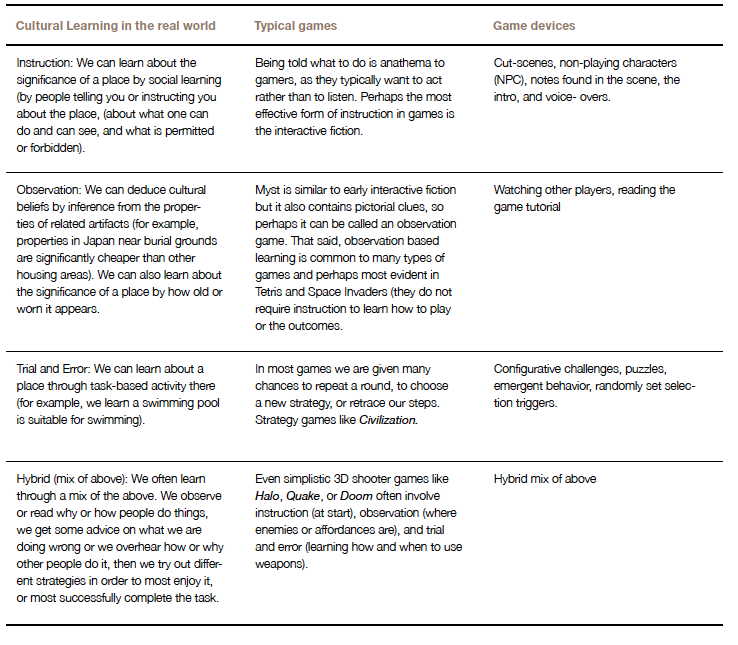
Table 1: Interaction Learning Modes in Games
Games can afford a sense of being socially embedded, being part of a team, building puzzles or games together, sharing messages or riddles, and instructing new players. Other players or scripted agents can add to a sense of 17 competition or allow a form of measuring stick. Caillois20 noted that for Huizinga “culture is derived from games” while for Caillois himself “the spirit of play is essential to culture, but games and toys are historically the residues of culture.” So it may appear that games can help us learn about cultural and historical settings, as initially we learn about our cultural environment through role-playing and other types of games. However, commercial games can hardly be considered hermeneutic, for the only way the worlds can be layered with anything approaching personalization and communication is through destruction and debris caused by the user’s battles and vandalism. Unlike games and game situations in real life, where playing may be changed due to in-game events or due to referentials, such contextual elements are typically faked in computer games. For example, instructions are often delivered via a narrator or book during the introduction; they cannot be added to, layered, or otherwise modified.
5 Games For Traveling and Tourism
So how do we blend game-styled interaction with virtual travel, history or heritage environments? I hope that it is now apparent that despite literature conflating narrative with environmental storytelling (such as by Carson21 and Jenkins22 ), knowledge derived from observation of place features in games is typically procedural) rather than prescriptive. There exists a degree of separation between games that develop procedural knowledge and virtual environments’ tendency to follow traditional pedagogy by presenting prescriptive knowledge.
Tourists learn about places by going there, observing events, and being instructed by signs, guides and printed material. Such learning when conveyed via games is typically before the start of the actual game, in the form of a textual introduction or voice-over. It is seldom part of the overall game play itself. Game tutorials, on the other hand, are procedural. Some games offer short walkthroughs where users may practice learning to jump, sidestep, use weapons etc. As contextually appropriate simulations, these games within games offer something real world tourism seldom encompasses, learning by doing.
In the real world, to travel through a country without outside resources we have to learn to “read” the land, and solve local problems with local solutions. While “tourists” can learn from seeing how people do things, they themselves do not learn by doing but by watching the actions of others, by reading the interpretations of others, and by listening to others. “Travelers,” on the other hand, undertake quests. Archaeologists are more akin to tourists, but they must actively interpret the place. The main objective of archaeology is usually attempting to uncover prescriptive knowledge, knowledge of events, what happened when, and who did what. Hence we could crudely separate games into those that attempt to unravel narrative (such as Myst and other types of interactive fiction) and those that allow interaction through doing (the competitive adventurerexplorer games). The former detective style games are much closer in spirit to the learning found in archaeology (tourism), while contextual travel (rather than commercial and luxury-based tourism) is closer to adventuring (traveling).
An obvious candidate for adventuring would be the First Person Shooter genre. Progress in these games is through procedural learning, knowledge learnt through trial and error—but the learning in the game itself is generally acquired through shooting, moving, and being shot. The strategist type game, where one tries to develop empires through selecting resources (and sometimes throwing dice), may be a blended genre, as it incorporates procedural learning (via calculated risk taking) and prescriptive learning (by the game providing historical facts about the resources that may help players make decisions). This type of game may expose the workings of previous civilizations, and it may incorporate historical events in the way it works out permutations of player decisions,23 but as a learning platform, it encounters the problem of how to separate fact from fiction for the player.
It may seem from the following table (Table 2) that we can tailor virtual environments to the expected social roles and objectives of the player, in terms of prescriptive learning as an archaeologist (detective), and as a tourist (non-playing character or observer), or in terms of procedural learning aimed at the traveler (adventurer):
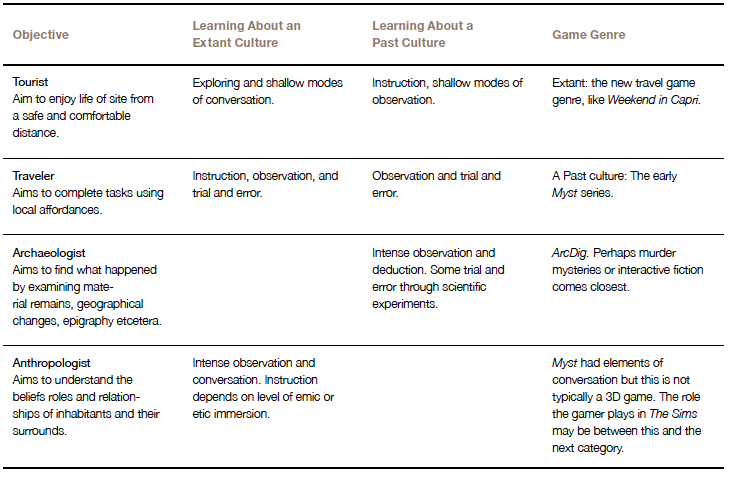
Table 2: Learning via Social Roles
But there is another important distinction between real world tourism and computer gaming. In the game world, we might read erosion and damage to detect whether we have been there before, but generally, we are meant to read place features in games in order to gauge where affordances and constraints are most likely to be located. Place features in games are designed to afford rather than entertain. It might depict a mood through genre conventions (such as specific lighting, sound, scale and symbolic details), but place is a stage on which things are meant to happen in the present or as information to indicate what will happen in the immediate future; place is not used to tell the stories of the past. These devices set the scene, rather than provide historically accurate information.
Having said that historical learning tends towards the prescriptive and not the procedural knowledge emphasized in games, one might wonder if game-style interaction could be of use in understanding other cultures; after all, games and culture are linked. For example, Caillois believes that games involve a sense of competition, mimicry, chance, or a sense of motion and vertigo. He goes so far as to write that “the preference for agon, alea, mimicry, or ilinx helps decide the future of a civilization.”24 Unfortunately, Caillois is not talking about computer games. Computer games typically involve competition and chance, but seldom fully involve mimicry or vertigo (perhaps due to limitations in the interface and controllers). Instead they tend to train and reward action, motor-coordination, and reflexes. Due to this emphasis, games are often competitive and destructive, focused on doing and changing rather than understanding, recovering and preserving. However, I do not think all is lost. Some games designers, for example, have used games to develop leadership and people management skills.25 The issue is not that computer games cannot help us engage in learning about history and heritage, but how to create the appropriate context, interaction motifs, feedback systems, and contextual goals, in order to evoke engaged responses.
6 Possible Ways of Learning About History And Heritag
In the Information Environments Program at the University of Queensland, I have encouraged students to explore virtual environment building through game-level editors and through user-testing. So far, they have discovered their own designer bias, and learnt a great deal about cross-software limitations, but they have not fully explored the conceptual problems of creating interactive “other” places that combine fact and fiction.
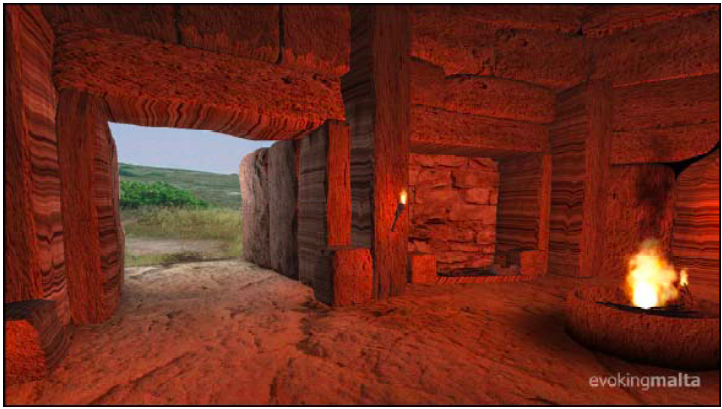
Figure 1: Virtual Malta Project with Unreal game engine
The Virtual Malta project (Figure 1) was modeled inside the Unreal Tournament game engine for Bernadette Flynn of Griffith University. The project included blue-screened videos of real people (the students) as ghost narrators, activated as people approached key points in the temple. Inside, flaming torches could be carried to illuminate what the viewer wanted to see in more detail. The reconstructed temple objects were also designed to trigger rituals when they were put in specific places. The project was designed to show how the temple might have been used, rather than create a static model that people could walk through without interacting with artifacts as they may have been intended to be used.
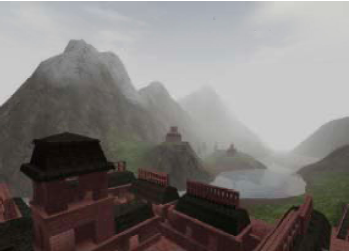
Figure 2: Allen St, Paradise Dam Project for Quest3D
The Allen St model was a recreation of an actual site, designed in tandem with an archaeologist. Rather than create cognitive overloading, messages were transparent and proximity based, and sound was also proxemic, fading away when people accidentally wandered away from areas with information. The user experience was also made more immersive by projecting the environment onto the back of a screen, with side walls to keep out excess light and sensor pads built into the floor so that people could move forward merely by stepping forward on the floor.
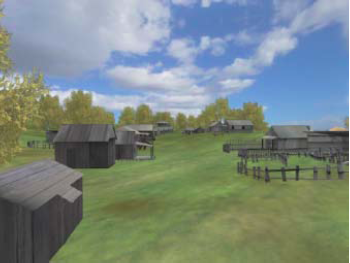
Figure 3: Virtual Palenque
For virtual Palenque (Figure 3) we used a curved mirror to project onto a back wall and side walls, and a 3D joystick and sensor pads to replace the keyboard and mouse. In order to allow for the creative expression of the students, the archaeologically measured temples were recreated, and there was also a simple game using Mayan cultural beliefs to open up a portal to an artistic and imaginative version of their underworld. The Mayan calendar was designed as a compass so that the player would need to learn certain symbols in order to travel through space and time. Weapons were items used by shamans that opened portals to the spirit world.
There are several projects still ongoing, based on the idea of learning through sharing with other people, or avoiding detecting through imitating inhabitants. In the former scenario, it is possible with some game engines to created parallel virtual environments where the players see each Figure 1: Virtual Malta Project with Unreal game engine 20 other but they only see their own world. Through sharing terms or pointing, they can make their items appear in the other player’s environment (Figure 4).
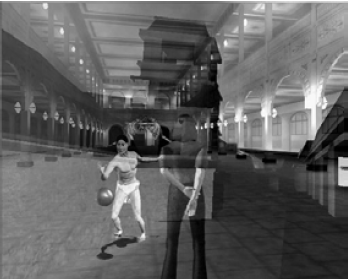
Figure 4: Allowing Users from Different Worlds to Communicate
We have also been working on a game scenario where the main character has to pretend to be a native, gossiping with the local bots (the inhabitants) in order to solve certain tasks such as climbing the social hierarchy. (They also must avoid being detected as imposters by the natives.) The Turing test asked people to decide if something behind a wall answering questions was human or an artificial intelligence (AI). In this scenario the participant is instead trying to stop the AI from realizing she or he is actually human, and an interloper. The believability of the artificial intelligence has now been reversed; the human characters now have to prove themselves, and in order to do so they learn about the local cultural beliefs and seek to imitate them. They may also try to find other human players and advance themselves by informing on the other impostors. This scenario could be highly competitive, and puts the onus to perform authentically on the participant, not the virtual environment. Players may not know which avatars are bots and which avatars are controlled by human players. A changing mix of scripted characters and real world users adds a form of mystery and engagement, and helps ensure that a reasonable level of challenge persists after the initial learning period.
Such a scenario requires a believably intelligent Artificial Intelligence that appears to have agency, agon (competition), and alterity (otherness). Mimicry is difficult for digital simulation, so here the humans are responsible for it. However, as a sort of cultural Turing test, this scenario may allow the integration of historical fact, cultural behaviors, embedded multiple users, and goal based motivation that relies on acquiring contextually appropriate cultural knowledge, not destroying it. I believe this scenario addresses some of the problems of social presence and cultural presence; other players do not benefit from acting like in tourists in the real world—the winners are the ones who “go native.”
One of my student groups also used a medieval style ‘slash and hack’ role-playing game for an archaeology project, and it may appear that historical learning is best utilized by such RPG games. In my own evaluations of archaeology students and visualization experts,26 I found that basing interaction on conventional game genres is both a blessing and a curse. When told a virtual environment is a game, participants of all ages and both genders seem much more at ease and aware of potential affordances. On the other hand, they tend to look for interaction and personalization while disregarding the actual content, and they conflate fact, conjecture and fiction.27 Further, adopting a conventional game-style genre may mean that students forget to cull non-authentic materials or objects, or leave in violent weapons and interaction methods for their own amusement. For example, adventure films have popularized archaeology as an interactive and engaging pursuit. On the other hand, they and computer games typically destroy the very object of admiration.
Digital media can recreate both objects and activities, but what sort of activity is both engaging and educational? How can we both significantly preserve and meaningfully communicate the past? These issues relate directly to games, as computer games show interesting forms of interaction and depiction of historical settings, but fail to separate fact from fiction, and do not immerse people in a local and historical perspective. So while adhering to game genres ensures that people have less trouble working out the goals of the virtual environment, the survivalist tendencies of these same game genres may mean that people do not notice peripheral information, do not explore and wander, or adopt local customs and beliefs.
These prototypes have encouraged me to develop roleplaying game templates in which students are required to collaborate and compete with each other in order to embed themselves in the “world.” Through attempting to recreate traditional buildings and costumes, students learn how to observe and critique each other’s designs, and play testing enables them to see how difficult it is to design for different learning styles and how essential clear navigation aids and coherent goal making is for successful virtual environments. They also have to review history and heritage as an interactive process, and work out how to communicate best about this, rather than copy and paste textual material from books or from the Internet.
7 Conclusion
Many virtual environments have aimed for realism rather than for meaningful interaction. Yet this may not be the most effective means of educating and engaging the public. Material culture is not a collection of objects; it is an embodied and embedded snapshot of a dynamic world-view, an interface and depository to social ideas and beliefs. This interface of art and craft allows us to visualize our cultural understanding and transmit it to others for review and feedback. However, cultural understanding can be amorphous and triggered only by insitu events or landmarks, people may prefer to wander rather than solve tasks, and testing people after the experience depends for its accuracy on their impartiality, their memory recall, and their ability to articulate what they have learned.
If culture is an interactive process of observation, instruction, and active participation, we need to know how we can meaningfully replicate this process in virtual environments. It may prove easier to evoke this world-view through vagueness and uncertainty rather than through clear and unbiased vision. In order to do this, we may learn from game-style interaction. Games are challenging, rewarding, and sometimes personalizable. They also offer cues on how to help people navigate through virtual environments. The specific elements that make three-dimensional games engaging and believable may also be usefully applied to virtual heritage environments. Unfortunately, digital game environments do not typically attempt to incorporate a hermeneutic dimension; this seems to be more commonly a feature of online communities. Games are typically not hermeneutic, and are based around procedural rather than prescriptive learning. However, games do offer some form of social context, embodiment, and challenge. They are also simulations.
When designing learning environments, we all too often forget that the point of the simulation is to challenge and reward the learning process rather than to depict a product. To stimulate that process we need to investigate what the user experience is for and how the interaction methods and metaphors can best present content, and best engage and coax the learner to develop transferable skills and knowledge. When evaluating games designed for archaeology, history, and heritage, we must focus on exactly what students should be learning and how it can be assessed, not just on the player experience.
I have suggested a framework for comparing game design components for learning about heritage and history, and 23 warned about the particular needs and issues of prescriptive learning at odds with the procedural learning nature of computer games. However, using computer games with historical content is not necessarily a satisfactory solution, for we must first decide what knowledge needs to be transmitted, and then how it can be learned through interaction. Only after we have decided on the content to be learned and the interaction that best allows this learning to occur can we consider which visual materials, scripts, animation and general game genres could be appropriate.
In my opinion, commercial games typically have inappropriate interaction scenarios for historical and heritage-based learning; they favor shallow and hurried cognition, not deep cultural reflection and understanding. I recommend that we move past virtual environments as a virtual tour, and that we seek to challenge the user to adapt to the local conditions in order to survive and prosper. For example, the way in which people require knowledge to help them resolve a challenge could provide them indirectly with insight into local conditions, values, and beliefs. To convey history via games, knowledge can be seen not just as a mirror but also as a tool and as a weapon. Historical knowledge as a game element can be potentially vague, dangerous, and powerful. Rather than simply present history to a player, we can entice them to explore it as a series of possibilities, values, and ideas that are metaphorically embedded and embodied in the game world. We can consider knowledge of the past as a constraint, an affordance, and as a reward, to entice the player not just to understand why and when, but also to value the how. Just as game maps are uncovered when the related area is explored, the power, accuracy, and value of historical knowledge could be related directly to the interaction history of the players that share or safeguard it.
The preliminary studies discussed feature either social understanding reached by interaction, or an embrace of the physical embodiment of the participants. Both methods are attempts to further our understanding of lived history through imaginatively emphasizing rather than hiding the constraints of digital media. Instead of trying to copy the fixed content of a book, I suggest that we embrace the layered, dynamic, and customizable potential of digital media. After all, culture is a dynamic and individually varying phenomenon that allows each of us to learn in our own unique ways. To limit digital media to a linear narrative is restricting not only in terms of the medium but also in terms of how we learn about ourselves and about each other, past and present.
Footnotes:
- Jesper Juul, “The Game, the Player, the World: Looking for a Heart of Gameness,” in Level Up: Digital Games Research Conference Proceedings, eds. Marinka Copier and Joost Raessens (Utrecht: Utrecht University, 2003), 30-45. Also available online at http://www. jesperjuul.net/text/gameplayerworld/.
- Clark Aldrich, Simulations and the Future of Learning: An Innovative (and Perhaps Revolutionary) Approach to E-Learning (San Francisco: Pfeiffer, 2004). 240.
- Karen Salen and Eric Zimmerman, Rules of play: game design fundamentals (Cambridge, Massachusetts: MIT Press, 2003). 572.
- Thomas W. Malone, “Heuristics for Designing Enjoyable User Interfaces: Lessons from Computer Games” in Proceedings of the 1982 Conference on Human Factors in Computing Systems, (1982), http://portal.acm.org/citation. cfm?id=800049.801756 (October 16, 2006).
- Alison Druin and Cynthia Solomon, Designing Multimedia Environments for Children (New York: J. Wiley and Sons, 1996). XII-XIII.
- Marc Prensky, Digital Game-Based Learning (New York: McGraw-Hill, 2001).
- James P. Gee, What Video Games Have to Teach Us About Learning and Literacy (New York: Palgrave Macmillan, 2003).
- Clark Aldrich, Simulations and the Future of Learning: An Innovative (and Perhaps Revolutionary) Approach to E-Learning (San Francisco: Pfeiffer, 2004).
- Kurt Squire and Sasha Barab, “Replaying history,” in Proceedings of the 2004 International Conference of the Learning Sciences, eds. Yasmin B. Kafai, William A. Sandoval, Noel Enyedy, Althea Scott Nixon and Francisco Herrera (Los Angeles: UCLA Press, 2004). 505-12. 10
- Steven Johnson, Everything Bad is Good for You: How Popular Culture is Making Us Smarter (London: Allen Lane, 2005).
- Steven Johnson, “What’s in a Game?” The Guardian (October 20, 2005).
- Kathleen W. Craver, Using Internet Primary Sources to Teach Critical thinking Skills in History (Westport, Connecticut: Greenwood Press, 1999). 2-3.
- Alan Amory et al., “The Use of Computer Games as an Educational Tool: Identification of Appropriate Game Types and Game Elements,” British Journal of Educational Technology 30 no. 4 (1999): 311-21. (19)
- David Hyerle, Visual Tools for Constructing Knowledge (Alexandria, Virginia: Association for Supervision and Curriculum Development, 1996). ix-xiv.
- Richard E. Mayer, Multimedia Learning (New York: Cambridge University Press, 2001). 13.
- Greg Costikyan, “Where Stories End and Games Begin,” Manifesto Games (2000-2001), http://www.costik.com/gamnstry. html. (October 16, 2006).
- Marc Ferro, Preface to The Use and Abuse of History: Or How the Past is Taught to Children (London, Boston: Routledge & Kegan Paul, 2003). viii.
- Kathleen W. Craver, Using Internet Primary Sources to Teach Critical thinking Skills in History (Westport, Connecticut: Greenwood Press, 1999). 6-7.
- Erik Champion, “Online Exploration of Mayan Culture” (paper presented at VSMM2003 Ninth International Conference on Virtual Systems and Multimedia, Hybrid Reality: Art, Technology and the Human Factor, Montreal, Canada, October 15-17, 2003). 3-10, 2003.
- Roger Caillois, Man, Play and Games (Chicago: University of Illinois Press, 2001). 58.
- Don Carson, “Environmental Storytelling: Creating Immersive 3D Worlds Using Lessons Learned from the Theme Park industry,” Gamasutra (March 01, 2000), http://www.gamasutra. com/features/20000301/carson_01.htm. (October 16, 2006).
- Henry Jenkins, “Game Design as Narrative Architecture,” Electronic Book Review (2004), http://www.electronicbookreview. com/thread/firstperson/lazzi-fair. (November 8, 2006). X
- Kurt Squire and Sasha Barab, “Replaying History,” in Proceedings of the 2004 International Conference of the Learning Sciences, eds. Yasmin B. Kafai, William A. Sandoval, Noel Enyedy, Althea Scott Nixon and Francisco Herrera (Los Angeles: UCLA Press, 2004), 505-12.
- Roger Caillois, Man, Play and Games (Chicago: University of Illinois Press, 2001). 35.
- Clark Aldrich, Simulations and the Future of Learning: An Innovative (and Perhaps Revolutionary) Approach to E-Learning (San Francisco: Pfeiffer, 2004).
- Erik Champion, “Evaluating Cultural Learning in Virtual Environment” (Ph.D diss., University of Melbourne, 2006). Also available online at http://www.itee.uq.edu.au/~erikc/papers/.
- Karen Kensek, Lynn Swartz Dodd and Nicholas Cipolla, “Fantastic Reconstructions or Reconstructions of the Fantastic? Tracking and Presenting Ambiguity, Alternatives, and Documentation in Virtual Worlds,” in Proceedings of ACADIA 2002: Thresholds Between Physical and Virtual, Pomona, ed. George Proctor (Pomona: ACADIA, 2002). 175-186.
References:
Aldrich, Clark. Simulations and the Future of Learning: An Innovative (and Perhaps Revolutionary) Approach to E-Learning. San Francisco: Pfeiffer, 2004.
Amory, Alan, Kevin Naicker, Jacky Vincent, and Claudia Adams. “The Use of Computer Games as an Educational Tool: Identification of Appropriate Game Types and Game Elements.” British Journal of Educational Technology 30 no. 4 (1999): 311- 21. http://www.nu.ac.za/biology/staff/amory/bjet30.rtf. (October 16, 2006).
Caillois, Roger. Man, Play and Games. Chicago: University of Illinois Press, 2001.
Carson, Don. “Environmental Storytelling: Creating Immersive 3D Worlds Using Lessons Learned from the Theme Park Industry.” Gamasutra (March 01, 2000). http://www.gamasutra.com/ features/20000301/carson_01.htm. (October 16, 2006).
Champion, Erik. “Online Exploration of Mayan Culture.” Paper presented at VSMM2003 Ninth International Conference on Virtual Systems and Multimedia, Hybrid Reality: Art, Technology and the Human Factor, Montreal, Canada, October 15-17, 2003. Also available online at http://www.itee.uq.edu.au/~erikc/papers/. (October 16, 2006).
Champion, Erik. “Evaluating Cultural Learning in Virtual Environment.” Ph.D diss., University of Melbourne, 2006. http:// www.itee.uq.edu.au/~erikc/papers/. (October 16, 2006).
Costikyan. Greg. “Where Stories End and Games Begin.” Manifesto Games, http://www.costik.com/gamnstry.html. (October 16, 2006).
Craver, Kathleen W. Using Internet Primary Sources to Teach Critical thinking Skills in History. Westport, Connecticut: Greenwood Press, 1999.
Druin, Alison and Cynthia Solomon. Designing Multimedia Environments for Children. New York: J. Wiley and Sons, 1996.
Ferro, Marc. The Use and Abuse of History: Or How The Past is Taught to Children. Boston: Routledge & Kegan Paul, 2003.
Gee, James P. What Video Games Have to Teach Us About Learning and Literacy. New York: Palgrave Macmillan, 2003.
Hyerle, David. Visual Tools for Constructing Knowledge. Alexandria, Virginia: Association for Supervision and Curriculum Development, 1996.
Jenkins, Henry. “Game Design as Narrative Architecture.” Electronic Book Review (2004). http://www.electronicbookreview. com/thread/firstperson/lazzi-fair (November 8, 2006).
Johnson, Stephen. Everything Bad Is Good For You: How Popular Culture is Making Us Smarter. London: Allen Lane, 2005.
Ibid. “What’s in a Game?” The Guardian (October 20, 2005).
Juul, Jesper. “The Game, the Player, the World: Looking for a Heart of Gameness,” in Level Up: Digital Games Research Conference Proceedings, edited by Marinka Copier and Joost Raessens. Utrecht: Utrecht University, 2003. Also available online at http://www.jesperjuul.net/text/gameplayerworld/.
Kensek, Karen, Lynn Swartz Dodd and Nicholas Cipolla. 24 “Fantastic Reconstructions or Reconstructions of the Fantastic? Tracking and Presenting Ambiguity, Alternatives, and Documentation in Virtual Worlds.” In Proceedings of ACADIA 2002: Thresholds Between Physical and Virtual, Pomona, edited by George Proctor. New York: McGraw-Hill, 2001.
Malone, Thomas W. “Heuristics for Designing Enjoyable User Interfaces: Lessons from Computer Games.” Proceedings of the 1982 Conference on Human Factors in Computing Systems, (1982), http://portal.acm.org/citation.cfm?id=800049.801756 (October 16, 2006).
Mayer, Richard E. Multimedia Learning. New York: Cambridge University Press, 2001.
Prensky, Marc. Digital Game-Based Learning. New York: McGraw-Hill, 2001.
Salen, Karen and Eric Zimmerman. Rules of Play: Game Design Fundamentals. Cambridge, Massachusetts: MIT Press, 2003.
Squire, Kurt and Sasha Barab. “Replaying history.” Proceedings of the 2004 International Conference of the Learning Sciences (2004), http://portal.acm.org/citation.cfm?id=1149126.1149188. (October 16, 2006).