
V3N1: Video Games as Learning Tools for Project Management
By Rudy McDaniel, Stephen M. Fiore, Adams Greenwood-Ericksen, Sandro Scielzo, Dr. Jan Cannon-Bowers | July 1, 2013
Why Video Games?
It is not surprising that the Entertainment Software Association (ESA)–formerly the Interactive Digital Software Association (IDSA)–aggressively advertises the popularity of electronic gaming in society. Within their yearly publication on gaming demographics, the organization includes this quote from USA Today writer Kevin Maney:
if you’re over 35, chances are you view video games as, at best, an occasional distraction… If you’re under 35, games are a major entertainment and a part of life. In that sense, they are similar to what rock ‘n’ roll meant to boomers.
All one needs to do to witness the phenomenal popularity of video games is wander inside the home of a young adult and take a look at the television’s peripheral connections. Chances are, you’ll find attached one or more gaming consoles (a Playstation2 or Gamecube, or perhaps even an Xbox 360) and an accompanying assortment of popular gaming titles. If not a console platform, there is likely a computer nearby with access to game titles in PC or Macintosh format. Gee notes that “the video-game industry makes as much money or more money each year than the film industry.” Seventy-five percent of heads of households play some type of electronic game, with the average gamer’s age being 30 (up one year from 2004), and the largest segment of gamers (43%) being between the ages of 18 and 49. From these figures, it is evident that a large number of the students filling seats in college classrooms have at least some experience in electronic gaming, and that they are likely to be open-minded toward teaching methods that take advantage of digital gaming or digital gaming techniques.
Even the gender inequity seems to be gradually decreasing, as the latest figures from the ESA reveal that 55% of gamers are male and 43% are female, a set of statistics that suggests the dearth of female gamers may no longer be a problem in future years. The increasing percentage of female gamers shows that this discourse community–what Gee might describe as a macro-level affinity group–seems to be gradually fighting for equilibrium, and the ESA also notes that “women over the age of 18 represent a greater portion of the game-playing population (28%) than boys from ages 6 to 17 (21%).” Furthermore, female gamers are not confined to a single gaming genre as some have speculated; Carr’s (2005) examination of gaming at an all-girls state school in the UK found that female gamers enjoyed playing not only “God-games” or simulation games like The Sims, but also other types of sports and fighting games previously thought to be the domain of male gamers only. These games included such titles as Tony Hawk’s Pro Skater 4 and Dead or Alive 3. Carr notes, “To attribute gaming tastes directly, solely, or primarily to an individual subject’s gender is to risk underestimating the complexities of both identity and preference.” Both the increasing numbers of female gamers and the wide breadth of interest for these gamers provide hope that digital games may in fact offer a means for better engaging and teaching both male and female students in the digital media classroom.
While the market penetration of gaming makes for a convincing argument for the popularity of games, it does nothing to suggest that these games are well-suited for non-entertainment functions such as teaching. In terms of connecting gaming with the classroom, we now have at least a small base of materials from which to draw ideas and frameworks for pedagogy and assessment. Much has been written about the potential of video games for teaching and learning in the 21st century. The journal Simulation & Gaming recently devoted two entire issues to a special symposium on video gaming and learning. While these sources are a great start, much of the discussion so far has been focused on the potential of the medium rather than on concrete examples that connect gaming technology to pedagogy.10
Proponents of gaming in the classroom claim that gaming solutions can be successful because they better address the learning patterns and multimodal11 competencies of those growing up with entertainment and communication technologies such as iPods, BlackBerry devices, PDAs, and multimedia phones. These devices now infiltrate all parts of the data-driven culture in which we find ourselves immersed, from home to school and work environments; de Castell and Jenson label this new type of atmosphere as an “attentional economy.”12 In this type of environment, engaging and sustaining students’ attention is a primary objective. Fortunately, gamers are cultivating skillsets that are compatible with this type of economy. As Dekanter notes, “the elements of interactive game playing–adaptivity, competition, communication–are becoming the traits of successful students and workers.”13 The task for instructors is now to try and harness these interactive skills and competencies and focus them into directions more useful for classroom learning.
The Problems of Inconsistency and Complexity
When considering the problems involved with using digital game technologies as tools for instruction, it is possible to divide those problems into two groups: problems that take place during the construction of games (i.e., design issues) and problems that take place during the playing of games (i.e., runtime issues). In the former, there is the potential to correct or improve educational video games either by a) following sound design practices and reapplying the elements of existing video game architectures, or b) developing new gaming architectures that can support educational games from the ground up. In the latter, during runtime, there is little opportunity to implement technology changes, but it is useful to acknowledge the complex social, cultural, and cognitive processes that are engaged when a player is interacting in virtual space. These forces can contribute to experiential inequities and inconsistent gameplay patterns that result in two different players from two different affinity groups having very different perspectives on a single game. There is plenty of literature that verifies the inequities of video game technologies and examines the stereotypical, cultural, or aggressive implications of digital gameplay.14
One significant problem with the notion of using gaming as a pedagogical tool during design is related to the inconsistency of the medium. As Apperley explains, the general feature of interactivity is not enough to unite video games of all makes and models under one common umbrella.15 As opposed to a textbook, for example, where commonalities such as structural and organizational entities (e.g., tables of contents, page numbers, title pages, and covers) are generally shared from one book to the next, video games have no such consistency, particularly in regard to aesthetics and visual look and feel. From one game to another, it is common to have completely redefined notions of gameplay, graphical fidelity, problem-solving strategies, scoring, collaborative play, and so forth. While genres of games may share some consistency in this regard, even within a specific domain of video games–first person shooters or real time strategy games, for example–there will undoubtedly be some variation to the ways in which a player interacts with the medium and its virtual components. Of course, this is often also precisely what makes video games so exciting and engaging for their players. Variations in gameplay, story, and mechanics have led to innovations and creative applications of programming and multimedia that transform certain games from mediocre market performers to blockbuster selling titles with dedicated groups of fans. Nonetheless, this inconsistency presents a challenge for those wishing to make use of structured lesson plans within a gaming environment.
Apperley argues for a move towards the study of what he calls the “nonrepresentational” characteristics of video games–those characteristics (primarily interactivity) that are not centered on the visual aesthetics of the medium. Specifically, he proposes the creation of “a more nuanced, meaningful, and critical vocabulary for discussing video games; one that can perceive the underlying common characteristics of games that might otherwise be regarded as entirely dissimilar if judged solely on representation.”16 While this task is undoubtedly a formidable undertaking, his idea is laudable; creating a standardized means for discussing the intricate differences in various types of interaction, for example, would do much to assist educators and designers during the construction of game-based scenarios and new media learning environments. Furthermore, a repository of sound design guidelines could be used to weed out problematic or inconsistent gameplay scenarios—if ninety-nine percent of users pick up objects in a virtual world using the same type of controller interactions, then it is probably safe to say that a significant change to this procedure is likely to be frustrating or confusing to a player. In our current state of affairs, a lack of commonality at both the macro (gaming in general as a medium) and micro (gaming as composed of game genres) level poses problems for the effective use of video games as pedagogical tools.
An equally troublesome characteristic of modern video games is that of complexity. Video games are complex and complicated by nature; the hardware generally has only very limited resources available and the software must be as efficient as possible in order to achieve the fast frame rates and the photorealistic fidelity that modern players demand and crave. In addition to these technical complexities, the production of a bestselling video game is a massive undertaking. The game Gun (2005), designed and developed by the game studio Neversoft, lists hundreds of names in its production credits, representing professionals from producers and art directors to voiceover actors and quality assurance employees. On the backend, video games often possess a million lines of programming code or more and can cost millions of dollars to produce, market, and distribute.17 To create a video game that has entertainment-quality graphics, story, audio, and gameplay, then, is no small endeavor.
Fortunately, there have been several attempts at creating open source game design engines that allow developers to extend core sets of functional code in new directions based on their needs and desired outcomes. These engines generally include the core functionality necessary for the creation of a 3-D navigable environment, and implement methods for dealing with physics, object collisions, and the importing of art objects and models. One online collection provides information on over 240 such 3-D engines each with its own set of features and custom tools.18 Other popular engines such as Ogre3D, Delta3D, and Panda3D have been applied to specialized areas such as academia or the military.
In addition to open source engines, another option for minimizing the complexity of game development is to use an engine packaged with a commercial video game such as Half Life or Neverwinter Nights. Rather than using this engine within the context of the original game, though, the idea is to use the existing engine to support new gameplay possibilities. To support this feature, commercial game developers often create toolsets that allow players to create their own environments, characters, dialog, and art–giving way to a new breed of game players known as game modifiers or more often simply “modders.” Modding games, while still a complicated process, simplifies the task of game development enough so that even college students unfamiliar with programming or 3-D modeling can learn to create a video game environment over the course of several weeks. Modders design their environments to contain different types of items, gadgets, “characters, enemies, modes, textures, levels, and story lines” that may be useful for any given learning environment.19 An example of this process using a modded addition for Neverwinter Nights and an Underground Railroad narrative is explained in greater detail in the latter half of this paper.
Learning by Designing
Given the problems of inconsistency and complexity discussed above, applying game design techniques to digital media coursework can be a challenging task. Perhaps a step in the right direction is to focus on those production-oriented aspects of game design that are relevant to specific areas of digital media curriculum rather than trying to adapt gaming conventions to an entire (and admittedly amorphous and emerging) discipline. This task involves applying one of Gee’s core learning principles. Gee’s design principle is described as “learning about and coming to appreciate design and design principles.”20 For instance, in courses requiring students to learn about interactivity, it can be worthwhile for students to implement interactivity first in a CD-ROM environment, then in an Internet environment, and finally in a gaming environment, thus roughly mimicking the evolution of interactivity in industry.21 Given the same source of content, then, a student would be able to observe the ways in which the user experience changes as a viewer/browser/player is given increasing amounts of control over their environment and the digital “objects” that exist within that environment.
In this paper, we choose to consider the ways in which gaming can augment learning outcomes in project management courses. When given production tasks, digital media students generally have a wealth of technologies available with which to capture their raw materials and record the types of direct world observations useful for their projects. They may take advantage of three-dimensional art and computer modeling programs, or choose instead to capture audio or video through digital recording devices. They may develop digital stories through scriptable narrative tools and design online environments using Internet scripting languages. They may decide to use multiple software programs to propel a new idea from its initial conception to its final launch. It is very easy for students to become sidetracked when making these technological decisions and when building these complex framing mechanisms, and they may lose sight of the more important goal, which is often the facilitating of an interaction between an author and an audience.
When students are asked to produce and to teach something using their product, though, the choices they make in the selection of raw materials become at least as important as the tools they use to capture and manipulate those materials. Furthermore, by building a product that is used to teach others about selected subjects or concepts, the students themselves are likely to retain this information for a longer period of time than they would simply sitting in a classroom listening to a lecture. In fact, the Learning Pyramid model of interactive learning retention rates associates a straightforward lecture with only a 5% retention rate, while a situation in which a learner teaches others about a concept or uses the concept immediately warrants a 90% retention rate.22
Far from being singularly useful, these project management skills learned in electronic game design are also relevant to the objectives of many other types of digital media courses. For example, in a writing for media or technologically-enhanced communications course, an instructor might introduce students to proposal writing, scheduling, resource management, collaborative teamwork, and presentation skills. By asking small groups of students to work throughout the semester and build a single “level” or “scene” of a moddable video game, they would have the opportunity to learn about many of these topics in great detail, while at the same time building up valuable interpersonal and rhetorical skills. A final presentation on the group’s accomplishments would further connect the project to curricular goals.
An even easier way to connect general students to digital media coursework through gaming, though, is to simply ask them to play their favorite games for X number of hours as a homework assignment and then use this experiential exercise as a device to drive in-class reflection or discussion about a lecture topic. In this type of situation, relatively little up-front planning is necessary, and there are no complicated programs to install or freeware modding tools to download. In the next section of this paper, we discuss similar ways in which playing games can be used to generate new ideas and thoughts about project management in a multimodal environment.
Learning by Playing
As the video game industry is necessarily highly secretive and competitive, the lessons learned from the industry often must come from the end user perspective. In other words: what can we learn from playing the games rather than from studying the process of video game development? Gee’s text What Video Games Have to Teach Us About Learning and Literacy asks this very question, and even provides an answer. Gee claims that something useful can be learned from all types of video games, whether these games are massively-multiplayer online role-playing games like World of Warcraft, Gamecube simulation games like Pikmin, or even the globally ubiquitous first-person shooter games like Halo 2. In addition, Gee’s work has reignited interest in educational gaming technologies, though the term “edutainment” has in recent years been replaced with the more politically pleasing phrase “serious gaming.”23 Furthermore, notions of “serious gaming” have led to what some have called “serious play.”24 The idea here is perhaps to ease some of the tension and frustration normally present with certain types of learning. As McLuhan notes, “both games and technologies are counter-irritants, or ways of adjusting to the stress of the specialized actions that occur in any social group.”25 In didactic social interactions, games can be even more useful, as they both alleviate the stress of learning and facilitate certain types of social interactions also involved in pedagogy. Though McLuhan at this point was not writing about electronic games, his arguments are equally applicable to those games that are designed to unfold in virtual environments.
Serious play has also had consequences in other fields, such as linguistics and literary theory. For instance, Derrida used the concept of “play” in his writing and analyses of literature in order to formulate new ideas about the construction and meaning of language and written expression.26 For digital media students, play might instead lead to new ideas about optimizing project workflows or creating new juxtapositions of narrative and media. In either case, though, play can be thought of as a generative tool leading to new ideas and outcomes rather than as a purely entertainment-oriented activity in pursuit of relaxation.
To support our notion of serious play as a tool for project management, we expand upon Gee’s 36 core learning-principles and add three more principles relevant to what we call “runtime project management” in the field of digital media. We call these principles the Interactive Learning Principle, the Attention-to-Detail Principle, and the Ethics Principle. For each of these three principles, we discuss example projects that depend upon the skills cultivated by these types of learning. Next, we discuss and critique particular video games with which students can study, develop, and hone these skills.
1. The Interactive Learning Principle
Crawford defines interactivity as “a cyclic process between two or more active agents in which each agent alternately listens, thinks, and speaks.”27 Using this definition and a metaphorical interpretation of what it means to listen, think, and speak, we can assess the quality of interaction by determining how well a virtual system can continue to engage a user’s attention in order to sustain interest in a virtual environment. In a video game, this equates to keeping the player playing for as long as possible. In successful video games like the Ratchet and Clank series for the Playstation 2, certain innovative techniques have been developed in order to keep the user interested and immersed in virtual space. Many of these techniques are directly applicable to the world of media project management, and include concepts such as:
- Forward-thinking design: How do you design products that allow the user to visualize additional interactivity once certain operations have been completed? For instance, video games like Ratchet and Clank will show additional areas of each level that the user will be unable to access 2 6 Jacques Derrida. Of Grammatology. 1st American ed. (Baltimore: Johns Hopkins University Press, 1997). 2 7 Chris Crawford. On Interactive Storytelling. (Berkeley, CA: New Riders Games, 2005), 29.until they have collected certain items or solved certain puzzles. How can such techniques encourage a longer interaction?
- Cooperative and collaborative media design: How can multiple team members work together to devise a world in which complex sensory experiences such as hearing (ambient sound and music), sight (3-D graphics and photorealistic environments), and touch (interactive gameplay) function as a single, cohesive unit? How can they plan projects so that each member of the team has an overall vision of the product rather than segmented and isolationist perspectives that encourage last minute work plans? Such complex design calls for improvements in communication in all phases of the project cycle.
- Distraction and misdirection through narrative: The earliest Playstation games included long load times during which a progress bar would slowly creep across a user’s screen as the next environment was loaded into memory. More modern games such as Ratchet and Clank instead use dynamic loading technologies in which the next environment is gradually loaded into memory as the player progresses. In addition, cutscenes of video can be used to advance the storyline for a video as the next environment loads. These sleight of hand techniques are often used to sustain immersion while still initializing the necessary technological processes of loading data and preparing the system for the next set of gameplay requirements.
In addition to the Interactive Learning Principle, other runtime characteristics related to project management include useful phenomena we describe as the Attention to Detail Principle and the Ethics Principle. Examples of these principles are given below.
2. The Attention to Detail Principle
Zork, which is an interactive computer game of the earliest variety (the game is text only), encouraged players to cultivate a precise yet simplistic vocabulary when communicating with the game and directing the actions of the virtual player. While lacking in the sophisticated graphical fidelity that modern games possess, Zork nonetheless demonstrates many of the characteristics of current video games: goal-driven gameplay, competition with virtual avatars (one example would be the thief, who would periodically appear in the game solely to relieve the player of prized possessions), and human/computer interactions. As interactivity was established through text only, a suitable level of detail was necessary to advance the player from one location to another. The instruction “give the jewel encrusted egg to the thief,” for example, might be more successful than “give jewel to thief.” While Zork’s designer’s did a fine job of making the language parser flexible enough to understand several variations of common commands, in certain situations, a precise level of detail was required in order for the player to meet a goal or advance in the game. With modern games now impressively grounded in high-fidelity graphics, such attention to detail is cultivated in other ways. An analysis of these types of games might permit an instructor to communicate the importance of detail to digital media students when other methods are unsuccessful.
3. The Ethics Principle
Like simulation, gaming can also provide a safe environment in which to experiment with ethics or to discuss ethical situations. In project management especially, students will often find themselves in situations where their personal beliefs about ethics will generate action in one direction or another.
The ethical decisions made by game designers can provide one such entry point for discussions of ethics. A simple though somewhat silly example can be found in a cartoon-like sports game such as Mario Golf. Mario Golf is a golf simulation for the Nintendo Gamecube. In this game, a player is permitted to taunt other players during multiplayer game with mild insults and annoying phrases that are built into the character’s repertoire. Is such a design encouraging unethical behavior, or is it simply making the game more enjoyable for other players during their periods of inactivity? The fact that a non-active player’s ability to taunt ceases when the active player begins their backswing reveals that the game’s designers do draw a line at some point in order to encourage what we might call virtual sportsmanship. Massively multiplayer online games also routinely provide opportunity for unethical behaviors; economic issues such as the management of virtual capital (buying or selling money on the Internet) and the existence of virtual outsourcing (paying other people to build up the attributes of your character, often referred to as “farming”)2828 are only two such examples.
Example: A Brief Case Study of Synthetic Learning
For a more concrete example of using game design experiences to build project management competencies, we can consider the creation of a “modded” video game that was built to teach fourth graders about African-American history and the Underground Railroad. The game, dubbed the “Carol Mundy Video Game,” incorporates digitized artifacts from local (Orlando) historian Carol Mundy’s private collection.29 The goal in this project was to create what we describe as a Synthetic Learning Game, or SLG, in order to a) teach college-level digital media students about project management at design time, and b) teach primary school students about history and culture at runtime. Fourth grade is also a significant grade level for this type of game technology; as Gee notes, the transition from the first three years of elementary school (where students are primarily learning to read in a general sense) to the fourth year (where reading becomes focused in particular subject areas) can be particularly difficult, even leading to what has been known as the “fourth-grade slump.”30
We describe SLGs as digital-media based environments that provide deliberate, well-managed synthetic experiences as means for enhancing learning and performance. We are using the term synthetic learning environments (SLEs) to describe such systems, and seek to generate knowledge that leads to their optimization in both design and implementation. Any synthetic learning environment depends on a rich source of content material from which to populate the environment and create relevant learning challenges. For example, organizations such as the Federation of American Scientists (FAS) are working to forge relationships between universities, museums, government agencies, and private developers in order to both optimize creative applications of game technologies and enable access to unique collections of source materials. Discover Babylon, a game designed to expand public understanding of Mesopotamia’s contributions to organized society, is only one such project currently being developed.31
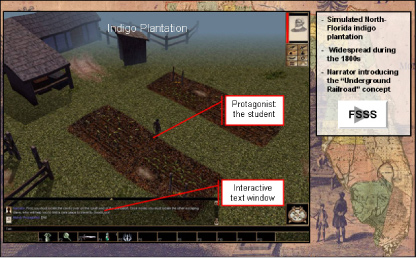
Figure 1 Mundy Game Opening
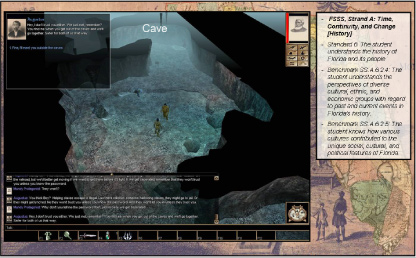
Figure 2 FSSS Benchmarks
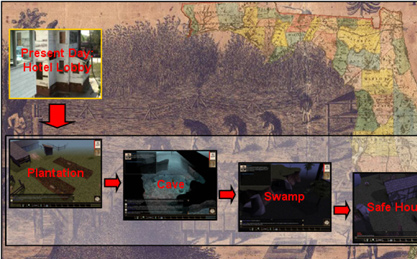
Figure 3 Level Layout for Mundy Game
In the case of the Carol Mundy Video Game, we were fortunate to have access to a large collection of unique content (newspapers, books, land deeds, audio recordings, dolls, and household objects, for example) that could be digitized for use in the game. This particular content collection provides a unique look into the lives and histories of Central Florida life from the 1720s to the 1970s, and is one that Carol Mundy was hoping to make accessible to the general public, particularly to those schoolchildren learning about African-American history and culture. Access to her special collection of historical materials was enabled through her African American History Education and Culture (AAHEC) organization.32
This SLG project was funded by UCF’s Institute for Simulation and Training as part of a collaboration between UCF’s Cognitive Sciences program and the School of Film and Digital Media. This in-house grant provided enough funding33 to support the development of a single level that included targeted learning materials and digitized artifacts from Ms. Mundy’s collection. This effort supported the development of a demonstration version of a story-driven learning game used for research in finding new ways to teach children about African-American culture and history using video game technology. Our goal was to create a compelling introduction to the Underground Railroad using existing commercial off-the-shelf (COTS) technology for role-playing computer games. The collaborative and multidisciplinary efforts involved with this development process contributed to the formation of the Partnership for Research on Synthetic Environments (PROSE) lab, which was formed to continue the study of synthetic learning in various environments.34
The first opportunities for learning for the digital media students involved in this project materialized immediately. As we had previously developed a rough timeline and schedule for the production of the game, we were able to use the existing scheduling documents as tools for instruction. As one example, we asked students to analyze and critique the Gantt chart constructed for the grant as an initial exercise, and to explain how this type of chart is useful for working on complicated projects (Table 1). Following this, students were then asked to follow the chart as we entered a fairly aggressive production schedule.
A screenshot of this game–the story begins on a North Florida indigo plantation–is shown in Figure 1. The initial task given to the player is to escape from this plantation and find freedom to the north. The player is given background information about their task and environment through the use of an interactive text window placed at the bottom of the screen. Connections to appropriate fourth-grade standards are then made by tying into specific benchmarks from the curriculum, in this case the Florida Sunshine State Standards for history (see Figure 2).
While the game in and of itself is interesting, what is more pertinent to the topic of this paper is the way in which the creation of this game inspired university students to become better project managers and team leaders. Though the head designer for the project was in fact a Human Factors doctoral student, digital media students were involved in many aspects of the game’s production, from synthesizing original digital music to developing storylines, programming dialog, and scripting gameplay interactions.
As these students worked with the mod tools available to them in this particular toolset, they began to think about things like interaction and resource management in entirely new ways. For instance, rather than thinking about interaction in the general terms of a human interacting with a machine, they began to understand interaction in more specific terms as they were tasked with creating interactive dialog and trigger-driven responses for the characters in their environment. In addition, they began to see resource management strategies as an essential part of the design process; certain models, textures, and maps were only able to be used in certain situations, and considerations like the density of characters or objects in a scene were critical to both the dramatic and interactive success of a given level or scene. Even the mapping of locations within the game provided an opportunity to teach students about the importance of goal-directed project management and the use of milestones within a project schedule (Figure 3).
Conclusion: Implications for the Digital Media Classroom
In this article, we examined only a few of the properties of computer and console games that make these technologies so compelling and interesting for teaching and learning situations. By discussing a use for gaming in a particular context, though, we hope to have shown how a focused application of gaming technologies can be useful as a means for engaging and exciting students about even seemingly bland topics like project management. Many other possibilities remain, from using games as simulators for universities, training, and hospitals (already being done) to using them as vehicles for environmental policy or for peace activism, as Crookall suggests might be a worthy pursuit. 35 By using games as a tool for learning during both design and play phases, it is possible to produce flexible outcomes for two very different categories of learning materials. Design time is an ideal opportunity to learn about the actual practice of project management, while runtime provides a perfect time to reflect and discuss the outcomes made possible by good project management strategies and open lines of communication within a team.

Table 1 Gantt Chart
The technological and rhetorical depth of this medium is what makes it so exciting, but this technological and textual complexity also makes it a dangerous and volatile entity capable of producing more distraction and entropy than genuine improvements in learning and retention. By considering video games as both texts (subjects of critical analysis) and technologies (subjects of technical analysis) we can begin to uncover the potential of these digital juggernauts as classroom aids and as motivational tools for learning about digital media theories and techniques. Indeed, if we are to survive in what de Castell and Jenson describe as an attentional economy, then we can imagine no greater and more widely-accepted form of currency for technologically literate students than that of the video game.
Footnotes
- James Paul Gee, What Video Games Have to Teach Us About Learning and Literacy. (New York: Palgrave Macmillan, 2003).
- Entertainment Software Association. “2005 Sales, Demographics and Usage Data: Essential Facts about the Computer and Video Game Industry.” Entertainment Software Association (2005), http://www.theesa.com/files/2005EssentialFacts.pdf. (February 28, 2006).
- James Paul Gee, What Video Games Have to Teach Us About Learning and Literacy. (New York: Palgrave Macmillan, 2003), 6. Entertainment Software Association. “2005 Sales, Demographics and Usage Data: Essential Facts about the Computer and Video Game Industry.”
- Entertainment Software Association (2005), http://www.theesa.com/files/2005EssentialFacts.pdf. (February 28, 2006).
- Ibid.
- Diane Carr, “Contexts, Gaming Pleasures, and Gendered Preferences.” Simulation & Gaming 36, no. 4 (2005): 464-82.
- Ibid., 479.
- Marc Prensky, Digital Game-Based Learning. (New York: McGraw-Hill, 2001); James Paul Gee. What Video Games Have to Teach Us About Learning and Literacy. (New York: Palgrave Macmillan, 2003); Nick DeKanter, “Gaming Redefines Interactivity for Learning.” TechTrends: Linking Research & Practice to Improve Learning 49, no. 3 (2005): 26-31; Suzanne de Castell and Jennifer Jenson. «Paying Attention to Attention: New Economies for Learning.» Educational Theory 54, no. 4 (2004): 381-97.
- David Myers, “Guest Editorial: Video Games: Issues in Research and Learning.” Simulation & Gaming 36, no. 4 (2005): 442-46.
- James Paul Gee, What Video Games Have to Teach Us About Learning and Literacy. (New York: Palgrave Macmillan, 2003), 9.
- Multimodal refers to the practice of using combined modes of sound, imagery, or text.
- Suzanne de Castell and Jennifer Jenson, “Paying Attention to Attention: New Economies for Learning.” Educational Theory 54, no. 4 (2004): 381.
- Nick DeKanter. “Gaming Redefines Interactivity for Learning.” TechTrends: Linking Research & Practice to Improve Learning 49, no. 3 (2005): 28.
- Nicholas L. Carnagey and Craig A. Anderson. “The Effects of Reward and Punishment in Violent Video Games on Aggressive Affect, Cognition, and Behavior.” Psychological Science 16, no. 11 (2005): 882-89; John Colwell and Makiko Kato. “Video Game Play in British and Japanese Adolescents.” Simulation & Gaming 36, no. 4 (2005): 518-30; Committee on Commerce, Science, and Transportation. The Impact of Interactive Violence on Children, One Hundred Sixth Congress, Second, 2000.
- Thomas H. Apperly. “Genre and Game Studies: Toward a Critical Approach to Video Game Genres.” Simulation & Gaming 37, no. 1 (2006): 6-23.
- Thomas H. Apperly. “Genre and Game Studies: Toward a Critical Approach to Video Game Genres.” Simulation & Gaming 37, no. 1 (2006): 7.
- Entertainment Software Association. “2005 Sales, Demographics and Usage Data: Essential Facts about the Computer and Video Game Industry.” Entertainment Software Association (2005), http://www.theesa.com/files/2005EssentialFacts.pdf. (February 28, 2006).
- Devmaster.net. “3d Engines Database.” (2005), http://www.devmaster.net/engines/list.php. (February 28, 2006).
- Wikipedia. “Mod (Computer Gaming).” Wikipedia: The Free Encyclopedia (2006), http://en.wikipedia.org/wiki/Mod_(computer_gaming). (February 28, 2006).
- James Paul Gee. What Video Games Have to Teach Us About Learning and Literacy. (New York: Palgrave Macmillan, 2003), 207.
- Nick DeKanter. “Gaming Redefines Interactivity for Learning.” TechTrends: Linking Research & Practice to Improve Learning 49, no. 3 (2005): 26.
- Nick DeKanter. “Gaming Redefines Interactivity for Learning.” TechTrends: Linking Research & Practice to Improve Learning 49, no. 3 (2005): 27.
- Ben Sawyer. “Serious Games: Improving Public Policy through Game-Based Learning and Simulation.” Foresight and Governance Project, Woodrow Wilson International Center for Scholars (2002), http://www.seriousgames.org/images/seriousarticle.pdf. (June 24, 2006)
- Suzanne de Castell and Jennifer Jenson. “Paying Attention to Attention: New Economies for Learning.” Educational Theory 54, no. 4 (2004): 384.
- Marshall McLuhan. Understanding Media: The Extensions of Man. (New York: McGraw-Hill, 1965), 235.
- Jacques Derrida. Of Grammatology. 1st American ed. (Baltimore: Johns Hopkins University Press, 1997).
- Chris Crawford. On Interactive Storytelling. (Berkeley, CA: New Riders Games, 2005), 29.
- 28 James Lee. “Wage Slaves.” 1Up.com (July 5, 2005), http://www.1up.com/do/feature?cId=3141815. (June 30, 2006).
- Steven M. Fiore et al. “Developing Games-Based Learning Environments for the Humanities.” (Paper presented to the Metro Orlando Urban League, Orlando, FL, December, 2006).
- James Paul Gee. What Video Games Have to Teach Us About Learning and Literacy. (New York: Palgrave Macmillan, 2003), 17.
- Federation of American Scientists. “Discover Babylon.” (2005), http://www.discoverbabylon.org/. (June 30, 2006).
- Carol Mundy. “African American History Education and Culture.” (2005), http://www.mundyhr.com/. (June 30, 2006).
- Around $6,000.00 for the prototype module. The entire amount was used to fund a graduate tuition waiver, so we maintain that the process could also be done for little or no cost, though an advanced undergraduate would likely be needed to facilitate and guide the production process.
- Partnership for Research on Synthetic Experience. “PROSE Team Overview.” (2005), http://www.cas.ucf.edu/create/technology_prose.php. (June 30, 2006).
- David Crookall. “Guest Editorial: Video Games: Issues in Research and Learning, Part 1.” Simulation & Gaming 36, no. 4 (2005): 437-39.
Works Citied
Apperly, Thomas H. “Genre and Game Studies: Toward a Critical Approach to Video Game Genres.” Simulation & Gaming 37, no. 1 (2006): 6-23.
Carnagey, Nicholas L., and Craig A. Anderson. “The Effects of Reward and Punishment in Violent Video Games on Aggressive Affect, Cognition, and Behavior.” Psychological Science 16, no. 11 (2005): 882-89.
Carr, Diane. “Contexts, Gaming Pleasures, and Gendered Preferences.” Simulation & Gaming 36, no. 4 (2005): 464-82.
Colwell, John, and Makiko Kato. “Video Game Play in British and Japanese Adolescents.” Simulation & Gaming 36, no. 4 (2005): 518-30.
Committee on Commerce, Science, and Transportation. The Impact of Interactive Violence on Children, One Hundred Sixth Congress, Second, 2000.
Crawford, Chris. On Interactive Storytelling. Berkeley, CA: New Riders Games, 2005.
Crookall, David. “Guest Editorial: Video Games: Issues in Research and Learning, Part 1.” Simulation & Gaming 36, no. 4 (2005): 437-39.
de Castell, Suzanne, and Jennifer Jenson. «� � � Paying Attention to Attention: New Economies for Learning.» Educational Theory 54, no. 4 (2004): 381-97.
DeKanter, Nick. “Gaming Redefines Interactivity for Learning.” TechTrends: Linking Research & Practice to Improve Learning 49, no. 3 (2005): 26-31.
Derrida, Jacques. Of Grammatology. 1st American ed. Baltimore: Johns Hopkins University Press, 1997.
Devmaster.net. “3d Engines Database.” (2005), http://www.devmaster.net/engines/list.php. (February 28, 2006).
Entertainment Software Association. “2005 Sales, Demographics and Usage Data: Essential Facts about the Computer and Video Game Industry.” Entertainment Software Association (2005), http://www.theesa.com/files/2005EssentialFacts.pdf. (February 28, 2006).
Federation of American Scientists. “Discover Babylon.” (2005), http://www.discoverbabylon.org/. (June 30, 2006).
Fiore, Steven M., Rudy McDaniel, Adams Greenwood-Ericksen, Sandro Scielzo, Alicia Sanchez, Janis A. Cannon-Bowers, and Carol Mundy. “Developing Games-based Learning Environments for the Humanities.” (Paper presented to the Metro Orlando Urban League, Orlando, FL, December, 2006).
Gee, James Paul. What Video Games Have to Teach Us About Learning and Literacy. New York: Palgrave Macmillan, 2003.
Gillespie, Thom. “Grand Theft Auto, the Video Game Everyone Loves to Hate, Allows Ethics and Morality Lessons.” Technos: Quarterly for Education and Technology (Winter 2002), http://www.findarticles.com/p/articles/mi_m0HKV/is_4_11/ai_97297270. (June 30, 2006).
Lee, James. “Wage Slaves.” 1Up.com (July 5, 2005), http://www.1up.com/do/feature?cId=3141815. (June 30, 2006).
McLuhan, Marshall. Understanding Media: The Extensions of Man. New York: McGraw-Hill, 1965.
Mundy, Carol. “African American History Education and Culture.” (2005), http://www.mundyhr.com/. (June 30, 2006). Myers, David. “Guest Editorial: Video Games: Issues in Research and Learning.” Simulation & Gaming 36, no. 4 (2005): 442-46.
Partnership for Research on Synthetic Experience. “PROSE Team Overview.” (2005), http://www.cas.ucf.edu/create/technology_prose.php. (June 30, 2006).
Prensky, Marc. Digital Game-Based Learning. New York: McGraw-Hill, 2001.
Sawyer, Ben. 2002. Serious Games: Improving Public Policy through Game-Based Learning and Simulation. Foresight and Governance Project, Woodrow Wilson International Center for Scholars, http://www.seriousgames.org/images/seriousarticle.pdf. (June 24, 2006).
Wikipedia. “Mod (Computer Gaming).” WikiPedia: The Free Encyclopedia (2006), http://en.wikipedia.org/wiki/Mod_(computer_ gaming). (February 28, 2006).