
V3N1: The Continuum of Audience Interactivity from Narrative Dramatic Cinema to Computed Interactive Narrative Drama (CIND): Focusing on the Writer
By Lori Ingle | July 1, 2013
Introduction
There is a continuum of audience interactivity between Narrative Dramatic Cinema and Computed Interactive Narrative Drama (CIND). The current trend to define CIND as interactive and cinema as passive obscures critical similarities between the two. There is nothing passive about cinema. On the contrary, it is a highly active and re-active form of experience. Broadly speaking, this high level of activity can be thought of as interaction with the crafting of the narrative.
The human mind never stops searching for meaning and logic. This incessant activity of the brain makes the audience a co-author that searches for two elements critical both in life and in narrative drama: credibility and meaning. Cinematic artists control the narrative decisions that weave credibility and meaning into their work by anticipating the audience’s inner-speech and manipulating it with attention to detail. This paper will focus on a few techniques used by cinema writers to help guide inner speech toward meaning, thus making the artist and audience interactive co-authors. Subsequent papers will address some of the techniques used by cinema directors, actors, and editors.
First, a few definitions need to be offered. Alexander Mackendrick notes that the word “narrative” implies things being in sequence: one situation followed by a subsequent situation. The word ‘dramatic’ implies doing or being done to, an action or reaction. Narrative dramatic structure (a story) therefore depends on the connections of cause-and-effect.” Chris Crawford gives us his definition of interactivity, “A cyclic process between two or more active agents in which each agent alternately listens, thinks, and speaks.” Both CIND and cinema have in common the cyclic nature of narrative dramatic structure. The agents involved in both include the obvious “on-screen” characters, but also the artist-author and the audience-co-author.
Credibility
In both cinematic and computed dramatic narrative, the audience asks: Is the situation plausible and understandable? Are the actions and reactions of the characters believable? In cinema, by laying well-crafted stories up against personal experience, the audience fills in the gaps, asks further questions, and looks for more clues in an attempt to make sense of the narrative world: “She must be frustrated to snap at her husband like that. Why is she so angry?” If the story is badly crafted, lacks clarity, and has lapses in logic, the inner speech is doubtful: “What? That doesn’t make sense, I don’t get it.” The co-authoring audience is critical to the success of credibility. Discussed in this paper are some of the writing elements that control credibility through consistency, clarity, and narrative logic.
To maintain credibility and interest, the story design in CIND must present situations that build logic specific to the decisions and confidence of the co-author: a shy co-author needs support, a bold co-author needs reaction that is specific and consequential. Both the co-author and the characters surrounding the co-author in CIND need the dramatic narrative attention from the writing elements used in cinema, because the co-author is curious about the other characters, “Why did she do this to me?” and is evaluating his own options, “How do I choose between these two?”
Meaning
If a story is well crafted, the co-author’s inner dialog accepts the credibility of the supplied world and begins to expect answers to questions about life. Artists can always rely on the human condition to seek answers to such questions as, “Am I alone in this?” and “Is there a better way to get what I want?” When the audience cheers for a character’s decision and attempt toward a goal, the artist-author has them hooked: “That’s an impossible decision, what would I do? I never would have thought of that!” and “Do it, do it!” or “Don’t do it!” The key to success in both cinema and CIND comes from treating the audience as an interactive, co-authoring, part of the story and from directing the inner speech with credibility and meaning.
In CIND, the co-author’s inner speech continues to cheer on and question other characters’ decisions, but the speech is also more introspectively personal: “I’m scared; I don’t want to mess this up!” Mistakes become as important as they are in our real lives causing us to learn something very specific about ourselves, “I am ineffective” or if properly setup, “I can speak my mind and the world doesn’t fall apart.” If the artist-author is careful and works for credibility, the story design, and perhaps even the narrative engine, can be built to ultimately lead the co-author to great personal meaning.
Listening to the Audience
In cinema, every aspect of the filmmaking process must take up the responsibility for listening to the audience and attending to detail: writer, director, production designer, actor, editor, sound designer, and composer. With each decision made, the cinematic artist asks and tests countless questions on the audience’s behalf during the making of a film. Not every audience is created equal, so not every answer is the same: Teenage males respond very differently than middle-aged women; Inner speech of the specific target audience must be considered.
The credibility of these choices is tested constantly throughout the cinematic process. As each successive filmmaking role (writer, director, production designer, actor, editor, sound designer, and composer) picks up the baton of creation, they initially perform the role of audience in judging the honesty, logic, and impact of the narrative.
Once each of these cinematic artists have had a chance to question previous layers and to add their own layers of creation (as guided by a director), the film is then screened for a larger, less artistically informed audience in a test called a preview. Usually, a dozen preview screenings can capture the success or failure of a given film’s credibility and ability to invoke meaning. And ultimately, the marketplace becomes the largest test of an audience’s interactive experience of a film.
With CIND, the artist-authors must also work with the co-author’s endlessly judging inner speech to maintain credibility because the question will no doubt be asked, “Is this decision real or contrived?” More critical however, is the need for CIND authors to listen carefully to the meaning that co-authors will make out of a narrative moment. The co-author’s agency, which is “the satisfying power to take meaningful action and see the results of our decisions and choices,” brings a psychological responsibility to the artist-author’s work in CIND. As a film editor and filmmaker for the past fifteen years, I have painstakingly studied and applied control over the narrative moment in order to generate meaning for the audience. I have seen a single film frame change the meaning of a moment from one of devastation to one that is wry. More recently, while teaching Interactive Writing, I witnessed the collapse of an audience-co-author into a fetal position of fear. Therefore, I do not believe that it is hyperbolic to state that technologically advanced CIND will so profoundly affect individuals personally that great care must be taken to protect the audiences’ mental and emotional states. Jeff Wirth created the Interactive Performance Lab at the University of Central Florida to explore intimate interactive performance (IIP), a more personalized form of improvisational theater in which audience members are expected to play active roles in the story. “IIP places individuals at the center of the stories, giving them a substantial ability to impact the course of the experience.” Critical to the success of intimate interactive performance is the degree to which the participant is willing to engage the experience. One of the techniques to support the audience member in this process is stroking, which means to give positive reinforcement to the audience for his/her offer, the term used to describe anything that a person says or does that becomes an opportunity to create the next element of the story. Another technique is to provide a buddy to journey with the audience. With this character, Wirth is able to give guidance and friendship to the participant to ease fear or discomfort. In Wirth’s lab, not only is the focus on exploring how to support, guide, read, and evoke audience behaviors in intimate interactive performance, but also a major goal has been established to search for techniques that maintain the health and well being of the audience during such intimate experiences.
The Cinematic Writer
Attends to Detail The cinematic writer actually “listens” to the audience by considering the credibility that the audience will judge when he or she chooses the ordinary and special world of the story, the characters that journey through it, the inner and outer problems those characters face, and every other element found in a dramatic story. Volumes can be written about the many techniques the writer uses to achieve cinematic credibility and meaning. This paper explores the elements of the narrative “beat” and the effect those fundamentals have on the character. A detailed example will be analyzed to show how the inner speech of a co-author can be influenced by the attention of the artist-author.
The Beat: Emotions, Objectives, Decisions, Events
“A beat is an exchange of behavior in action/reaction. Beat by Beat these changing behaviors shape the turning of a scene.” Although beats are widely thought of as the smallest building blocks in dramatic narrative, there are in fact four elements in a given beat or moment: emotion, objective, decision, and event (new information or new event). Charles Jehlinger, who taught acting from before the turn of the century until the 1950’s to such a range of talents as Cecil B. DeMille and Robert Redford, identified two of these smaller elements and the two principles that govern them. Jehlinger states that every character has only one emotion and one objective in any given moment. The principles he teaches are: “we must stay with one objective and one emotion until something occurs to change it” and that “only two things can ‘occur’ to change objectives and emotions: new information or an event. We do not change for any other reason…. The objective is the conscious intent of the character…. The emotion is any feeling large enough to change your life or destroy it.” The event, a form of new information, can be considered an event only if it causes the emotion and/or the objective of the character to change. Once the emotion and/or objective change, a decision is then made. Decisions are defined as a choice between irreconcilable goods or the lesser of two evils.10 Armed with the decision, the character acts, creating a new piece of information or new event that ideally operates as an obstacle for the other character. Actions and reactions are simply new pieces of information or new events intended as obstacles for the other character. This volley continues through the moments until there is a significant change in the focus, which then defines the next beat.
Real people actually operate with multiple emotions and objectives. However, dramatic narrative must depart from reality and narrow the spectrum visible to the audience, because only one emotion and one objective can be clearly communicated to a co-author at any given time. Mixed emotions cannot be acted or edited with clarity. To achieve the desired sense of internal conflict, the writer (actor, director, editor) chooses an emotion that is at odds with the objective. For example, a wife having trouble with her marriage could serve her objective to save my marriage by choosing to dress attractively and offer her husband drinks. She tells herself that her husband is a fine man, a good father to their children, that she loves him; but even now as he kisses her, she feels disgust. She has no idea why. If the scene is crafted this way, the audience would sense her inner struggle and interpret it as mixed emotions or a love-hate relationship, but the actress would still be feeling only the single emotion, disgust.11
A grid is useful for breaking down the moment. The following is a modified version based on the diagram offered by Don Richardson, a student of Charles Jehlinger.12 To fully map the moment, the decision/event and the degree columns have been added. Dividing the decision from the event works best for actor, director, and editor to make sure that the “decision” is not lost in the reveal to the co-author. For writing purposes, keeping them together works fine.
The degree column enables the writer to track, on a scale of one to ten, the intensity of any element: emotion, objective, decision, event, or audience’s empathy. The writer is able to create an arc of audience experience and tension that ebbs and flows: sometimes rising slowly to a sudden burst, sometimes exploding immediately and then relaxing and recovering. Measuring the degree is useful at this micro-level of dramatic narrative, and can be helpful at the macro-level as well.
From 1996 to 1998, I was fortunate enough to work as Associate Editor with James L. Brooks on his film As Good As It Gets.13 Brooks’ passion for detail and uncanny ability to listen to the unspoken inner speech of the audience makes his film an ideal focus for this paper.
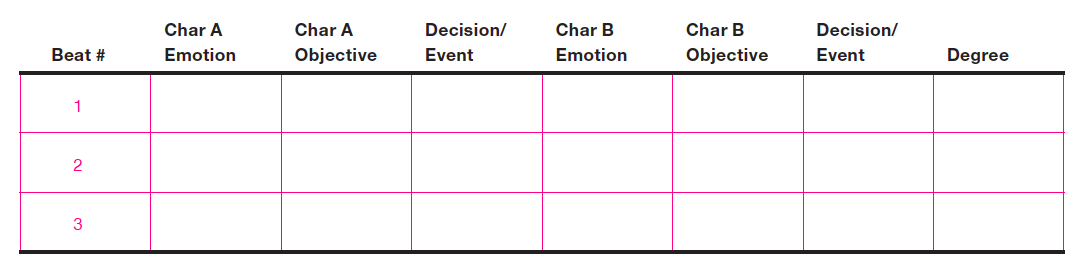
Table 1 Moment Breakdown
Melvin Udall, a novelist who suffers from obsessive-compulsive disorder (OCD), finds life difficult and threatening. OCD is a psychiatric disorder characterized by obsessive thoughts and compulsive behavior. Melvin exemplifies a typical behavior for those suffering from OCD in the opening scenes of the film: a continual washing of the hands prompted by a feeling of uncleanliness. To combat his disorder, Melvin has learned to follow a precise routine and to intimidate a path through people with enough linguistic absurdity and cruelty that his days are bearable, albeit cumbersome and lonesome. Carol Connelly, Melvin’s waitress, has been made into one of the elements in his obsessive breakfast habit, so that on a practical level, he cannot keep his routine without her: his usual breakfast at his usual table, served by his usual waitress. As a piece of his norm, Carol has made a small crack in his intense barrier, offering Melvin a touch of humanity, edgy enough to be palatable. Bearing the “I can do anything” spirit that comes from being a single-mother, she is confident, and even proud, of her ability to handle Melvin with humor. However, Carol has one Achilles heel: her very sick child. The following beat breakdown tracks Melvin and Carol through their first scene in the film. Melvin accidentally trips on her weakness during a teasing banter and nearly loses his permission to return to the restaurant.
This breakdown is based on the script. The breakdown for the final cut of the film is much more detailed, including many subtle moments within the beats, as found by Jack Nicholson, Helen Hunt, Jim Brooks, and Richard Marks (Editor). These additional creative decisions that truly create credibility are discussed in the papers that follow within this series. In this case, the assigned degree measures co-author interactivity and investment.
Notice that an internal conflict appears to exist within Melvin between the emotional choice of fear and the objective to keep my routine. The film establishes before this scene that Melvin cannot keep his routine unless he is angry and aggressive. Melvin must achieve the same goal, but from an awkward, unpracticed place of fear and timidity. This new emotional space creates an unusual decision for him, to back down. Melvin appears to the audience to be a complicated character full of mixed emotions.
As Good As It Gets: Cinematic Credibility
The interactive inner speech can quickly turn negative against the story if subtle detail is not attended to diligently. “Ouch, that was vicious—no one would say that! It doesn’t make any sense. I don’t buy it.” Successive beats, such as in the above scene, are full of credibility challenges.
Melvin: Melvin’s character and back-story14 is a delicate balancing act throughout the entire film. Too much venom, and we will hate him; not enough rancor and we will doubt that he suffers under the control of OCD. In this scene, we get a chance to see the complexity of the OCD barriers, giving us a sense of history. Everyone here dislikes him, except Carol, who has become integral to his routine, as has the table, the plastic cutlery, and the breakfast order. Stakes are what the hero stands to gain or lose in the adventure.15 We see the stakes for Melvin when this scene reveals his routine. His emotion and objective, noted in the beat breakdown and made clear in the script, reveals the strength of the stakes. When Brooks wrote the bitter exchange between Melvin and Carol about death and Carol’s son, “and it certainly sounds like your son will [die]” the level of cruelty had to be balanced by Melvin’s vulnerability and the bantering relationship he has clearly, in the past, created with Carol. He gets our empathy: “What a complicated life he leads. No wonder he’s crabby.”
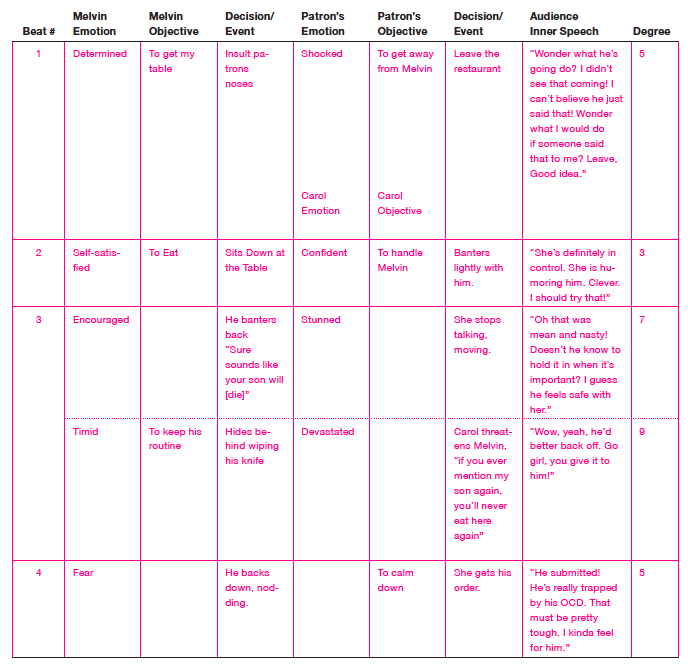
Table 2 Moment Breakdown of a scene from As Good As It Gets
Carol: With her emotion clearly transitioning from “confident” to “stunned,” we have clarity about the stakes and we believe the moment. Carol’s character is served by the setup Brooks provided in the earlier part of the scene. The word setup means, “to layer in knowledge.”16 Her calm, no nonsense handling of Melvin, as well as the other waitresses, tells us that she is cool under fire, capable of handling difficult situations, and sort of proud of her abilities, hence her objective “to handle him.” The payoff comes when Melvin crosses the line with her. Payoff means, to finally deliver the full meaning of “that knowledge to the audience.”17 We might have asked: “Why isn’t she just throwing him out? Why put up with it?” But instead we ask: “Wow, how is she going to competently handle this now?” Additionally, the conversation about her son at the opening of the scene is critical to setting up her vulnerability. Without it, we would have responded to her threat saying: “Hmm, she’s a protective parent” rather than the more accurate “He hit the nerve of a single mother struggling with a sick son, big mistake.” When we are in sync with a character, we can find meaning.
As Good As It Gets: Cinematic Meaning
The meaning behind any moment fully depends on the established credibility. The inner speech turns from doubt and confusion to problem solving. With emotional empathy, these turn to positive declarations of meaning and hope, both toward the character and ourselves. We, the co-authors, are pulled into the highest level of identification, and that creates personal introspection.
Melvin: Melvin’s fear of Carol’s threat gives us the greatest empathy for him as yet in the film. The meaning is clear and the menace of OCD is apparent: He is trapped. Without the restaurant, the table, the cutlery, and Carol, his world would be turned upside down. He must make a decision, and it is terrifying. Melvin must let down his considerable guard and acknowledge the choice in front of him. He is not going to be able to change the subject as he has done earlier in the film with other characters. Our inner speech reflects Melvin’s pain: “Oh this is messed up. He put his foot in it and he’s about to lose it all. I hate it when I say the wrong thing. I have no idea how to get out of it and I feel like a moron. I guess I’m not alone.”
Carol: Melvin’s damaging words stab at Carol’s efforts to deal with her life and her son. Brooks sets Carol up as a woman who constantly talks about her son, his health, his reactions to her dating, and how he is so amazing. These are the sentiments of a woman struggling to keep control of a potentially dangerous and out of control situation. Self absorption and adoration for her son are her understandable vices. Melvin cuts to the core of what she has become, belittling her, and flippantly throwing the death of her son, her greatest fear, into the mix. Our inner speech catches all of this: “Okay, that was brutal… sure she’s a little full of her own life, but look at what she has to deal with! I lose it when someone insults me. How is she staying calm?”
Decisions made by characters in narrative drama are measured against our own tendencies, and regardless of the different specific meanings that come from our individual perspective, the creative work is a success because the characters are drawn with credible back-stories, problems, emotions, objectives, decisions, and actions. Within the world that is created, the logic must be consistent even if it differs from the co-author’s experience. The inner speech may read: “I wouldn’t do that, but I can see how that character might.” Our interactive inner speech is driven to question, understand, and if possible, learn.
The CIND Writer Attends to Detail
Cinema has found its elements and principles organically over time, and while the stories in some cases are certainly bettered by the codification, the production of work has not had to wait for it. However, because CIND must capture the appropriate generalizations with rules that govern a wide range of narrative situations, it requires, by definition, a codification of these principles and elements before we can even begin to create the engine, let alone the project. While on this journey, much of what cinema has discovered, and continues to discover, can offer direction.
“A data-driven storytelling engine would require two major sections: a mass of data and a means of assembling that data into a story in response to the player’s actions.”18 The agency of all characters and the crafting of code require that the CIND writers think in terms of process. McKee notes that “to plot means to navigate through the dangerous terrain of story and when confronted by a dozen branching possibilities to choose the correct path. Plot is the writer’s choice of events and their design in time.”19 In CIND, plot is the writer’s and the co-writer’s choice. Crawford suggests that we use a metaplot which is “something like a plot, only it is specified by rules, not events. … Story is data, but storytelling is process. … That storyteller might be called an engine, a system, or an agent, but the term most commonly used is drama manager.”20
The Drama Manager
Crawford believes that a drama manager must listen, think, and then speak. “The drama manager must monitor the story’s progress. This step is simple listening.” Developing dramatic interpretations of the events, a drama manager must then determine how the story should progress. And finally, the drama manager needs to translate “its determinations into some form that will actually change the story world in a manner that helps the story evolve in the desired direction.”21 Finding a mathematical relationship between the cause and the effect and expressing that in a simple mathematical formula addresses anything that can be quantified. However, “an interactive storyteller need not achieve perfection of mathematical description; getting close enough for dramatic fidelity is all that’s required.”2222 Sometimes the same is true in cinematic narrative drama. For example, behind an objective is motivation. “Think through to a solid understanding of motive, but at the same time leave some mystery around the whys, … room for the audience to use its own life experience to enhance your character in its imagination.”23 Story mirrors life. We as humans are used to not fully understanding the motivation behind a certain person’s behavior. And yet, McKee also notes, “Somehow we must lead the audience to interpret the inner life from outer behavior.”24 The exchanges we experience with each other everyday are where we get clues to the mystery of another’s motivation. We expect the fidelity of response to be specific: we do something, the other person responds with an emotional tone and an action that hints at a reason. Jehlinger provides us the answer. He has found the basic elements needed in dramatic cinema to provide clarity to the audience about what is happening: “we must stay with one objective and one emotion until something occurs to change it” and “only two things can ‘occur’ to change objectives and emotions: new information or an event. We do not change for any other reason.”25 This is the data with which the story manager must work.
The Data
The drama manager relies on small units of data, often described as atomic in nature. The most outstanding example of CIND thus far is Façade, created by Michael Mateas and Andrew Stern. A joint dialog behavior (jdb), “Façade’s atomic unit of dramatic action (and closer to the canonical beat of dramatic writing) consists of a tightly coordinated, dramatic exchange of 1 to 5 lines of dialog. A beat’s jdbs are organized around a common narrative goal, such as a brief conflict about a topic” or the need to transition in or out of the beat.26 While joint dialog behaviors, like stepping stones, enable the narrative flow within a beat from one exchange to the next, they are implicitly, not explicitly, driven by two of Jehlinger’s smaller atomic units of drama, the emotion and objective of the character. Mateas and Stern note that “Façade is not generating sentences,” but that it is certainly generating sequences.27 Perhaps Jehlinger’s work is a step toward being able to generate those sentences, because for the audience to understand what is happening, the elements need to be handled by the artist-author and experienced by the audience-co-author as separate, distinct parts: emotion, objective, event, new emotion, new objective, and decision followed by an action, which becomes another event.
Event
Crawford describes Mateas’ and Stern’s work. “The construct at the core of their system is called a beat. A beat is what I call an Event; it is a single dramatic atom, although it is expressed as a sequence of audiovisual steps.”2828 Classically, an event is an occurrence, especially one that is particularly significant. According to Jehlinger, an event can be only considered an event if it causes the emotion and/or the objective of the character to change. Once the emotion and/or objective have changed based on that event, the character does something; they act, creating an event for another character to respond to, hence the action/reaction that McKee refers to in his definition of a beat: “a beat is an exchange of behavior in action/reaction.”29
We know that the word verb is used to show that an action is taking place. Crawford describes his work as Verb Thinking. “Verb Thinking…is central to understanding interactivity. The answer to the classic question ‘What does the user DO?’ is ‘The user does Verbs’.”30 Verb thinking also drives dramatic cinema, creating conflict, change, and meaning. “Nothing moves forward in a story except through conflict”31 and “The secret of all drama is difficulty.”32 Indeed the power offered by the scene in As Good As It Gets is found in the very struggle with which Melvin and Carol must wrestle during their interaction. “Event means change.”33 It is not enough to think of verbs (events), as simply action. That action must create change, or the moment is not dramatic. Whether watching a cinematic version or participating in an interactive version of our example scene, the events that Melvin and Carol create for each other are subtle, but they still create change. “Story events are meaningful….Story design…lays bare the network of chain-linked causalities that when understood, gives life meaning.”34 The changes brought on by each event raise the stakes and reveal meaning to anyone involved, the characters and the audience. Events must always create conflict and meaning for the protagonist, which in the most personalized version of CIND, will be the audience.
Objective
“The objective is the conscious intent of the character … (it) must always be difficult to attain.”35 Crawford folds the concept into behavior and uses the intrinsic variable in his personality model as motivation: “The personality model mirrors the behavioral universe of the story world…. Five broad types of variables could be used in a personality model: intrinsic, mood, volatility, accordance, and relationship. The first type includes the intrinsic personality traits associated with any character: greed, lust, pride, and so forth. The second type, mood, includes the variable emotional states people are subject to, such as anger or joy; these personality traits change with time. Volatility variables govern the readiness with which mood variables can change; accordance variables govern the readiness with which relationships change. The last variable type includes the relationships each actor has with all the others.”36 The broad nature of motivation from the personality model, and more specifically, the intrinsic variable, relates more closely with the dramatic concept of the spine.
In cinematic narrative drama, the inner problem and the outer problem work to provide motivation by creating the super-objective or the spine. The inner problem “is a personality flaw or a moral dilemma to work out.”37 The outer problem is the trouble foisted upon the character by outside forces; for example, the need to save a family member or the need to escape a bad situation. Another way to think about these two would be to consider them desires; the unconscious desire is the subconscious need that the character is unaware of and is self-contradictory in nature, and the conscious desire for the character is the need or goal of which they are aware. The spine or super-objective of the story is the deep desire in and effort by the character to restore the balance of life. If the character has no unconscious desire, then the conscious desire becomes the spine. However, an unconscious desire (inner problem) is always more powerful as the spine. The spine broadly defines the arc of change that the character goes through during the story. However, it is the specific details of the journey that progresses the story forward. These are found in the smaller objectives. In drama, there are beat objectives, scene objectives, sequence (of scenes) objectives, and act objectives. Each of these objectives is the conscious goal that drives that part of the narrative; each smaller objective must serve the intention of the next larger objective.
Jehlinger’s work gives us the ability to access the smallest objective, without which the story would lack credibility and meaning. Drama managers need to be built with the fine grain motivation of the moment, in addition to the larger motivations of the spine.
Emotion
“The second type [of personality model variable], mood, includes the variable emotional states people are subject to, such as anger or joy; these personality traits change with time. Mood spontaneously diminishes. No matter how angry you become, the passage of time will surely diminish that anger…. The storytelling engine, therefore, must examine each actor’s mood at regular intervals and relax it toward zero.”38 Jehlinger approaches emotion differently. The emotion is intended to help motivate and to communicate empathy, credibility, and meaning. The emotion should stay alive until something occurs to change it. This makes the emotion meaningful. We get to see the transition from one to the other. That gives us clues to the motivation of the character.
The behavior that Crawford describes, the diminishing over time, sounds more like McKee’s thoughts about feeling. Jehlinger states “emotions are feelings large enough to change your life or destroy it.”39 He means the big ones, such as anxiety, bewilderment, contempt, curiosity, defiance, desire, disgust, embarrassment, fear, and frustration. McKee states that emotion is a relatively short-term, energetic experience that peaks, burns, and then is over. Although, unlike Jehlinger, he does not state what would cause the burnout, he does note that feeling is not emotion. McKee believes that feeling is a long-term pervasive background that colors whole days, weeks, and even years. In this context, feeling operates more like an inner problem or unconscious desire.
Decision
“The user should be able to make lots of dramatically interesting decisions. How do you generate enough interesting decisions? How do you pare away the boring decisions? The interactive story world must present the player with decisions that hang on a razor’s edge, decisions that could readily go either way.”40 McKee agrees, “True choice is dilemma. [So] the choice between good and evil or between right and wrong is no choice at all.” Rather, the choice should be between irreconcilable goods or the lesser of two evils.41 Additionally, the true self “is revealed in the choices a human being makes under pressure: the greater the pressure, the deeper the revelation, the truer the choice is to the character’s essential nature. Choices made when nothing is at risk mean little.”42 So the goal of dramatic narrative in both CIND and cinema is to build situations where the decisions become incrementally more and more difficult. Decisions such as these can exist within beats, scenes, sequences, and acts.
The Beat: Final Thought
The choices other characters make in CIND are only clear to the co-author if the emotions and objectives remain active until other emotions or objectives take their place. The system might also feel more responsive and direct to the co-author if the drama manager changes the assumed emotion and objective from the co-author only after the co-author acts.
Conclusion
The audience has always held a co-authorship role with art. The artist can choose to ignore the inner speech of co-authorship and create an inconsiderate work or can choose to listen using all available and previously discovered methods. Defining the elements and principles of dramatic narrative has taken over one hundred years in cinema, and the task is far from complete. However, since CIND requires codification for programming, the choice to rely on cinema when designing drama managers will help considerably to reduce the workload.
This paper is the first of a series of papers I am writing that work with the final cut of the first restaurant scene in As Good As It Gets, addressing the nuances of credibility and meaning in more detail. The purpose of this series is to raise the awareness of and a dialog about the co-author’s inner speech and its manipulation in cinema, with the hope of beginning the delicate, intricate work of finding credibility and meaning in CIND.
Footnotes
- Alexander Mackendrik, On Film-Making, An Introduction to the Craft of the Director, ed. Paul Cronin (New York: Faber and Faber Limited, 2004).
- Chris Crawford, Chris Crawford on Interactive Storytelling (Berkeley: New Riders, 2005).
- Janet H. Murray, Hamlet on the Holodeck, The Future of Narrative in Cyberspace (Cambridge: MIT Press, 2001).
- Jeff Wirth, iPLAY (See http://www.cas.ucf.edu/iplay).
- Jeff Wirth et al., “The Orlando Game: An Experimental Intimate Interactive Performance,” SFDM Tech Report UCF- DM-2005.1. (2005).
- Jeff Wirth, Interactive Acting (Fall Creek, Fall Creek Press, 1994).
- Jeff Wirth, Interview with author, December 15, 2005.
- Robert McKee, Story, Substance, Structure, Style and the Principles of Screenwriting (New York: HarperCollins Publishers, 1997).
- Don Richardson, Acting without Agony, An Alternative to the Method (Needham Heights, Allyn and Bacon, Inc., 1994).
- Mckee, Story.
- Richardson, Acting without Agony.
- Richardson, Acting without Agony.
- James L. Brooks, As Good As It Gets (Culver City: TriStar Pictures, 1998).
- McKee defines back-story “as the set of significant events that occurred in the characters’ past that the writer can use to build his story’s progressions” (McKee, 1997).
- Christopher Vogler, The Writer’s Journey, Mythic Structure for Writers (Studio City, Michael Wiese Productions, 1998).
- McKee, Story.
- McKee, Story.
- Crawford, Interactive Storytelling.
- McKee, Story.
- Crawford, Interactive Storytelling.
- Crawford, Interactive Storytelling.
- Crawford, Interactive Storytelling.
- McKee, Story.
- McKee, Story.
- Richardson, Acting Without Agony.
- Michael Mateas and Andrew Stern, “Structuring Content in the Façade Interactive Drama Architecture” (paper presented at the annual Artificial Intelligence and Interactive Digital Entertainment (AIIDE), Los Angeles, California, June 2005).
- Ibid.
- Crawford, Interactive Storytelling.
- McKee, Story.
- Crawford, Interactive Storytelling.
- McKee, Story.
- Richardson, Acting Without Agony.
- McKee, Story.
- McKee, Story.
- Richardson, Acting Without Agony.
- Crawford, Interactive Storytelling.
- Vogler, Writer’s Journey.
- Crawford, Interactive Storytelling.
- Richardson, Acting Without Agony.
- Crawford, Interactive Storytelling
- McKee, Story
- McKee, Story
References
Brooks, James L., dir. As Good As It Gets. Los Angeles: TriStar Pictures, 1998.
Crawford, Chris. Chris Crawford on Interactive Storytelling. Berkeley: New Riders, 2005.
Mackendrick, Alexander. Paul Cronin, ed. On Film-making, An Introduction to the Craft of the Director. New York: Faber and Faber Limited, 2004.
Mateas, Michael and Andrew Stern. “Structuring Content in the Façade Interactive Drama Architecture.” Paper presented at annual Artificial Intelligence and Interactive Digital Entertainment (AIIDE) Conference, Los Angeles, California, June 2005.
McKee, Robert. Story: Substance, Structure, Style, and the Principles of Screenwriting. New York: ReganBooks, an Imprint of HarperCollins Publishers, 1997.
Murray, Janet. Hamlet on the Holodeck. Cambridge: MIT Press, 2001.
Richardson, Don. Acting Without Agony, An Alternative to the Method. Needham Heights: Allyn and Bacon, Inc., A Pearson Education Company, 1994.
Vogler, Christopher. The Writer’s Journey: Mythic Structure for Writers. Studio City: Michael Wiese Productions, 1998.
Wirth, Jeff. Interactive Acting. Fall Creek: Fall Creek Press, 1994.
Wirth, Jeff, Kenneth Ingraham, and Michael J. Moshell. “The Orlando Game: An Experimental Intimate Interactive Performance.” Tech Report UCF-DM-2005.1. School of Film and Digital Media, University of Central Florida (2005)
Wirth, Jeff. iPLAY. See http://www.cas.ucf.edu/iplay. (July 1, 2006).