
V3N1: A Case for a Formal Design Paradigm for Serious Games
By Glenda A Gunter, Ph. D., Robert F. Kenny, Ph. D., Erik Henry Vick, Ph.D. | July 2, 2013
Introduction
Serious games have become an educational trend. While we agree with James Gee that learning always takes place in well-constructed games, we contend that if content learning is to take place as a result of playing serious games, a new design paradigm must be developed. We also contend that educational effectiveness needs to be integrated as a goal from the start of the design process and that sound educational practices need to be formally incorporated into all serious games.
We are witnessing a mad rush to pour educational content into games or to use games in the classroom in an inappropriate and ad hoc manner in hopes that players are motivated to learn simply because the content is housed inside a game. A failure to base serious game design on well-established and practical instructional theories as proposed by well-respected educators like Robert Gagne and James Keller increases the risk of the game failing to meet its intended educational goals, yielding a player base who is entertained but who has not acquired new skills or knowledge. Well-developed video games certainly engage players, but games designated as educational are not always based on sound educational principles and theories, thereby potentially losing power as an pedagogical tool. If educational games are to succeed in being truly educational, a formal design paradigm that embraces both didactic and good design principles needs to be integrated at the beginning of the process of building the games.
This paper calls for a systematic implementation of well-established and appropriate instructional principles into the design of serious games, ensuring that the conceptual framework for developing content, curriculum, and best practices are embedded at a fundamental level and with educational soundness as the underlying skeletal lynchpin. Such a paradigm allows an easier assessment and verification of educational effectiveness and should provide a common ground for game designers and educators to collaborate, to allow game designers to more effectively add educational content to games and, conversely, to allow educators to more effectively incorporate games into their curricula.
Which Theory to Put into Practice
Deciding on which educational or instructional theories to follow is complicated. There may be as many educational theories as there are learners. While certain aspects of how today’s digital students learn have changed, the basic approaches to learning have not–especially for those things that students need to retain, such as the acquisition of literacy, meta-learning principles like basic numeric manipulation, science, social interaction, information mining, and communication. After an extensive search through the literature, we have found three theories that appear to most closely align with generally accepted game design principles: Keller’s ARCS Motivational Model, Gagne’s Events of Instruction, and Bloom’s Taxonomy. In this paper, we will review all three and analyze them against current game design ‘best practices’ in an attempt to codify and cross-reference the best of both into a unique design rubric specifically conceived for serious games.
Educational research builds the foundation for the development of sound instructional strategies. Similarly, in order to enhance learning, each new educational game should be based on learning theory and educational research. Educators have shown that the use of instructional theories has been shown to enhance learning and increase motivation and student achievement. Which theory you use depends on what you want to teach, how you want to teach it, and to whom you are teaching. The latter is very important because today’s digital students learn differently from previous generations and they are motivated in ways that are atypical to traditional ways of thinking. The question is how do we make the leap between learning theory and serious games in order to increase the efficacy of the medium and to empower students who are motivated by different means and who think, perceive, and learn differently?
Robert Gagne, a psychologist, educator, and instructional theorist is known for his contributions in the area of cognition and instructional theory. Instructional theory looks to understand under what conditions learning takes place. Gagne was very influential in the development and design of formal instructional systems, which borrow many of the principles of systems design (analysis, design, development, implementation, and evaluation), and materials and initiatives commonly used in training for inventory and logistics support for the military.
Gagne’s instructional theory has three major components. The first component was based on a taxonomy or classification of learning outcomes. He recognized that learners must go through a hierarchy of skills from simple to complex and identified five areas of learning outcomes he felt were crucial to successful learning; they are cognitive strategies, verbal information, intellectual skills, motor skills, and attitudes. Second, he proposed that particular internal and external conditions must be met in the instructional cycle for achieving the desired learning outcomes. Different types of learning require a variety of conditions that are appropriately matched to the particular learner and can effectively bring about the outcome of learning. In others words, instructional designers must match strategies to the interactive instructional conditions found in the game environment. Third, he developed what he labeled the Nine Events of Instruction that serve as a guide for developing and delivering a unit or units of instruction.
Gagne’s Events of Instruction
In his book, The Conditions of Learning, Robert Gagne identified nine mental conditions for learning (known as Events of Instruction). Gagne sought to understand what processes were necessary for individuals to internalize what is being taught. Gagne developed three principles that he considered essential for successful instruction:
- Providing instruction on the set of component tasks that build toward a final task
- Ensuring that each component task is mastered
- Sequencing the component tasks to ensure optimal transfer to the final task
For example, a teacher must teach phonics, the basic form of literacy, or alphabet recognition in order for students to then read words. Only after students learn to interpret or read words, can they then learn to read a sentence, and then two sentences, and then a paragraph, and so on. Gagne’s skill-building hierarchies fit very well into the increasing level of challenge model already followed in successful serious game design and that they easily lend themselves to become the basis for standard practice.
Careful preparation must take place so that learning is optimal and instruction can be broken down into meticulously designed lessons. Gagne believed that a variety of internal and external conditions must be present for learning to occur and he also believed that learning results in observable behavior. The internal conditions can be described as situations that include attention, motivation, and recall. The external conditions are the factors surrounding a person, such as timing and place. The observable behavior is the result of the internal process of learning. As per Gagne there are nine events that stimulate the processes required for learning to take place and be effective. According to Gagne’s theory, employing these sequenced steps would assure that the learner mastered the desired content and learning objectives. Gagne’s framework has been modified for a variety of educational settings. These adaptations became the foundations for multimedia authoring software programs like Linkway, HyperStudio, and HyperCard during the late 1980s and early1990s. We feel this framework would also be a perfect fit in the development and design of serious games.
The Nine Events of Instruction that Gagne believed all instructional strategies and lessons should include:
- Gain the learners attention
- Inform the learners of the objectives
- Stimulate recall of prior learning
- Present stimulus or lesson
- Provide learning guidance and instruction
- Elicit performance
- Provide feedback
- Assess performance
- Enhance retention and transfer
Following this research, Benjamin Bloom, also an educational psychologist, conducted research in student learning. Bloom and other psychologists sought to classify learning behaviors to understand better how knowledge is gained. Bloom classified learning into three domains: cognitive, affective, and psychomotor. Bloom defined the cognitive domain as a student’s intellectual level–that is, what a student knows and how they organize ideas, opinions, and thoughts. Bloom explained the affective domain as a student’s emotions, interests, attitude, attention, and awareness. Lastly, he categorized the psychomotor domain as one that includes a student’s motor skills and physical abilities. All of these domains can overlap in learning activities and are integrated throughout learning experiences.
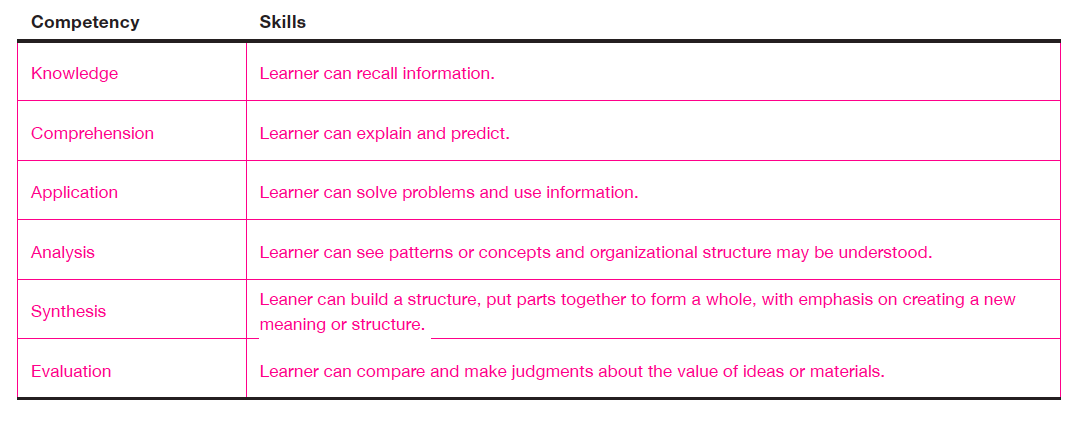
Figure 2. Bloom’s Taxonomy
Bloom was determined to develop a practical means for classifying curriculum goals and learning objectives. Many educators continue to develop curriculum goals, learning objectives, and specific learning activities with these three domains in mind. Educators are responsible for planning curriculum activities that support what students already should know (anchored instruction) and what they should learn (extending the learning experience). Educators create their instructional methods based on state standards, learning objectives, and learning theories. Teachers often organize skills they want students to acquire using a scaffolding effect from simple to complex. Within the cognitive domain, Bloom identified six levels that can be used to acquire knowledge about a topic. The levels move from simple to complex and are designed to increase a student’s comprehension. These levels commonly are referred to as Bloom’s Taxonomy (see Figure 2).
Many teachers may not realize they are creating instructional lessons and plans that only challenge students range within the first two levels. For instance, if students are learning about computers and then are asked to name only the parts and describe what they do, the activity has stayed in the Knowledge and Comprehension levels. If students are asked to propose how computers have changed their lives, the assignment has moved to the Analysis level.
The taxonomy provides a useful structure in which to categorize learning and strategize learning, since educators generally characteristically develop questions and lessons with particular level in mind. Developing game content, questions, and levels of inquiry using a taxonomy or hierarchy such as this that is based on appropriate instructional theory creates a new paradigm for instructional game design that benefits from instructional theory.
Bloom’s Taxonomy has been linked to mastery learning, which is defined as a model for learning in which students continue to gain information and knowledge, working through activities, content or teacher instruction only after they have mastered the content of the previous lessons, activities, and/or modules. Bloom demonstrated through his research that all students can learn a subject given sufficient time and motivation. According to Bloom, the critical ingredient is changing instructional methods by providing ample time and proper feedback so students can master the content.
Keller’s ARCS Model
One of the shortcomings of many instructional theories is that they begin with an assumption that the learner is already generally ready to learn and/or is already motivated to learn specific content. Motivation is a necessary but insufficient condition needed to ensure that learners actually learn something. Even the most sophisticated instructional program will fail if students are not motivated. Without a desire to learn, retention, let alone any other level of learning, is unlikely to occur. Instructional designers must strive to motivate learners so that they learn new skills and transfer them to newly acquired knowledge (that is Gagne’s ninth event of instruction: enhance retention and transfer).
James Keller, another educational psychologist who was a contemporary and colleague of Robert Gagne at Florida State University, devised a motivational model based on a synthesis of existing research on psychological motivation. The ARCS model relies on four foundational categories applied to the design of instructional activities: Attention, Relevance, Confidence/Challenge, and Satisfaction/Success.
Attention: The first aspect relates to gaining and keeping the learner’s attention. Strategies include initiating the instructional event with some sort of sensory stimuli, through an inquiry arousal (i.e., a series of thought provoking questions), and/or variability (such as varying the kinds of media or inquiry-based activities used). Much debate about motivation and attention throughout the twentieth century surrounded the concept of arousal and its relationship to limited capacities and cognitive load10.
Relevance: Simply put, learners need to be able to understand implicitly how the activity relates to their current situation, and/or to them personally. This is the first step in most instructional design models that rely on an understanding of learner attributes as a part of the analysis process.
Confidence/Challenge: This fundamentally paves the way for learners to feel that it is worth it to put forth a good faith effort into participating in the activity. However, the activity cannot be perceived as either too hard or too easy. If learners believe they are, somehow, incapable of achieving the objectives or that they will be wasting their time because it will take too long, or, conversely, that the challenge is beneath them, their motivation will most assuredly decrease.
Satisfaction/Success: Learners must attain some type of satisfaction or reward from the learning experience. Attribution Theory11 contends that learners must also be able to attribute successful completion of the activity from their own efforts. Judging success is a subjective evaluation that can be as simple as being happily entertained or enjoying a sense of achievement or accomplishment. Attribution plays a role in what Bandura12 referred to as self-efficacy–a person’s belief about his or her own capabilities to produce the intended effect. Being self-assured as to one’s accomplishments is directly tied to whether the learner can attribute that success to one’s own efforts and their ability to find their newly learned skills can be applied in other areas. Satisfaction can also be promoted through external rewards in the form of a passing grade, a high score relative to others, or a reaction by another person or mediated agent.
Keller never intended for his model to stand apart as a separate system for instructional design, but one that would be incorporated in accordance with instructional models and history such as Gagne’s Events of Instruction13 which makes a cross-reference to Gagne a fairly straight-forward task (see Figure 3 below).
Keller’s model attempted to fill a glaring hole that reduced the effectiveness of most educational theories. Most educational theories overlook the fact that there is no assurance that a student may be generally motivated to learn but may not be motivated to learn the specific instructional content introduced by an educational activity. Further, instructional designers cannot assume they understand the learners’ motivation. To analyze needs, the designer should understand how to encourage students to come to the same conclusions as to the values, interests, motivation, and content as set by the learning objectives of a particular lesson. Over the years, many follow-on strategies have been developed to turn Keller’s model into practice.
Dempsey and Johnson14 proposed using a rubric when applying the ARCS model to select and analyze games they were developing. Their scale (see Figure 3) adds practical application to the theoretical foundations proposed by Keller:
Karoulis & Dmetriadis15 discussed certain aspects of the ARCS model and proposed adhering to it in any educational activity. Most of these characteristics can be correlated directly into serious game design and can serve as a measurable and objective design and development checklist for serious game developers. These features are referred to as representations in the literature and provide practical applications and implementations of Keller’s theoretical construct.16
Among the representations are:
- Arousing one’s curiosity and interest
- A perception that accomplishing something is personally important
- Being able to relate the activity to a highly desired goal
- Expecting to be ultimately successful
- The compatibility to anticipated goals
- Content/concepts are easy to understand
- Opportunity to create something personal
- Layered/scaffolded challenges
- Challenging the imagination by creating a fantasy (extrinsic & intrinsic)
- Timely and accurate feedback (formative & summative)
- Perceived ability to control one’s own destiny
- Pattern recognition (cognitive modeling)
- The perception of freedom
- Establishing a reward system
- Relating and applying the activity to the learner’s real world context
- Fidelity in graphics design
It would seem that the correct and appropriate manipulation of any of the above attributes can lead to an enhanced motivation on the part of the learner for the educational activity.
Harlow classified two broad motivational categories that have been applied to instructional activities that also correlate to serious game design: process and reward.17 Process comprises the actual participation in any activity, such as the enjoying interaction and interface with the media, enjoying the increasing level of expertise, immersing and suspending the disbelief, taking pleasure in the mechanics of interacting with that content, and feeling satisfaction or success through gains from the process of interacting. The reward may be intrinsic or extrinsic, be applied at the completion of participation, and set the stage for further engagement.

RETAIN: A Design Model for Serious Games
Game design can be defined as the formal methods for the specification and planning of content and features for video games. The goal of these methods is to maintain intellectual control of the elements of the development process that lead to an immersive and entertaining game (e.g., to create a roadmap that describes the implementation).
Many assume that incorporating educational content into a video game will automatically succeed, both in achieving a fun game and in meeting educational goals. More to the point, many educators claim that a video game can provide the motivation required for learning simply because it is a video game. This is a new instance of the same error that Keller set out to correct. In terms of video games, while players may generally be motivated towards playing video games, there is no assurance that that they are motivated to learn what the game is proposing to teach. Further, it is a mistake to assume that all video games are motivating and fun.
In the game industry, a conservative estimate of the odds of any particular game design getting a green light for development and release are one in a thousand. The implication is that the other nine hundred and ninety nine games are found lacking in the attributes that lead to a successful game. While it is true that the metrics for success in the game industry are monetary, these metrics are a reflection of the game’s motivational power to engage players. In other words, only one in one thousand game designs are motivating and of those that are found to be motivating, many still wither on the vine. Therefore, the assumption that a game will succeed due to its innate nature is fallacious.
Similarly, many game designers and educators alike assume that learning always occurs in successful games. This may be true at a vacuous level, but one must ask: What is the relevance of learning that orcs have thirty-seven hit points more than hobgoblins? What is the relevance of learning how to defeat über sub-boss number seventeen in the big fight scene? More to the point, one must question how relevant, targeted learning may be included in video games without interfering with the game’s entertaining content.
James Gee19 suggests that thirty-six meta-learning principles are found in all games (serious or otherwise). Similar to Kiefaber’s20 arguments that gaming is inherently social, Gee proposes that playing games can be closely linked with building relationships and social hierarchies. Games are really social activities to the extent that the game itself often becomes secondary to the social experience. Gee also suggests that, when asked, most gamers will tell you that the main enjoyment they gain out of playing a game is the ability to become immersed in a world that they have a hand in creating, providing a sense of self-control and self-determination.
The idea that interacting with media is inherently a social activity is not new. In the mid 1990s, Reeves and Nast21 developed a series of research-based propositions to support notions of the social aspects of interacting with new media. If interfacing with computers and other media can be likened to interacting with people, then it follows that developing an instructional design basis for games can be likened to designing instructional activities for learners.
The problem centers on deciding which learning theory to follow, as there certainly are as many theories around as there are learners.
Serious game design, then, is the formal methods for the specification and planning of both educational and fun content and features that support both the game play and educational goals of serious video games. The goal of serious game design is similar in nature to that of entertainment games, but is more complex, in that not only must one maintain intellectual control of the design elements that lead to a fun and engaging game, but one must also plan instructional elements that lead to a fun, engaging, and educational game experience. To be sure, instructional strategies and learning theories must be included in these formal methods.
As Rouse2222 states, there are as many methods for producing a game design as there are game designers. However, these methods derive from the fundamental principles that are ubiquitous to games: suspension of disbelief, increasing dramatic tension, semiotics, system theory, software engineering, interactivity, engagement, and choice design. These strategies also describe the fundamental principles required to support an educational game, however, the methods based on these principles require an expanded focus.
In order to create an educationally successful game, one must define the game’s (or designer’s) focus, that is, the essence of what the game is about23 at the beginning of the game design process. For a serious game, this need does not diminish. The focus frames the game’s semiotics and provides the context for the design. For serious games, however, this designer’s focus is necessary but insufficient. In addition to the designer’s focus, a didactic focus is required for serious game design. To wit, one must know the semiotics and context for the entertainment the game is to provide and the semiotics and context for the education the game is to provide.
Salen & Zimmerman24 define play as the navigation of a suite of choices (i.e., decisions), where each decision leads to an action that has a discernable outcome and therefore game design boils down to the process of creating a set of critical choices that reinforce the focus of the game and communicate to the player how to advance the game. This visualization goes to the root of designing interaction.
The Multivalent Model of Interactivity establishes four modes of interactivity as related to games25. These modes are: Cognitive Interactivity (the psychological, emotional, and intellectual engagement of the player), Functional Interactivity (the structural interactions with material components of the system), Explicit Interactivity (participation with designed choices), and Beyond-the-Object Interactivity, (the participation in the culture of the game outside the direct experience of game play). While many entertainment games are successful targeting only the functional, explicit, and beyond-the-object modes of interactivity, serious game also require designs that support cognitive interactivity In instructional design, the application of an instructional strategy as described by researchers like Gagne, Keller, and Bloom supports cognitive interactivity. Therefore, in serious game design, an application of an instructional strategy will enable cognitive interactivity as well.
The Relevance Engagement Translation Assimilation Immersion Naturalization (RETAIN) model for serious game design is an apposite use of Gagne’s Events of Instruction, Keller’s ARCS model and the scaffolding principle found in Bloom’s Taxonomy. Given the fact that Gagne’s Nine Events were the result of work performed while studying simulation as a tool of education, it follows that the events have a natural application in video game structure. Keller’s ARCS model can be similarly adapted to design of game events or encounters. Bloom’s Taxonomy can be applied to enhance retention and transfer in the game context.
A subset of the Events of Instruction already occurs in game design. However, it does not appear that an equivalent in Common Game Elements for entertainment games (as shown in Figure 4) exists for the third Event of Instruction (stimulate recall) or the ninth event (retention and transfer) that keeps the spirit of Gagne’s work. The other seven Instructional Events all have corresponding Game Element complements. As with the set of fundamental principles of game design described above, some of these common game elements require an expanded focus in serious game design, but the similarity between the instructional models and the game elements is a strong argument for the adoption of these three strategies in serious games.
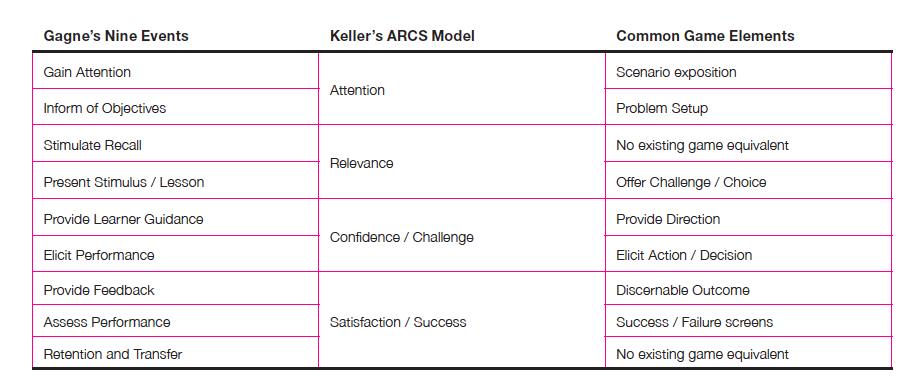
Figure 4 Comparing Gagne’s Events of Instruction, Keller’s ARCS Model, and common game design elements
A mapping to Keller’s ARCS model is more complete on its face, but to capture the spirit of Keller’s model as a model of motivation for learning, some expansion of existing elements must occur. In an entertainment-based video game, the player’s attention can be gained via traditional game elements (e.g., a dramatic hook, increasing tension, cutscenes, and/or music). In the design of a serious game, however, simply gaining the player’s attention is insufficient. The scenario exposition and problem setup must be expanded to include some type of advanced organizer26 to introduce relevant, educational content for the lesson.
A distinction of the relevance category of Keller’s model that is often lost in translation is that the activity must be relevant to the learner and be relevant to previous instructional events. Continuity of information flow is a critical part of Gagne’s events of instruction. A serious game design must take into consideration both of these concepts, especially as it relates to providing relevance to previously learned concepts from previous attempts to play the game.
The challenge provided by a video game must be attainable, just as in Keller’s ARCS model. In fact, given player’s expectations27 and the concept of meaningful play as defined by Salen and Zimmerman2828 it is arguable that there is no difference between the requirements of the Challenge category of the ARCS model, Gagne’s Events Five and Six, and the tenets of game design. Therefore assimilation of these principles into serious game design is unnecessary–they are already there.
The same argument may be extended to the Success category of the ARCS model with the exception that any player failures in the pedagogic realm must include attribution to the player and assistance in overcoming the shortfall. That is to say, players they should not believe they were unable to succeed in a given didactic task merely because the game “cheated” or otherwise blocked their success. As attribution is definitely a necessary prerequisite for eventual success and confidence, self-efficacy plays a very important role.29
Gagne’s Nine Events of Instruction are traditionally used to describe an individual lesson, but these events can be used to describe a curriculum as a whole. When used to describe a curriculum, the presentation of the lesson activity can be expanded to include multiple lessons, each described by the nine events. In this manner, Gagne’s Events of Instruction describe both a successful game and individual units of game play (i.e., the game as a whole and the levels that compose the game). Thus a formal structure for serious game design emerges:
- Provide a Game Focus / Hook—describe the essence of the game and provide an entry point for game play
- Provide a Didactic Focus‑define the subject matter to be taught during game play and provide an entry point for instruction
- Provide references to beyond-the-object reference sources which inform the pedagogic content development for the game
- Introduce a Game Progression (via units of game play—levels, modes, etc.)‑define the game units as described below
- Define the critical path30 for game play and didactic resolution
- Define pedagogic elements to be used
- Describe how formative feedback will be distributed during each unit of game play
- Describe how summative evaluation31 will be distributed during each unit of game play (per individual lesson) and at the conclusion of game play (per the curriculum as a whole)
- Describe how replay will be encouraging to assist in retention and to remediate shortcomings
Similarly, a formal structure of game unit design in serious games:
- Scenario Exposition (Unit focus)‑describe the essence of the game unit and how it is important to the game progression
- Didactic Exposition (Lesson focus)‑describe the essence of the lesson and how it is important to the curriculum progression
- Describe the use of backleading, cutscenes, and flashback techniques to bring to mind previous game unit’s and lessons, and the use of scaffolding to reinforce retention and transfer of previous lessons to future learning experiences
- Develop the Scenario’s Crisis‑describe the critical path from the start of the unit to the crisis and describe the resolution of the crisis. Include both game play elements and didactic elements and evaluate their fit to one another
- Provide direction necessary for the resolution of the game unit and the lesson
- Elicit decisions/Create actions‑describe how decision making will be elicited during game play and how these choices will instruct and advance the game
- Provide discernable outcomes to each decision and action that support both the didactic and designer’s focus
- Provide a summary of performance at the end of the game unit that includes proper attribution for shortfalls and successes.
- Include descriptions of how remediation will be implemented for failed tasks Describe the use of scaffolding in subsequent game units to reinforce the lessons offered in this game unit
Additionally, Gagne’s Events of Instruction and Keller’s ARCS model should be used in a proactive manner to create game encounters or game events within serious games. Salen & Zimmerman32 speak of creating designed choices for the player on the game’s critical path. The act of creating designed choices resolves into five steps:
- Knowing the state of the game at the outset of the choice
- Determining how the choice will be communicated to the player
- Extrapolating how the player will arrive at his choice
- Determining what the consequences of the decision will be
- Determining how the results will be communicated to the player
These five steps fit nicely within events one through seven of Gagne’s Events of Instruction and likewise to Relevance, Confidence and Success in the ARCS model. Therefore, expanding the method for creating designed choices:
- Create a situation that will gain the player’s attention via dramatic elements
- Describe the upcoming choice in detail to ensure that the intent of a didactic choice is communicated Know the state of the game at the outset of the didactic choice, and further, know the state of the instruction.
- Additionally, ensure that the placement of this choice is properly scaffolded with other choices
- Determine how the didactic choice will be presented in the context of the game and determine the learning objectives that will be satisfied by this choice
- Extrapolate how the player will arrive at his choice and provide learner guidance during the course of the choice to assist in the acquisition of knowledge
- Determine the consequences of each didactic choice and their impact on the instruction
- Determine how to best assist the player in attribution of the outcomes of these didactic choices and how to assist the player in learning from mistakes
- Describe how the choice affects assessment with regard to learning objectives and describe how this assessment will be communicated to the player
- Describe the linkage of this choice to other choices that will reinforce the lesson and test the transfer of knowledge
Of course, these instructional strategies should also be used as a self-check for serious game design. The design itself should be reviewed to ensure it follows Gagne’s Nine Events and Keller’s ARCS model. Additionally, the structure of the game progression should be verified against Bloom’s Mastery Level theory to ensure players have the opportunity to master the basics before being asked to perform advanced tasks. This practice will help to ensure success and the feeling by players that the learning objectives are possible to achieve. At the same time, learner/players can develop intellectual skills as they progress through different levels.
Conclusions and Future Work
Why not consider the game environment as a learning tool when students are learning about complex concepts? We submit that if instructional strategies are applied concurrent to content development in game design students would quickly adapt to the process of learning and actually enjoy the conditions under which they learned the concepts. Because the RETAIN Model is based on established, well-known, and well-studied instructional design theories, such as Gagne’s Nine Events of Instruction, Keller’s ARCS Motivational Model, and Bloom’s Taxonomy that are embedded during the design and construction of the games, better opportunities to teach content to digital, game playing students emerge.
In the future, we intend to further develop this paradigm into a design process for content that ties meta-learning principles and focused learning principles to content development and that allows these principles to be used as assessment tools for evaluation of serious game designs prior to their implementation. While we believe that Gee and his colleagues have successfully demonstrated that games have been very effective in enhancing high-level cognition and learning, much of what Gee is working with is in the affective learning domain. We contend that if content learning is to also take place as a result of playing serious games, the game design must encompass all three learning domains: cognitive, affective and psychomotor, and intend to continue to refine the RETAIN model with explicit methods in this regard. Of course, additional research that evaluates the application of the proposed paradigm to serious game design is called for in the future.
Footnotes
- James Gee, What Video Games Have To Teach Us About Learning and Literacy (New York: Palgrave McMillan, 2003).
- Marcy P. Driscoll, Psychology of Learning for Instruction, 3rd ed. (New York: Allyn & Bacon, 2005).
- Robert Gagne, The Conditions of Learning, 4th ed. (New York: Holt, Rinehart & Winston, 1985).
- Gary B. Shelley et al., Teachers Discovering Computers: Integrating Technology and Digital Media in the Classroom, 4th ed. (Boston, MA: Course Technology, 2006).
- Benjamin S. Bloom, Taxonomy of Educational Objectives, Handbook I: The Cognitive Domain (New York: David McKay Co Inc, 1956); David R. Krathwohl. Benjamin S. Bloom, and Barbara M. Bertram, Taxonomy of Educational Objectives, The Classification of Educational Goals. Handbook II: Affective Domain (New York: David McKay Co., Inc., 1974).
- James H. Block, Mastery Learning: Theory and Practice (New York: Holt, Rinehart & Winston, 1971). David Levine, Improving Student Achievement Through Mastery Learning Programs (San Francisco: Jossey-Bass, 1985)
- John M. Keller, “Motivational Design of Instruction,” in Instructional Design Theories and Models: An Overview of Their Current Status, ed. Charles M. Reigeluth (New York: Lawrence Erlbaum, 1983), 383-434; John M. Keller, “Using the ARCS process in CBI and Distance Education,” in Motivation in Teaching and Learning: New Directions for Teaching and Learning, ed. Michael Theall (San Francisco: Jossey-Bass, 1998); John M. Keller “Motivational Design of Instruction,” in Instructional Design Theories and Models: An Overview of Their Current Status, ed. Charles M. Reigeluth (New York: Lawrence Erlbaum, 1983), 383-434; John M. Keller and Thomas W. Kopp, “Application of the ARCS Model to Motivational Design,” in Instructional Theories in Action: Lessons Illustrating Selected Theories, ed. Charles. M. Reigeluth, (New York: Lawrence Erlbaum, 1987), 289 - 320.
- Glenda A. Gunter and Robert F. Kenny, “Video in the Classroom: Learning Objects or Objects of Learning?” (paper presented at Annual convention, Association for Educational Communications and Technology, Chicago, Illinois, October, 2004); Robert F. Kenny and Glenda A. Gunter, “Digital Booktalk: Pairing Books with Potential Readers” (paper presented at Association for Educational Communications and Technology, Chicago, Illinois, October, 2004). Robert. F. Kenny. Teaching Television in a Digital World: Integrating Media Literacy, 4th ed. (Westport, CT: Libraries Unlimited, 2004); Glenda A. Gunter and Robert F. Kenny, “Thinking Out of the Hexagon—Digital Media in the Classroom” (paper presented at the annual convention of Association for Educational Communications and Technology, Orlando, Florida., November. 2005); Robert F. Kenny and Glenda A. Gunter, “Literacy Through the Arts” (paper presented at the annual Conference of Association for Educational Communications and Technology, Orlando, Florida, November, 2005); Robert M Yerkes, and James D. Dodson, “The Relationship of Strength and Stimulus to Rapidity of Habit Formation,” Journal of Neurological Psychology 18 (1908): 459-82.
- Dolf Zillman “Television Viewing and Psychological Arousal,” in Responding to the Screen: Reception and Reaction Processes, ed James. Z. Bryant (Hillsdale, NJ: Lawrence Erlbaum Associates, 1991), 103-133; Dolf Zillman and Hans Brosius, Exemplification in Communication (Mahwah, NJ: Lawrence Erlbaum Associates, 2000).
- James Sweller. Instructional Design in Technical Areas (Camberwell, Victoria, Australia: Acer Press, 1999).
- Bernard Weiner, Achievement Motivation and Attribution Theory (Morristown, N.J.: General Learning Press, 1974); Bernard Weiner, Human Motivation (New York: Holt, Rinehart & Winston, 1980); Bernard Weiner, An Attributional Theory of Motivation and Emotion (New York: Springer-Verlag, 1986).
- Albert Bandura, Social Foundations of Thought and Action (Englewood Cliffs, NJ: Prentice-Hall, 1986).
- Robert Gagne, The Conditions of Learning, 4th ed. (New York: Holt, Rinehart & Winston, 1985). Robert Gagne, Instructional Technology Foundations (Hillsdale, NJ: Lawrence Erlbaum, 1987). Robert Gagne, Linda Briggs, and William Wager, Principles of Instructional Design, 4th ed. (New York, Holt, Rinehart and Winston, 1992).
- John V. Dempsey and Robert B. Johnson, “The Development of an ARCS Gaming Scale,” Journal of Instructional Psychology, 25, 4 (1998): 215-221.
- Athanasis Karoulis and Savvas Demetriadis, “Motivation and Representation in Educational Games,”in, Interaction Between Learner’s Internal and External Representations in Multimedia Environment, State-of-the-Art Report, ed. Stavros Demetriadis. (Kaleidoscope NoE, D21-1-1, 2004), 296-312.
- Shaaron Ainsworth and Nancy VanLabeke, “Multiple Forms of Dynamic Representation,” Learning and Instruction, 14, 3 (2004): 241-255: Diana I. Cordova and Mark R. Lepper, “Intrinsic Motivation and the Process of Learning: Beneficial Effects of Contextualization, Personalization, and Choice,” Journal of Educational Psychology, 88, 4 (1996): 715-730; Thomas W. Malone, “What Makes Things Fun to Learn? A Study of Intrinsically Motivating Computer Games,” Technical Report (Palo Alto, California: Xerox Palo Alto Research Center, 1980a); Thomas W. Malone, “What Makes Things Fun to Learn? Heuristics for Designing Instructional Computer Games,” (proceedings of the 3rd ACM SIGSMALL symposium and the first SIGPC symposium on Small systems, Palo Alto, California, 1980b): 162-169; Jette Van der Meij and T. de Jong, “Examples of Using Multiple Representations,”.in Interaction Between Learner’s Internal and External Representations in Multimedia Environment, State-of-the-Art Report, ed. Savvas Demetriadis (Kaleidoscope NoE, D21-1-1, 2004): 66-80.
- David Harlow, “Games as an Educational Tool,” Gamedev.net (2004). http://www.gamedev.net/reference/articles/article2082.asp (February 24, 2006).
- John V. Dempsey and Robert B. Johnson, “The Development of an ARCS Gaming Scale,” Journal of Instructional Psychology, 25, 4 (1998): 215-221.
- James Gee, What Video Games Have to Teach Us About Learning and Literacy (New York: Palgrave McMillan, 2003).
- Matt Kiefaber. Implications of Online Gaming. (1998). http://www.units.muohio.edu/psybersite/cyberspace/onlinegames/index.shtml, (February 24, 2006).
- Byron Reeves and Clifford Nast, The Media Equation: How People Treat Computers, Television, and New Media Like Real People and Places (Palo Alto, California: Center for the Study of Language, 1996).
- Richard Rouse, Game Design: Theory and Practice (Plano, TX: Wordware Publishing, Inc., 2001).
- Ibid.
- Katie Salen and Eric Zimmerman, Rules of Play: Game Design Fundamentals (Cambridge, MA: The MIT Pres, 2004).
- Ibid.
- David Ausubel, The Psychology of Meaningful Verbal Learning (New York: Grune & Stratton, 1963).
- Richard Rouse, Game Design: Theory and Practice (Plano, TX: Wordware Publishing, Inc., 2001).
- Katie Salen and Eric Zimmerman, Rules of Play: Game Design Fundamentals (Cambridge, MA: The MIT Pres, 2004).
- Albert Bandura, Social Learning Theory (New York: General Learning Press, 1971).
- Critical Path is a project management term that relates to a series of tasks that must finish on time and in a specific order so that the entire project is able to complete on correctly and on schedule. Each task in a critical path is known as a critical task.
- Formative feedback and summative evaluation are both educational terms that describe the content and timing of the feedback given to a student. Formative feedback differs from summative evaluation in many ways. Formative is information gathered for the purpose of improving performance during the process of learning. For example, a teacher may provide corrective feedback during a golf lesson in order for the student to take corrective action. Summative evaluation normally refers to final determination as to whether the student has passed (i.e., met the requirements of) the lesson after all instruction has completed.
- Katie Salen and Eric Zimmerman, Rules of Play: Game Design Fundamentals (Cambridge, MA: The MIT Pres, 2004).
References
Ainsworth, Shaaron and VanLabeke, Nancy. “Multiple Forms of Dynamic Representation”. Learning and Instruction, 14,3 (2004): 241-255.
Ausubel, David. The Psychology of Meaningful Verbal Learning. New York: Grune & Stratton, 1963.
Bandura, Albert. Social Learning Theory. New York: General Learning Press, 1971.
Bandura, Albert. Social Foundations of Thought and Action. Englewood Cliffs, NJ: Prentice-Hall, 1986.
Block, James H. Mastery Learning: Theory and Practice. New York: Holt, Rinehart & Winston, 1971.
Bloom, Benjamin S. Taxonomy of Educational Objectives, Handbook I: The Cognitive Domain. New York: David McKay Co Inc, 1956.
Cordova, Diana I. and Lepper, Mark R. “Intrinsic Motivation and the Process of Learning: Beneficial Effects of Contextualization, Personalization, and Choice”. Journal of Educational Psychology, 88, 4 (1996): 715-730.
Dempsey, John V. and Johnson, Robert B. “The Development of an ARCS Gaming Scale”. Journal of Instructional Psychology, 25, 4 (1998): 215-221.
Driscoll, Marcy P. Psychology Of Learning For Instruction, 3rd ed. New York: Allyn & Bacon: 2005.
Gagne, Robert. The Conditions of Learning, 4th ed. New York: Holt, Rinehart & Winston, 1985.
Gagne, Robert. Instructional Technology Foundations. Hillsdale, NJ: Lawrence Erlbaum, 1987.
Gagne, Robert, Briggs, Linda and Wager, William. Principles of Instructional Design, 4th ed.. New York, Holt, Rinehart and Winston, 1992.
Gee, James P. Gee. What Video Games Have To Teach Us About Learning and Literacy. New York: Palgrave McMillan, 2003.
Gunter, Glenda A. and Kenny, Robert F. “Video in the Classroom: Learning Objects or Objects of Learning?” Paper presented at Association for Educational Communications and Technology, Chicago, Illinois, October, 2004.
Gunter, Glenda A. and Kenny, Robert F. “Thinking Out of the Hexagon - Digital Media in the Classroom”. Paper presented at the annual convention of Association for Educational Communications and Technology, Orlando, Florida, November, 2005.
Harlow, David. Games As an Educational Tool. (2004). http://www.gamedev.net/reference/articles/article2082.asp (February 24, 2006).
Karoulis, Athanasis and Demetriadis, Savvas. “Motivation And Representation in Educational Games”. In Interaction Between Learner’s Internal and External Representations in Multimedia Environment, State-Of-The-Art Report, edited by Savvas Demetriadis. Kaleidoscope NoE, D21-1-1 (2004): 296-312.
Keller, John M. “Using the ARCS Process in CBI and Distance Education” In Motivation in Teaching and Learning: New Directions for Teaching and Learning, edited by. Michael Theall (San Francisco: Jossey-Bass,1998).
Keller, John M., and Kopp, Thomas W. “Application of the ARCS Model to Motivational Design” In Instructional Theories in Action: Lessons Illustrating Selected Theories. Edited by Charles. M. Reigeluth. New York: Lawrence Erlbaum, 1987, 289 - 320.
Keller, John, M. “Motivational Design of Instruction”. In Instructional Design Theories and Models: An Overview of Their Current Status. Edited by Charles M. Reigeluth, New York: Lawrence Erlbaum, 1983, 383-434.
Kenny, Robert F. Teaching Television in a Digital World: Integrating Media Literacy, 4th ed., Westport, CT: Libraries Unlimited, 2004.
Kenny, Robert F. and Gunter, Glenda A. “Digital Booktalk: Pairing Books with Potential Readers”. Paper presented at Association for Educational Communications and Technology, Chicago, Illinois, October, 2004.
Kenny, Robert F. and Glenda A. Gunter, Glenda A. “Literacy Through the Arts”. Paper presented at the annual Conference of Association for Educational Communications and Technology, Orlando, November, Florida, 2005.
Kiefaber, Matt. Implications of Online Gaming. (1998). http://www.units.muohio.edu/psybersite/cyberspace/onlinegames/index.shtml, (February 24, 2006).
Krathwohl, David R., Bloom, Benjamin S., and Bertram, Barbara M. Taxonomy of Educational Objectives, the Classification of Educational Goals. Handbook II: Affective domain. New York: David McKay Co., Inc., 1974.
Levine, David. Improving Student Achievement Through Mastery Learning Programs. San Francisco: Jossey-Bass, 1985.
Malone, Thomas. W.. “What Makes Things Fun to Learn? A Study of Intrinsically Motivating Computer Games”. Technical Report. (Palo Alto, California: Xerox Palo Alto Research Center, 1980a).
Malone, Thomas W. “What Makes Things Fun to Learn? Heuristics for Designing Instructional Computer Games”. (proceedings of the 3rd ACM SIGSMALL symposium and the first SIGPC symposium on Small systems, Palo Alto, California, 1980b), 162 – 169.
Prensky, Marc. “Digital Game-Based Learning”. Computers in Entertainment, 1,1 (2003).
Reeves, Byron and Nast, Clifford. The Media Equation: How People Treat Computers, Television, and New Media Like Real People and Places. Palo Alto, California: Center for the Study of Language, 1996.
Rouse, Richard. Game Design Theory and Practice, Plano, TX: Wordware Publishing, Inc., 2001.
Salen, Katie and Zimmerman, Eric. Rules of Play: Game Design Fundamentals, Cambridge, MA: The MIT Pres, 2004.
Shelley, Gary B., Cashman, Thomas J., Gunter, Randolph E., and Gunter, Glenda A. Teachers Discovering Computers: Integrating Technology And Digital Media in the Classroom, 4th ed. Boston, MA: Course Technology, 2006.
Sweller, James. Instructional Design in Technical areas, Camberwell, Victoria, Australia: Acer Press, 1999.
Van der Meij, Jette and de Jong, T. “Examples of Using Multiple Representations”. In Interaction Between Learner’s Internal and External Representations in Multimedia Environment, State-Of-The-Art Report. Edited by Savvas Demetriadis, Kaleidoscope NoE, D21-1-1, 2004, 66-80.
Walker, Henry M. “Do Computer Games Have A Role in the Computing Classroom?” Inroads-The SIGCSE Bulletin, 35, 4 (2003): 18-20.
Weiner, Bernard. Achievement Motivation and Attribution Theory. Morristown, N.J.: General Learning Press, 1974.
Weiner, Bernard. Human Motivation. New York: Holt, Rinehart & Winston, 1980.
Weiner, Bernard. An Attributional Theory of Motivation And Emotion. New York: Springer-Verlag, 1986.
Yerkes, Robert M. and Dodson, James D. “The Relationship of Strength and Stimulus To Rapidity of Habit Formation”, Journal of Neurological Psychology 18 (1908): 459-82.
Zillman, Dolf. “Television Viewing and Psychological Arousal”. In Responding to the Screen: Reception and Reaction Processes. Edited by James. Z. Bryant . Hillsdale, NJ: Lawrence Erlbaum Associates, 1991, 103-133.
Zillman, Dolf. and Brosius, Hans. Exemplification in Communication. Mahwah, NJ: Lawrence Erlbaum Associates, 2000.