
V2N2: The Changing Narrative Paradigm Analog to digital and what that means
By Michael Niederman | March 8, 2013
A narrative paradigm shift has occurred, the catalyst being the technology shift to digital in virtually all form of communications. Kuhn suggests that human experience will qualitatively evolve under the influence of a new invention. The technological shift from analog to digital is one of those events in the world that affects our basic mode of communication and has had a direct effect on how we “organize” our world. The current generation of “young” people (35 and under) are functionally different and the current turmoil and disconnect seen in both the classroom and our culture is the result of two paradigms at war. This conclusion is based on observations made while teaching writing and video production over the past twenty years at the college level. The shift to a digital narrative paradigm signals a group of changes caused by the technological advancement that has recast how we communicate and ultimately how we think.
“Nothing has changed since the Greeks first described it.”
“There is no new narrative.”
“Interactive narrative or non-linear narratives are meaningless phrases.”
“It is a technological gloss on the same old thing.”
“At the core of our culture is still classic narrative structure and any changes you see are just another generation putting their spin on it.”
These are just a few of the arguments that support my conclusion that a new narrative paradigm has overtaken our teaching environment. A digital narrative paradigm describes the relationships of how we communicate and ultimately how we think and the shifting paradigm involves a group of changes caused by the technological advancement in the media education field. Myself and other media teachers saw this change in a small way as we have gone from analog tape-to-tape editing to digital computer based editing. How students addressed editing changed, and many of the values of structuring, planning and discipline were replaced by a variety other methods. None of the different approaches seemed to please their “old school” instructors but the work produced by these students is often creative, with great merit as well as different. These changes seen in one area have now occurred culture-wide as digital methods impact everyone who has engaged with contemporary society.
The new paradigm embodies qualities often in direct opposition to the old paradigm; Linear and non-linear, depth and breadth, classic and eclectic and possibly even order and chaos. What occurred in my classroom with the most recent group of students is that the changes were far-reaching and complex and were all tied together by the unifying element, a digital perspective. The discussion of a new narrative paradigm can illuminate a series of changes in students such as odd study habits, obscure cultural interests and lack of interest in what we think is important in our culture. If we look back through the last 25 years a series of changes can be identified that might explain this generation as a product of the new paradigm and exhibiting as much difference as someone born before World War I. There are a variety of theories to explain rapid technological change, most notably Moore’s Law, but the kind of profound change in the core narrative form that has occurred in less than a generation has no easy theory to describe it and is best described as a unique and true shift.
The Analog paradigm and Linear Narrative as the norm
Our culture has taken certain things as the norm. This is based on thousands of years of western storytelling tradition. At the core of this is traditional three-act structure with a set group of story elements that arranged and rearranged with endless variation. This dynamic has been discussed with profound and deep thinking by a wide variety of theorists like Vladimir Propp, John Cawelti, and Northrop Frye. Storytelling tradition is reflected in the traditional approach to knowledge where Beginning-Middle-End/Introduction- Body-Conclusion is woven into the vast majority of world cultures and their modes of communication. This most basic formula is at the core of mainstream culture and is a common structure to virtually all communication. It has been handed from one generation to another with little change until now. This summation while not perfect does in broad strokes describe what most would agree is the narrative norm and its place in our culture.
The Changes in hindsight
The change from analog to digital in the world of technology is relatively easy to track. It is a history that has been charted in many books and often the front pages and business sections of newspapers on a daily basis. The changes in the narrative paradigm have been much harder to track though some knowledgeable people have made the attempt but often focused on non-linear narrative as the change (this is only a part of it) and with an accent on the future or better described as “let’s talk about the Holodeck” discussion. The observations in this article are based on anecdotal evidence. In this case anecdotal evidence based on the result of these changes (the under thirty crowd) provides a clearer and more unified starting point to make sense of a complicated issue. The observation of the changing paradigm is based on the coming together of a variety of elements that included personal, professional and larger cultural experiences, which I realized were summed up in my dayto- day experience with students.
New inputs: First games then the Internet then…
The under 30 crowd grew up playing DIGITAL games and using DIGITAL information. The world was translated into 0 and 1s and what was 0 and 1s were as real as the world. Instant messaging and on-line gaming have a reality that I can intellectually understand but the students have a much deeper and real connection with these digital forms of reality. The relationship previous generations always had to media—analog with an easily understood connection between reality and the media representation was transformed by the translation process that occurs with digitization, reality is sampled and is never again whole in the same way analog media can create.
Volume of input: Television went from 3 networks to many
Television remote controls were at one time mechanical devices using tuning forks. That was okay because there were only a few channels to flip through. A few voices became many in the last 30 years (have you looked at a remote lately) and the volume of information that television puts into our homes and into our minds have reached a deafening roar. The current generation of students that grew up in that volume has simply adapted. The incredible volume became the norm and they selected rather than turned down the volume. Now substitute the world sampled for selected. Television is only one medium among many that has gone this route as availability of media has risen sharply in the last 25 years.
Speed of input: Multitasking became the norm
Students today listen to music, read a book and watch TV and/or work on the computer. They have adapted to their world by creating an environment that resemble the world the must compete in on a regular basis. Multitasking is an adaptive behavior that allows the individual to have control of an uncontrollable situation that is swimming in the media overload that is the modern world. [See Middletown Media Study.]
The brain “wiring” started to change: Is it organic or cultural?
What I saw as my own unusual approach to working and collect information (I was a multi-tasker as a kid and assumed I was just odd) began to appear to become more the norm. It raised several questions. Was the cultural change more a question of habit rather than some profound shift? If it is organic how do you even begin to measure it? How do you analyze it without letting value judgments color the process? These questions are beyond well beyond my expertise and the anecdotal observations I bring to the discussion. I will leave these as questions to ponder.
Cultural literacy debate in Late 80’s
From my perspective, an early sign of some changes happening came from E.D. Hirsch and the cultural literacy debate that has its moment in the late 80’s. This debate always disturbed me because it seemed to be the wrong discussion but that point I couldn’t imagine what the right discussion was. It seemed irrelevant to what I was seeing in the classroom where I saw bright students coping with a series of technological changes that were occurring at speeds I had never seen before.
Changes hitting a critical mass in the 90’s
By the middle 90s the students I was seeing in the classroom had been raised almost exclusively in this changed environment and a critical mass was achieved, These new kind of students began to show up in my classes in grater and great numbers just as I was teaching a class that gave me insight into the nature of the new student.
Teaching “Writing for multimedia”
I designed and taught this class from the mid nineties. It addressed issues of translating traditional storytelling form/logic into strategies useful for writing both web based information and game base interactive media. It exposed me to a group of students who by their very nature were at the forefront of the paradigm shift because of their embracing of computer use and awareness of themselves as somehow different. At that point I had been teaching writing for almost fifteen years and seen some changes take place with my students. What I had expected and seen in the 80’s as a shared story sense and common culture actually existed. Talking to these students drove home the fact that sense of common culture began to slip. Things I often took for granted in broad range of topics, my students stared at me blankly. Using Television as an example they knew the Brady Bunch but not Monty Python even though they were produced in the same year. While this lack of awareness isn’t like losing a figure to obscurity like Martin Luther King, the process of one generation handing their culture to the new seemed to have been disconnected. This disconnect seemed more than a simple issue of a generation gap because their interests as demonstrated in the breadth of their class assignments were astonishing. This lead to the next set of questions for me as a teacher in the classroom; how do they go about getting their knowledge base, how, when and in what environments were they doing the assignments I was asking and how do teachers teaching more traditional content see these changes reflected in their experience?
The pedagogy and experience of this class deserves a close examination at another time but issues that came into clarity from this experience were these:
These were bright and talented students whose methods of intellectual engagement and habits were not the same as the students who I began teaching 15 years earlier.
Their relationship with technology was fundamental different then the preceding generation and went far beyond just being more facile with a program.
Because of their interests in computers, they were different than a lot of their peers but with each class the difference became more and more distinct, including a change in their sense of story and ultimately change how they viewed and dealt with the world.
The arguments against the changes as a paradigm shift
As this notion of a paradigm shift began to become clearer, the obvious arguments against this conclusion also emerged. They tended to fall into one of two categories.
Student Decline
Some teachers claim we are experiencing a growing sense of educational deficiencies in our students. No foundation, no grounding in the classics. “Our students don’t have the basics”. They are more interested in video games then any book and they will always take the easy route rather then do the “real work”. At my school I have seen an increase in plagiarism and a difficulty in understanding what plagiarism even is but it is too easy just to say they are a lazy worthless generation. The issue is more complex then that. In fact I would argue the plagiarism upswing points seems to the paradigm shift rather than a decline. Plagiarism is hard for them to understand because they live in a world of acquisition where anything digital is fair game. The do it with movies, images, music and in their own mind, the process of research (the internet) and writing (Cut and paste) is what they are doing and a legitimate act of creation. Overall, they might seem incredibly shallow in their basic knowledge but their ability learn software, play complex simulations (games to the rest of you…) and manage and manipulate information when it is required speaks to vary flexible and able minds, just not very much like the majority of the over 35 crowd.
Nothing New
Nothing has changed. There is no new narrative. Interactive narrative or nonlinear narratives are meaningless phrases. At the core is still classic narrative structure and this phenomenon is much as they have been throughout history, reactions to classic structure. All the variations are still defined by classic structure. We perceive the world in a linear fashion and narrative will always be defined by that experience. However, this argument does not account for two important things. The reactions against classic structure have always been part of a sub-culture and a reaction to mainstream culture. What I’m looking at now is mainstream culture (or at least what passes for mainstream culture), a culture shared by the vast majority of 30 and under group. What else is new is the profound transformation the world moving from analog to digital creates. It changes the inherent relationship to all information. The ability to manipulate digital media and its very nature (it’s all 0 and 1’s you know…) means a different state of consciousness for the group that was raised on it from day one.
The New Paradigm
The table below in simple terms set up the shift of the paradigm.
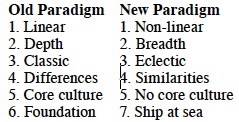
Non-linear
Students don’t think in what we think of as a conventional structure, in the linear tradition. They approach knowledge by linking ideas or knowledge. A hypertext metaphor seems to work describe the approach more accurately.
Breadth not depth except
Areas of interest become the target of deep interest. New threads are often found in these excursions but there is no “coherent” (Linear) structure to the information. Scattered by “traditional” definitions.
An eclectic approach
Everything is of interest but the traditional or “classic” topics/content rank no higher than comic books and trance music. Popular culture is of high value and there is little or no high art/low art distinction.
Everything is similar — A digital perspective
A digital perspective changes the relationship to all types of content. Students perceive that underlying everything is zeroes and ones. This changes the relationship to the information. They see similarities where we have traditionally seen differences. Each piece of media in an analog world has a distinct existence. For example, photos are based on negatives that are all distinct which based on a specific location, time and event. For us of the older generation this is part of the romance or value we often place on these pieces of media. Inherent in all digital media is a transformation process, the sampling that leads to digitization of the media. All the different types of media at some point exist in the identical state and can only be differentiated with the use of a program. They media is stored or transported in the identical fashion whether it is music, text, images or moving pictures. This “similarity” of experience translates into a very different relationships and instinct to interact or manipulate all media in similarly complex and often transformative ways.
No core culture/sub-cultures rule
There is no majority based mainstream culture for the next generation. While we have a common tongue and America’s culture has become the common thread around the world, however. the culture hand off that has traditionally occurred between generations has become smaller and smaller. While not embracing it, I knew most of my parent’s culture. The amount and speed of information coming at all of us has reduced what we all share as a common culture (think of the decline of the role of the three broadcast networks) and the “digital generation has developed a strategy of sampling the world in the manner that interests them. They perceive their identity through their sub culture and their digital perspective extends to themselves and their identity.
A new metaphor for cultural literacy
Traditionally we use the word “foundation” when talking about someone who we thought of being culturally literate as is they have a good foundation. That required all the content and skills we have conventionally viewed as part of a good education. This approach does not describe the majority of the under 35 generation. A better metaphor would now be a ship on an ocean with the important question being, is it sea worthy? This “ship” is the tools and skills that allow them to navigate the vast information that is a part of their world. They cast their questions overboard like a fishing line and troll for the answer. How successful they are is dependent on both the ship (tools) and their skill. Not a perfect system but clearly a change in method and the resulting notion of literacy. It is undeniable that we are all sailing in a vast sea of information dramatically different from 25 years ago and it is why many older people feel like they are ill equipped to deal with it or in other words, drowning in information.
Final observations
The new paradigm means the student arrives with a different knowledge base and skill set and that requires different teaching styles and that quite possibly will require us as teachers to question the foundations of what we consider our role as teachers are.
These ideas emerged out of a classroom experience while enjoyable, was neither easy nor totally successful. What was clear was that these issues would not go away. Now several years removed from teaching this class, some ideas have emerged to that can be part of a strategy for teachers to deal with the students who have been and will be arriving at our institutions for now on.
Accept the fact that we are no longer the masters of the tools
Many teachers have relied for last two decades on being the master of the tools. This often worked because students didn’t have access or the training and that’s what they were showing up at college to get. Now as we all know, college is too expense and the tools too cheap. Technology is needed but is no longer the foundation for our interaction with our students.
Focus on aesthetics/skills that have value in both traditions
In my own department, this issue has pushed us to focus on two things, storytelling and critical thinking. While in many respects this sounds like a return to more traditional educational values, these educational objectives are married to technology and culture in a way that has meaning for the students. It requires finding value in alternative forms that are a part of their milieu and creating structures within the curriculum that reward them for living in both worlds,
Develop a notion of expanded storytelling
There is bridge from the past to the future that is inclusive of the shift from analog to digital. We ask the students to live in both worlds; we must be able to do much the same. From my perspective as a teacher of media it translates into a notion of expanded storytelling that at the moment is inclusive of both paradigms. Part of me thinks that analog/linear paradigm will always be with us but I also owned a Betamax deck. In other words, we do not know what the future holds and for the moment I find the best place for my students is to be inclusive of both paradigms and see what happens next.
As an educator many questions have come up from these observations. What does it mean to our teaching? What does it mean to our core values? What does it mean for the notion of a cultural literacy? How would basic forms of communication change? I can only begin to have answers at the moment; I couldn’t have articulated these observations as I was teaching the class. But as with any difficult challenge, the questions must come first.
References:
Kuhn, T. (1962). The Structure of Scientific Revolutions. Chicago, IL: University of Chicago Press.
Propp, V. (1993). Morphology of the Folktale (Publications of the American Folklore Society). Austin, TX: University of Texas Press.
Cawelti, J. (1976). Adventure, Mystery, and Romance: Formula Stories as Art and Popular Culture. Chicago, IL: University of Chicago Press.
Frye, N. (1967). Anatomy of Criticism: Four Essays. Princeton, NJ: Princeton University Press.
Papper, R., Holmes, M., Popovich, M. (2004) Middletown Media Studies, Ball State University IDMAA Journal Spring 2004
Article Authors

Michael Niederman
Michael Niederman is an award-winning film and video-maker, as well as the chair of the Television Department at Columbia College in Chicago. He has taught in all areas of the department but now focuses on writing, directing and transmedia. Niederman is a board member of the National Academy of Television Arts and Sciences and founding board member of the International Digital Media and Arts Association. His award-winning projects include the dramatic film "The Paled Man" which was screened nationally, and the documentaries "Voices from Northern Ireland," shown on the PBS network, and "Seven-Day Wonder," "Presumed Guilty," and "Shades of Grey which have all aired on WWTW-TV in Chicago. In 1996, he served as the host of Reel Time, a thirteen-part series focusing on student film/video makers and their works produced at and broadcast on WYCC/Channel 20, Chicago. He has worked extensively in corporate and educational media production, writing films and tapes for a wide variety of organizations. He has written and lectured extensively on television, popular culture and emerging narrative forms.