
V2N2: Growing Up Digital: Implications for Teaching and Learning
By Robert F. Kenny | March 8, 2013
Introduction
Robert McMahon (1996), an early media literacy pioneer with the New Mexico Media Literacy Project, once quipped that if you want to keep a child’s attention in school, all you have to do is show them a commercial once every seven minutes. He may have been more right that he knew. For years, media educators and communication theorists have analyzed and critiqued ideas about the impact media have had on our youth, including inferences that the types of media people use help define the way they think (Ong,1982; Greenfield, 1984; Fiore, 1997). These extensions to McLuhan’s (1964) original concepts of the ‘media and the message’ have a bearing on questions about the effects television viewing and more recently, video game playing may be having on the cognitive abilities in children (Fiore, 1997; Gladwell, 2000; Prensky, 2001). These questions also ask for more investigation as to which long-standing instructional techniques still can have a positive bearing on learners, considering the fact that many educators are beginning to understand that today’s mediacentric youths think, see, and otherwise perceive differently than previous generations.
If one of the fundamental principles of instructional design such as the ADDIE model is to first analyze the learners, then it follows that perhaps it is time to reexamine what may be a major paradigm shift in cognition. This article attempts to investigate the applicability of psychological style as a means to identify cognitive processing characteristics of two groups of K-12 students from different generations but with similar demographics to determine if today’s youths actually perceive and process information differently than previous ones.
Changes in Cognition and Changes in Media Production
Media production techniques have changed significantly. Encouraged by the successes of those who pioneered the use of rapidly presented video montages that were developed in the music videos produced for networks like MTV, VH1, and Nickelodeon, today’s television and video game producers regularly communicate very complex messages using extremely fast-cuts and video montage. The term sound byte was originally conjured up by the media industry to refer to a practice used during political campaigns in which candidates were directed by their handlers to deliver their speeches in short 30-60 second declarations to make it easier for the news media to use them during their nightly broadcasts. Now with the ever-increasing use of rapid cuts and multiple on-screen vectors, according to some, sound bytes may just be the longest segments on television (Stephens, 1996). Marc Prensky (2001) made his case for labeling today’s youth the ‘games generation’ referring to their ability to think and process information at ‘twitch speeds’. In eight short years, McMahon’s ideas on the length of a child’s attention span may now prove to be an overstatement.
Child development psychologists like Robert Doman (1984) have long posited that toddlers learn more in their first five years than in any other time of their lives. During these formative years, these youngsters rely mostly on rightbrained activities, perceiving and processing images very rapidly at rates that equal or exceed a new image every 100-300 milliseconds. One wonders what happens to this rapid learning process just about the time that a child enters his or her formal educative years and why many never seem to develop leftbrain skills that are associated with critical thinking and language learning. It may be pure coincidence or it may just be a combination of extended usage of new media, television viewing, and computerized video games that have caused an imbalance in the brains of a child who never quite out-grows an over-dependence on right-brained processing activities leaving his or her left brain to become under-developed. Whether there is a direct causal relationship between this imbalance between left and right brain and shortened attention spans, and television viewing has not been shown –relegating the argument to a “chicken and egg” dilemma. Has the faster pacing actually re-wired our children’s brains or has the predilection for rapid pacing and shorter scene segments become more prominent because of viewer preferences? The answer lies in the fact that television is not alone in promoting this tendency towards shorter and shorter attention spans in our youth. Studies have supported researchers’ claims that children spend an average of four thousand hours over their teenaged years in front of computer screens (Greenfield, 1984; Healy, 1998; Prensky, 2001; Tapscott, 1997, 1998). Children may actually be watching television less than previous generations. These researchers have attempted to use their findings to support their same claims that computer usage increases in Attention Deficit Disorder (ADD) and/or Attention Deficit Hyperactivity Disorder (ADHD) and/or violent behaviors.
While causal relationships have still yet to be decisively proven, there is no question that today’s media-centric youths somehow perceive (and learn) differently than previous generations. There is an ever-increasing volume of evidence that claims today’s teenagers’ brains have been, somehow, rewired by this increased exposure to computerized media are true (Diamond, 1988; Fiore, 1997; Gee, 2003; Goode, 2000; Healy, 1998; Luria 1966, 1973; Moore, 1997; Restak, 2003; Tallal, 2000; Tapscott, 1997). Accordingly, this alleged re-wiring of the brain has produced several side effects. Prensky (2001) claims that today’s ‘games generation’:
- has the ability to process information at “twitch speed” (i.e., process a wide range of information at once).
- has a preference for graphics over text-based communications and an increased ability to recognize patterns
- approaches information randomly
- has the need to stay connected with their peers and actively participate in the learning process
- is motivated by a sense of play
- has the need for an immediate payoff
- has developed a “new” sense of reality that commingles back and forth with fantasy
- has a personal relationship with technology (p. 52).
Prensky’s references to changes in perceptual processing bring up several interesting questions with regards to the kinds of mediated instructional strategies that might be more motivating and more effective as a source of perceptual stimuli for recognition and recall. In fact, an investigation into the construct of the video game design culture reveals several incidences of where educators could take some lessons in how to better match the learning environment to the needs of today’s students (Gee, 2003). A total review and update of previous studies relating to cognition and learner attributes just may be in order.
Analyzing Learner Attributes - Which Tool is Best?
Educators have not always agreed on the best instruments for analyzing learner attributes. In fact, there may be just as many analysis methods as there are learners. However, two approaches seem to stand out and have garnered considerable amount of research. The multiple intelligences (MI) learning style instrument has been widely used and re-purposed (Gardner, 1993). Gardner suggests that humans possess at least eight distinct units of mental functioning. These units, which he labels intelligences are alleged to have their own specific sets of abilities that can be observed and measured (Morgan, 1996). Gardner proposed that each of these abilities comprises a separate construct. One downfall with the multiple intelligences approach is the fact that the results are mostly based on self-reported responses to preference questionnaires that reflect a learner’s preferred style. Research has shown that students do not always learn best from their preferred method of receiving information (Sternberg, 1997).
Morgan (1996) suggests that the eight intelligences are really a re-categorization of cognitive styles. Cognitive style analyses are based on assessments of the participants’ activities that take place during the process of learning. The idea of cognitive styles actually predates Gardner’s work, who, surprisingly, never makes mention of them in his works. The concept of cognitive style came out of the New Look movement about perception that was born during a symposium sponsored by the American Psychologist Association held in New York in 1949 (Witkin, 1981). Participants in the New Look movement were a loose confederation of psychologists who based their research on Dewey (1935) and became critical of the dominant approaches to perception then in vogue. Their main criticism was that most then-current approaches tended to ignore the person doing the perceiving. Out of that symposium came a flood of new studies aimed at looking at the personality traits of individuals (i.e., individual differences). Out of this broad context of research emerged definitions for cognitive styles that have gone through several iterations and refinements (Witkin,1981). For example, Wittrock (1979) defined cognitive style as the stable ways in which persons differ in perception and encoding of information. Guilford (as cited in Green, 1985) defined cognitive style as that “which conceptualizes intelligence as having a process dimension” (p. 2). According to this view, learning is not merely an automatic reaction to a stimulus but a set of operational steps that varies depending on individual proclivities. Brumby (1982) asserted the following assumptions regarding cognitive style:
- One’s cognitive style is singular (i.e., an individual has only one) and can be measured on a bi-polar scale.
- While an individual possesses one main style, others may be present in varying degrees.
- Individuals can select an appropriate style appropriate to the task at hand.
Ridberg, Parke, and Heatherton (1970) found that cognitive style is an accurate predictor of performance in a variety of measurement tools including those for reading recognition, secondary learning, and reasoning. Sam Messick (1970), a charter member of the 1949 New Look movement, catalogued nine dimensions of cognitive style covering research he and his colleagues performed, as well as that of others who came along in the years that followed. His list included scanning, breadth of categorization, conceptualizing style, levelers versus sharpeners, distractibility, tolerance for unrealistic experiences, cognitively complex versus simple, field-dependent versus independent, and impulsive versus reflective. Of the nine mentioned, meta-research has shown the latter two to be the most commonly accepted as credible sources for investigating how individuals perceive and process visual patterns (Green 1985). If this is true, it follows that a study that assesses changes in students’ choice patterns (also referred to as impulsive-reflective tendencies) might be a way to confirm current theories on the impact of media, computers, and video games usage on things like students’ ability to pay attention, how they perceive, and how they learn.
The Need to Revisit Cognitive Styles
The majority of the research on cognitive styles is twenty years or older. Participants in the studies were students who were encountering older forms of multimedia and did not encounter daily doses of MTV and fast paced video games. An evaluation might be in order to analyze the results of the more popularly used cognitive style inventories administered in the earlier years and compare them to current research whose participants are digital learners. One such instrument is the Matching Familiar Figures Test (MFFT) that was developed in the late 1960s by Jerome Kagan (1966). A review of the literature reveals there is little reference to the MFFT (specifically in the educational domain) since Cairnes and Cammock’s (1984) reliability studies performed in Northern Ireland in the early 1980s. Some studies were conducted as late as 2003, but most of that work was conducted in the fields of psychology and cognitive sciences and not in education. Furthermore, it is not difficult to imagine how twenty years of apparent brain rewiring attributed to hours and hours of sitting in front of video and computer screens might affect the results of cognitive style evaluations, especially instruments that measure impulsive and reflective tendencies. Further, it would be interesting to re-examine related instructional strategies such as pacing, the amount of simultaneous information that can be absorbed at once, spiral learning, the proper mixing of active and passive activities, ideas about intrinsic and extrinsic motivation, and changes that may be needed in instructional strategic delivery strategies based on any new outcomes that result from re-evaluating the impulsive-reflective cognitive style.
There have been several previous attempts to look into relationships between instructional strategies and cognitive styles (Clements & Gullo, 1984; Jelsma & Pieters, 1989; Thompson, Teare, & Elliott, 1983; van Merriënboer, 1990; Waring, Farthing & Kidder-Ashley, 1999). But most of these studies predate the predominant rapidly-paced production techniques that have become commonplace in today’s commercial-produced products and programs. The digital media revolution has resulted in a myriad of products that allow media consumers to also become producers. Being able to easily produce content has only made digital media more pervasive, adding to the need to take a closer look at their potential impact on younger learners who do not know of a world without them.
These ideas about brain rewiring cause one to ask whether our formal education system is still basing its views about cognition and learning on outdated thinking. For some, a significant body of evidence exists that posits what many refer to as Attention Deficit Disorder (ADD) is really nothing more than a skill developed for rapid multi-tasking by children who have been raised in the digital age (Prensky, 2001). In other words, a child raised in the fast-paced digital world is simply choosing what to pay (and/or not pay) attention to. Some researchers even propose the notion that attention deficits may simply be an act of a child choosing to turn off, (i.e., power down) because of a belief or perception that the school environment he or she enters every day actually impedes his or her learning (Moore, 1997). Given the long-respected view that learner attribution affects what is learned and how it is learned, a change may be warranted in the way in which educators view digital media’s role in motivating learners, initiating learning, and conveying more complex or abstract thought (Jones, et al, 1972; Weiner, 1974, 1986). We may well be entering an era in which these newer forms of media technologies that employ visual imagery supplemented by quick motion, sounds, and editing can become important and successful motivational learning objects and pedagogical tools, and may be required if education is to become more effective and address the current needs of students.
Corcoran (1981) once defined intelligence as a skill in a particular medium suggesting that the symbolic codes used in that medium serve communication purposes and are internalized by a receiver eventually become an authentic tool for thought. Indeed, there is evidence that fast thinking is a trainable activity and using fast thinking techniques may well be a motivational factor in that this kind of pacing more closely matches the learning and/or cognitive style of today’s learners. The US military, for example, used tachistoscopes to train frogmen to rapidly identify while underwater the different shapes of hulls of enemy ships during WWI. Follow-on research resulted in several uses of what was eventually called ‘T-Training’ to teach speed reading and even foreign languages (Fletcher, 1993; Greenwald, 1972). Educators have had some successes in modifying cognitive styles using film media (Ridberg, Park & Hehterington,1970). Since most studies that review the impact of changes in tempo are quite dated, it would seem that it is time to re-look at the cognitive processing attributes of today’s learners to see if these perceived differences may also necessitate like changes in instructional delivery strategies.
Impulsive - Reflective Scale
Along with dependant-independent variables, the impulsive-reflective scale has one of the most often researched instruments in the cognitive psychology domain (Heineman, 1995; Sternberg & Grigorenko, 1997). This scale was developed from Jerome Kagan’s research (1965) using a fifteen-question instrument he called the Multiple Matching Figures Test (MFFT) to measure cognitive tempo (i.e., rate of cognition) in younger aged children in which their speed and attention to detail was indexed. According to Kagan (1966), children deemed to be impulsive tend to react very quickly and make quick decisions (i.e., they select the first answer that occurs even though it may be wrong), while reflectives tend to take more time to consider various options; they are also generally more accurate with their interpretations. He came to the remarkable conclusion that contrary to many stereotypes about bright children thinking quickly, neither tendency for fast or slow decision times were significantly related to verbal ability or innate intelligence. Some have criticized Kagan’s findings, noting that although response times were positively correlated with performance, overall, the correlations were often quite low –ranging from close to zero to around .45 (Block, Block & Harrington, 1974). On the other hand, some believed that those criticizing Kagan ignored the converse of the measurement scale that compares slow-accurate to fast-accurate, indicating that accuracy, not speed counts the most in complex problem- solving situations (Ayabe, 1973; Bridgeman, 1980).
Some of the negativity towards Kagan’s views on cognitive assessment is attributable to misapplying its use. For example, some psychologists took an extremely bi-polar view of the impulsive-reflective classification, and, as a result, tended to make over-generalizations about the overall psyche and/or personality of their subjects in cases calling for less polarization and more sub-categorization. On the other hand, educators have successfully used the reflective-impulsive classification in specific educational evaluations. Campbell and Davis (1982) found that the “reflection-impulsivity style construct emerges as an ecologically valid and parsimonious descriptor of a component of student behavior” to the extent that it can be used to determined whether learning performance is actually hindered (p. 8). Boyden and Gilpin (1978) found latency and error rates to be independent of measures of distractibility. Others concluded that the relationship between impulsivity and academic achievement is not necessarily tied to aptitude or intelligence but to one’s ability to pay attention and/or to process specific types of inputs (Messer 1970; Kogan 1971; Leino 1981). In particular, Cooper (1982) suggested that differences in the speed at which a person is able to process information is an accurate indicators of one’s ability to process visual information. Hedberg and McNamara (1985) found that with visual information, the tendency towards reflective or impulsive behaviors is an important predictor of performance, mainly in relation to time and error under conditions of response uncertainty and time pressure. Merriënboer (1990) was able to use the classification as a predictor of academic performance and use it to prearrange feedback strategies to increase effective computer usage, especially in younger students. Anderson and Revelle (1994) looked at changes in daily arousal rhythm patterns and the role they play in causing similar alterations in impulsivity-reflectivity tendencies. They found that impulsives tend to demonstrate high alertness and sense of arousal (i.e., the processes that mediate non-specific alertness, or liveliness), a key element in learning preparedness. Their research supports the idea that impulsivity rates vary (i.e., are more prominent) by the time of day, with impulsive tendencies being more pronounced in the morning hours. These views of impulsive tendencies appear to contradict much of the current thinking with regards to shortening attention spans and detrimental effects of rapidly paced environments have on a child’s ability to learn. If this finding is true that there actually are certain instances where rapid-fire processing actually aids the learning process and that today’s digital child has developed an increased ability to handle rapid fire visual inputs, it follows that educators need to attempt to find a match between the instructional strategies and corresponding student’s abilities –at least as a motivational technique. Robert Doman (1984) put it best: teach to one’s strengths in order to remediate the weaknesses.
Reliability of the MFFT
The original MFFT was evaluated for validity and reliability and adapted over the years by several individuals with mixed results (Block, Block & Harrington, 1974; Watkins, Lee & Erlich, 1978; Arizmendi, Paulsen & Domino, 1981). Ikegulu and Ikegulu (1999) found that the notion of a generalized visual processing rate may be questionable based on the fact that there have been few repeated studies to test the generalizability of the measurement. Other research indicates that impulsive-reflective designation might be best depicted on a continuous (i.e., from low to high), rather than a bi-polar scale, as reported in the impulsive-reflective arrangement (Salkind & Wright,1977). Salkind and Wright went on to hypothesize that continuous scaling seems to contradict a basic definitional premise of a cognitive style (that is style by its very nature is bi-polar). This apparent anomaly appears to some to create a lack of power for the impulsive-reflective scale to be useful in accurately classifying a cognitive style. Ault, Mitchell, and Hartmann (1967) contributed the loss of power to Kagan’s possible over-reliance on latency rather than number of errors to determine reflective versus impulsivity. The findings of Ault, Mitchell and Hartmann seem to ignore Kagan’s (1965) original hypothesis that stated that categorization is the result considering together both speed and error-rate.
From 1978 through 1984, Ed Cairns & Tommy Cammock (1984) conducted several studies to answer most of the above reliability concerns. The result was the development of a 20-question version (MFFT-20) of Kagan’s original study (which contained only twelve). To further strengthen power of the MFFT, Cairns and Cammock (1984) confirmed their 20-item variation of the original instrument with five separate reliability tests. The final version of their instrument includes twenty sets of pictures reduced down from an original list of thirty-two that was, in turn, linked together and prioritized by several earlier studies. Based on the information discovered in their studies, the authors determined that the MFFT-20 was a superior instrument with regards to reliability and validity to earlier tests.
In spite of the apparent validity of Kagan’s ideas and the reliability of Cairns and Cammock follow-up studies, the idea of using cognitive style as a predictor of learner performance appears to have fallen out of favor in the past couple of decades. Not much has shown up in a review of the literature for almost twenty years. The instrument has primarily been used primarily overseas and mainly for evaluations of psychological disorders (Miyakawa, 2001). The instrument has also been used in Spain recently to test its reliability as a first stage in a Spanish adaptation (Buela-Casal, Carretero-Dios, del os Santos- Roig, Bermúdez, 2003). This study also concludes that the MFFT-20 is a “reliable and valid measure of reflexivity and impulsivity.” (p. 151).
Re-looking at the usefulness of the MFFT-20
The apparent test-retest reliability of the MFFT-20 makes it well-suited to be used as a comparison vehicle between multiple groups. This creates an opportunity to re-look at the MFFT-20 almost twenty years later to a new set of individuals with similar characteristics (similar sample size of school children of the same chronological age). Because impulsive-reflective behaviors mitigate with aging (Waring, Farthing & Kidder-Ashley, 1999), it is difficult to perform longitudinal studies using the same individuals. On the other hand, doing comparison studies between participants of similar age and demographic settings might provide interesting insight as to whether the impulsive-reflective characteristics in children of the same age group have changed over time, especially in light of the ever increasing discussions about today’s children’s brains being re-wired by constant interfacing with digital technologies. There has been so much in the news and in the literature lately about ADD tendencies in children and conclusions and comparisons drawn between cognitive tempo and attention deficiencies, looking at differences in impulsive-reflective could provide another useful way to determine the effect this alleged re-wiring has had on impulsivity and reflectivity tendencies over time and, in turn, whether these potential changes have any affect on the way students learn.
The fact that changes in cognitive tempo can be made trainable makes individualized longitudinal studies less valid where time is the constant and outside environments are one of the variables. An alternative might be to test with a different set of participants whose demographics match closely with those of the first testing group. It should follow that with many of the demographic characteristics of the test participants being constant, one of variables between the groups is the amount of time and energy being devoted each day to watching television and playing video games. While no causal relationships may be drawn from such an implementation, re-applying the MFFT-20 could provide some insights as to general cognitive inclinations of groups of individuals with similar characteristics.
A Comparison Study
The focus of this study was to determine if changes had taken place over time with regards to impulsive–reflective tendencies in students of similar ages and demographics and to determine whether the kind of changes in mediated instructional delivery style that are more in line with the cognitive tempo of today’s net generation students might be useful in enhancing their motivation and interest in learning. The concept of comparing the two group’s cognitive styles came about as a part of a much larger study that involved evaluating participant’s abilities to remember certain facts from a rapidly-paced video (Kenny, 2002). In order to draw as many comparisons as possible to the norms developed for the Cairns and Cammock study, the subjects for this study came from a population of ninth grade students from a high school in Central Florida with similar chronological and demographic characteristics to those participating in the original studies in which the MFFT-20 instrument was developed. Using this particular age group is significant because it is at this point chronologically that Cairns and Cammock (1984) found that the differences in latency and error rates tended to level off. Others also agree with the idea that impulsivity is a characteristic that mitigates with age (Okun 1979; Wright 1979).
The overall sample set of this study consisted of 204 male and female subjects who were categorized by cognitive style as determined by a computerized version of the Cairns and Cammock instrument. For this study, the paper copies of the exact same figures and alternative choices were scanned into a computer and imported into a program written in Macromedia Director. The computerized program presented the pictures and their alternatives on one screen and allowed subjects to click on their selected picture to indicate their response. Additionally, the program automatically kept track of the total number of choices made by each participant and the amount of time to first choice (i.e., latency) for each of the picture sets.
Multiple copies of an executable form of the program were made so that each subject was able to view their own individual screen in a lab containing 30 Dell Pentium IV computers. Subjects wore headphones in order to hear the directions that were being read and also being displayed on the computer screen. The headphones also added the convenience of providing a more focused environment and eliminated surrounding stray noises and disruptions. The program presented two sets of sample items followed by 20 sets of actual pictures in the exact order as the paper version of the MFFT-20. Participants answered the two sample questions and then clicked on a START button when they were ready to begin the actual instrument. They were asked to click a START button to move on after completing each set of twenty questions. The process of clicking the button initiated the internal system clock that tracked latency to first response. By delivering and tracking the responses in this way, the program avoided counting any delays that might occur on the part of the computer processor as part of the latency calculations during test administration.
The program scored the subjects on each question according to latency based on the time it took for participants to make their first choice and the total number of errors before first correct response. As with the paper version of the MFFT-20, subjects in this study were presented with 20 example pictures of familiar items and are then asked to identify which one of six alternatives is identical to the example. If an error was made the subjects were subsequently asked by the program to retry until a correct response was given. Once a correct choice was made, the program displayed the next set of pictures until all twenty sets were completed. Controls were put in place so that subjects were not able to see each other’s screens. Each participant’s responses were recorded on the hard drive of the computer in a text file. These text files were then imported into an Excel file and later transferred into an SPSS data base for statistical analysis.
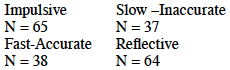
Figure 1: Results of the MFFT-20
The median dividing line between impulsive and reflective was determined according to the specifications for the MFFT. A median split score was calculated for both latency and total number of errors. The scores were placed into quadrants made up of two intersecting axes, as shown in (Figure 1).
Those who made very quick but inaccurate decisions ended up in a quadrant labeled impulsive. Those who were more deliberate (i.e., showed an increased latency to first response) and made fewer errors than the calculated median were to be determined reflective. Subjects found to be fast-accurate (i.e., faster and more accurate than the calculated medians) or slow-inaccurate are placed in two other cells and disregarded for the purposes of this study. To complete the study, comparative statistics were drawn to show the median and average number of errors and latency times for the Cairns and Cammock studies and the current implementation.
Discussion
Due to the way the results were reported from the Cairns and Cammock study, a formal statistical comparison was difficult. The purpose for their research was to show reliability for the newly constructed 20-item test. Therefore, reporting detail statistics was not necessary or required. Because no detailed statistics for the participants were offered, any comparisons made are mainly anecdotal, due to insufficient power resulting from the lack of individual statistics from the original study. The intent of the comparison had to change and rest with determining if there is enough anecdotal evidence to warrant further investigation using whole new groups of individuals and begin keeping track to determine trends. A casual observation of the comparisons of medians reveals that something had changed between that data derived from the Cairn and Cammock studies and this study. Both the median number of errors decreased (from over eighteen to eleven), as well as the median latency to first response (from 11.7 to 9.12). A statistical significance test was not conducted but the results show that something interesting happened from one implementation to the other. The means rather than the median was used as the test variable between the studies because that is the value most consistently reported in the Cairns and Cammock studies. Not only did the participants in the current study notably reduce the time it took to make their first choice, but also the average number of errors made showed marked reduction. The differences appeared to be great enough to show that there has been a definite reduction in the media split for impulse to first response and the number of errors from 1984 until now.
These reductions seem to indicate that latencies to first response for visual activities are growing shorter, but the quicker response times do not always translate to a higher number of errors. Stated positively, more correct answers were being selected in less time. In addition, when one compares the median latencies and errors and the percentages of fast-accurates between the Cairns and Cammock studies and the current study, there appears to be a general lowering of the latencies and errors and a general increase in the number of fast-accurates as a percentage of the total sample. The number of participants who landed into either the reflective or impulsive categories represented approximately 59% of the total sample, which represents an increase of about 20 percentage points above those who did likewise in the Cairns and Cammock studies.
Other trends between the Cairns and Cammock study and the current one appear to have developed. For one, females were excluded from the Cairns and Cammock study due a determination that the differences between males and females were significant enough at that time that including them would confound the results. In the current study, the differences between males and females were not significant. An investigation could be made to determine whether the differences in cognitive styles between males and females have lessened with the latter’s increased usage of digital media.
The results of the cognitive style instrument used in this study to categorize subjects indicate that learning styles have definitely changed since the original instrument was analyzed and developed. While the results can only be deemed generalizable to those who participated in each study, they do indicate that perhaps changes are taking place with regards to today’s youth’s propensity for and skills in visual processing. Technological improvements have both significantly increased the occurrence of rapidly presented montage passages found in television programs, in movies and movie trailers, and in commercials in particular. These improvements have also made it possible to more effectively and easily test the effect onthe rapid presentation speeds and cognitive style in ways that was not practicable previously. One of the premises of the current study was to see if the ability of today’s media-centric youth to more quickly perceive and assimilate visual images was due to casual television viewing habits and video game usage. Future studies need to be developed to determine the extent to which this may be occurring and whether increasing visual perceptual skills can be a trainable activity and one that can be useful to developing instructional strategies for students who appear to be attracted to these kinds of visual inputs. Indeed the idea of resurrecting cognitive style studies is appealing for these reasons.
Summary and Conclusions
Most universally recognized instructional design and development theories have accurately established that audience/pupil analysis is an important part of the design process. Cognitive style is one of many different analysis techniques that are useful for this purpose. The MFFT-20 developed by Cairns and Cammock in the late 1970s and early 1980s has been determined by independent reliability studies to be even more powerful than the original MFFT that was designed by Jerome Kagan in the 1960s and 1970s. The MFFT-20 has been shown to be more effective measurement tool for analyzing this form of cognitive style. Because the primary purpose of the five studies reported in by Cairns and Cammock was to develop a more reliable instrument, no results for individual participants were reported. This made it extremely difficult to test for statistical differences in means between the Cairns and Cammock study and the current one due to the resulting lack of power.
On the other hand, an informal comparison of Cairns and Cammock’s results and those reported in this article appear to contribute to the ever-increasing body of evidence that something is changing with regards to today’s mediacentric youths that cannot simply be written off as another fad or temporary change in students’ perceptions. Recent studies (Kenny, 2002; Papper, Holmes & Popovich, 2004; Waring, Farthing & Kidder-Ashley, 1999) that looked into perceptual processing speeds and their fondness for and the ability to multiprocess media back up claims that today’s youths are able to process wide ranges of simultaneously delivered multimedia information, especially if that information is being conveyed using digitally mediated methods. In addition, Tapscott’s ‘Net Generation’ also shows tendencies that indicate that more and more of them demonstrate a predisposition for what educators have traditionally labeled ADD. In other words, ADD may well be on its way to becoming the norm.
The results of the comparison between the Cairns and Cammock study and the current one raise several interesting questions as they relate to the goals and objectives of K-12 schools of providing educated members of today’s and tomorrow’s workforce. First, is the business world that values employees who are capable of multitasking being severely under-served and short-changed by the apparent failure of our schools to recognize the value of students’ ability to rapidly process information? Has the failure of our schools to make corresponding changes in the way knowledge is imparted contributed to the apparent increase in disappointing literacy and other results being reported by our educational institutions? Is there going to be a huge cultural clash between those already in the workplace and the younger generation that is on the verge of entering and who do not know a time without the Internet or newer forms of digital media production? Is it possible to train the older generations to process information more rapidly so that it can compete with this new, upcoming digitally- oriented population? Answering these questions and others like it should help us break from the cycle of failures.
Perhaps it is time to make dramatic changes in teaching methodologies ratherthan making our younger generation conform to older forms of thinking andlearning. It has been said that no generation has ever taught the next to bedifferent than itself. Maybe the digital media revolution will change this trendand help find new ways to motivate students to think for themselves. Whileconsiderable more examination needs to be conducted to confirm the inferencessuggested by this informal review and in the many recent books andarticles published on the subject; the results do imply that we may be shortchanging students by simply labeling them with attentional problems.
There have been some studies that investigated how differing cognitive styles can affect the outcomes of instruction, but they mostly dealt with matching styles of teachers to their students. Very little seems to have been done that take cognitive style into consideration as a modifier of the delivery methods themselves. Further, most of the reported studies dealing with measuring cognitive styles appear to be quite dated. The results of this comparison do suggest, however, that studying them (impulsive-reflective scale in particular) still has relevance.
One definition of insanity is to keep doing the same thing over and over again and expect the results to be different. It is more insane to do the same thing over and over again and attain worse results and still be satisfied with them. Perhaps, the reason for deteriorating results in today’s schools is that the students are changing and the instructional methods are not. Using welltested assessment instruments like the MFFT-20 can provide some interesting insights into what kinds of changes in cognitive processing capabilities are being brought on by the major paradigm shift in communicative, social, and vocational attitudes of today’s digital generation. It would be interesting to then assess instructional delivery methodologies in terms of which ones positively reflect this major change in cognitive characteristics of the learners rather than continuing with the current practices of trying to improve education solely by tinkering with the curriculum. It is not suggested that instructional techniques and/or subject matter be changed solely because the digital generation displays a different and unique set of cognitive styles. To be sure, some of the processing characteristics being displayed by our youths reflect an imbalance in right versus left brained activities –something that surely needs to be corrected in our attempt to provide a balanced education. But identifying these proclivities is the first step in implementing Doman’s “teach to the strengths and remediate the weaknesses” concept.
References:
Anderson, K. K., & Revelle, W. (1994). Impulsivity and time of day: Is rate of change in arousal a function of impulsivity? Journal of Personality and Social Psychology 67(2): 334-344.
Arizmendi, T., Paulsen, K., & Domino, G. (1981). The Matching Familiar Figures Test: A primary, secondary, and tertiary evaluation. Journal of Psychology Spring: 812-818.
Ault, R. L., Mitchell, C., & Hartmann, D. P. (1967). Some methodological problems in reflective-impulsivity. Child Development 47: 227-231.
Ayabe, H. I. (1973). Measuring reflection-impulsivity accurately. Annual Meeting of the American Educational Research Association, February 25 - March 1 (ERIC Document Reproduction Service No. ED 079 333), New Orleans, LA.
Block, J., Block, J. H., & Harrington, D. M. (1974). Some misgivings about the Matching Familiar Figures Test as a measure of reflection-impulsivity. Journal of Developmental Psychology 10: 611-632.
Boyden, J. G., & Gilpin, A. R. (1978). Matching familiar figures test and Stroop test performance in adults. Perceptual and Motor Skills 46: 854.
Bridgeman, B. (1980, Fall). Generality of a “Fast” or “Slow” test-taking style across a variety of cognitive tasks. Journal of Educational Measurement 17: 211-217.
Brumby, M. N. (1982). Consistent differences in cognitive styles shown for qualitative biological problem-solving. British Journal of Educational Psychology 52: 244-257.
Buela-Casal, G., Carretero-Dios, H., del os Santos-Roig, Bermúdez, M.P.(2003). Psychometric properties of a Spanish adaptation of the matching familiar figures test (MFFT-20). European Journal of Psychological Assessment, 19 (2), 151-159.
Cairns, J., & Cammock, T. (1984). The 20-Item Matching Familiar Figures Test. (ERIC Document Reproduction Service: No. 015681-4).
Campbell, D., & Fiske, D. (1959). Convergent and discriminate validation by the multi-trait/multi-method matrix. Psychological Bulletin 56: 81-105.
Campbell, D. S., & Davis, R. B. (1982). On the validity of reflection-impulsivity as a construct in classroom research. Annual Meeting of the American Educational Research Association (ERIC Document Reproduction Service No. ED 222 502), New York, March, 1982.
Clements, D.H., & Gullo, D.F. (1984). Effects of computer programming on young children’s cognition. Journal of Educational Psychology, 78, 309-318.
Cooper, L. A. (1982). Strategies for visual comparison and representation: Individual differences. Advances in the Psychology of Human Performance. R. J. Sternberg. Hillsdale, NJ, Lawrence Erlbaum Associates.
Corcoran, F. (1981). Processing information from screen media: A psycholinguistic approach. Educational Communications and Technology Journal 29(Summer): 117-128.
Diamond, M. (1988). Enriching heredity: The impact of the environment on the autonomy of the brain. New York: The Free Press.
Dewey, J. (1935). Liberalism and Social Action. New York: GP Putman’s Sons.
Doman, J., R. (1984). Learning problems and attention deficits. Journal of the National Academy for Child Development, 4(6).
ERIC. (1960). Teaching Foreign Languages by Means of the Tachistoscope: French, Spanish, Latin. ERIC Document Reproduction Service: ED033626.
Fiore, Q. (1997). War and peace in the global village. Hardwired.
Fletcher, J. E. (1993). Assessment of the Visual Image in Film, Television and the New Visual Media: Research Design. ERIC Document Reproduction Service: ED393408.
Gardner, H. (1993). Multiple intelligences: Theory in practice. New York, Basic Books.
Gee, J. P. (2003). What video games have to teach us about learning and literacy. New York: Palgrave MacMillan.
Gladwell, M, (2000), The tipping point: How little things can make a big difference. New York: Little, Brown and Company.
Green, K. E. (1985). Cognitive style: A review of the literature. Chicago, IL, Johnson O’Connor Research Foundation, Human Engineering Lab. (ERIC Document Reproduction Service No. ED 289 902): 38.
Greenwald, M. A. (1972). A Survey of Reading Instrument Usage in New Jersey Public School Reading Programs, Grades K-12. ERIC Document Reproduction Service: ED056844.
Healy, J. M. (1998). Failure to connect: How computers affect our children’s minds and what we can do about it. New York: Simon and Schuster.
Hedberg, J. G. & McNamara, S. E (1985). Matching feedback and cognitive style in visual CAI tasks. Annual Meeting of the American Educational Research Association (ERIC Document Reproduction Service No. ED 260 105), Chicago, IL, March 31 - April 4, 1985.
Heineman, P. (1995). The matching familiar figures test. Available [Cooper #139] http://www.personality-project.org/perproj/others/heineman/mfft.htm. Accessed August 12, 2004.
Ikegulu, P. R. & Ikegulu, T. N. (1999). The effectiveness of window presentation strategy and cognitive style of field dependence status on learning from mediated instructions. ERIC Document Reproduction Service (ED 428 758).
Jelsma, O., & Pieters, J.M. (1989). Practice schedule and cognitive style interaction in learning variants of a maze task. Journal of Applied Cognitive Psychology, 3, 73-83.
Jones, E. E., Kannouse, D. E., Kelley, H. H., Nisbett, R. E., Valins, S., & Weiner, B. Eds. (1972). Attribution: Perceiving the causes of behavior. Morristown, NJ: General Learning Press.
Kagan, J. (1965). Impulsive and reflective children: Significance of cognitive tempo. Learning and the Educational Process. J. D. Krumboltz. Chicago, Rand McNally.
Kagan, J. (1966). Reflection-impulsivity :The generality and dynamics of conceptual tempo. Journal of Abnormal Psychology 71: 17-24.
Kenny, R. (2002). The effects of cognitive style and gender on verbatim and gist memory for rapidly-presented montage video. Dissertation: University of Florida.
Kogan, N. (1971). Educational implication of cognitive styles. Psychology and Educational Practice. G. S. Lesser. Glenview, IL, Scott Foresman.
Leino, J. (1981). Psychometric test theory and cognitive processes: A theoretical scrutiny and empirical research. Research Bulletin No. 57, Helsinki University, Institute of Education, Finland. (ERIC Document Reproduction Service. No. ED 223 672).
Luria, A. R. (1966). The human brain and psychological processes. New York: Harper and Rowe.
Luria, A. R. (1973). Cognitive development, its cultural and social foundations. Cambridge, MA: Harvard University Press.
Messer, S. B. (1970). Reflection-impulsivity: Stability and school failure. Journal of Educational Psychology 61: 467-490.
Messick, S. (1970). The criterion problem in the evaluation of instruction: Assessing possible, not just intended outcomes in The evaluation of instruction: Issues and problems. D. E. W. M. C. Wittrock (ed.). New York, Holt Rinehart.
McLuhan, M. (1964) Understanding Media: The Extensions of Man. New York: McGraw Hill.
Miyakawa, J. (2001). Performance on Matching Familiar Figures Test, classroom behaviors, and school achievements of elementary school children in Japan. Japanese Journal of Psychology, 72.
Morgan, H. (1996) An Analysis of Gardner’s Theory Of Multiple Intelligence. Roeper Review, 18, 263-269.
Moore, P. (1997). Current schooling techniques retard learning. Inferential Focus Briefing September 30.
O’Brien, C. R. (1968). Variables of perception in selected individuals viewing progressively accurate visual stimuli. Education. Gainesville, FL, University of Florida: 104.
Okun, M. A., Callistus, W. M., & Knoblock, L. B. (1979). Adult age differences in cognitive tempo. Annual Meeting of the American Educational Association, San Francisco, CA, National Instiute of Health, Bethesda, MA. (ERIC Document Reproduction Service No. 174 632).
Ong, W. J. (1982). Orality and literacy: The technology of the word. London, Routledge.
Papper, R., Holmes, M. & Popovich, M. (2004). Middletown Media Studies. IDMAA Journal, Spring.
Prensky, M. (2001) Digital games-based learning. New York: McGraw-Hill.
Restak, R. M. (2003). The new brain: How the modern age is rewiring your mind. New York: Rodale St. Martins Press. Ridberg, E. H., Parke, R. D., & Hetherington, E. M. (1970). Modification of impulsive and reflective cognitive styles through observation of film-mediated models. Journal of Experimental Psychology 5(3): 369-377.
Salkind, N. J., & Wright, J. C (1977). The development of reflection-impulsivity and cognitive efficiency. Human Development 20: 377-387.
Stephens, M. (1996). The rise of the image the fall of the word. New York, Oxford University Press.
Sternberg, R.J. & Grigorenko, E. (1997). Are cognitive styles still in style? American Psychologist, 52, 700-712.
Tallal, P. (2000). Newsweek, January 1.
Tapscott, D. (1997). Growing up digital: The rise of the net generation. New York: McGraw Hill.
Tapscott, D. (1998). The digital economy: Promise and peril in the age of networked intelligence. New York: McGraw Hill.
Thompson, R.W., Teare, J.F., & Elliott, S.N. (1983). Impulsivity: From theoretical constructs to applied interventions. Journal of Special Education, 17, 157-169.
van Merrienböer, J. J.G. (1990). Instructional strategies for teaching computer programming: Interactions with the cognitive style reflection-impulsivity. Journal of Research on Computing in Education, 23 (1).
Waring, D. A ., Farthing, C. B., & Kidder-Ashley, P. (1999). Impulsive Response Style Affects Computer-Administered Multiple-Choice Test Performance. Journal of Instructional Psychology, June.
Watkins, J. M., Lee, H. B., & Erlich, O. (1978). The generalizability of the matching familiar figures test. Annual Meeting of the American Educational Research Association (ERIC Document Reproduction Service No. ED 175 882), Toronto, CA.
Weiner, B. (1974). Achievement motivation and attribution theory. Morristown, N.J.: General Learning Press.
Weiner, B. (1986). An attributional theory of motivation and emotion. New York: Springer-Verlag.
Witkin, H. A. & Goodenough, D. R. (1981). Cognitive styles: Essence and origins. Field dependence and field independence. New York, International Universities Press.
Wittrock, M. (1979). The cognitive movement in instruction. Educational Researcher 8: 5-11.
Wright, J. C. (1979). Changes in conceptual tempo over time: Developmental versus logical familiarization. Bicentennial Meeting of the Society for Research in Child Development. March 15-18., San Francisco, CA.