
Ball State launches new digital marketing center
March 3, 2015
Businesses today are challenged by explosive change in the digital marketing environment. Using social media to build brands, generate leads, and create audience loyalty is increasingly necessary, but also requires significant investment in tools and staff time. For companies unfamiliar with this territory, digital marketing strategies can be downright intimidating.
With these challenges in mind, Ball State University launched the Center for Digital Marketing Advancement (DMA) in September 2013. This project is a collaboration between Ball State’s Center for Media Design, H.H. Gregg Center for Professional Selling, and Building Better Communities. DMA is an industry-focused research endeavor that creates an external engagement arm to identify and communicate digital marketing best practices and methods for educating future marketing technology workers at all levels.
“Through validated best practices, commissioned research, and professional certification, DMA seeks to demystify digital strategies for small to mid-size companies who want to take their digital marketing to the next level,” said Dave Ferguson, Associate Vice President for the Emerging Media Initiative. “DMA draws from Ball State’s significant strengths in digital research, applications and education, and will strengthen Indiana’s reputation as an international destination for digital marketing tools, design and talent.”
The DMA staff is compiling interviews with some of Indianapolis’ leading digital marketing companies to identify best practices. These best practices are being deployed clients across all business sectors. DMA is validating results and communicating best practices in employee training workshops, conducting best practice research and presentations and will soon have a professional development certificate in digital marketing strategies.
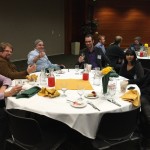
iDMAa 2014 Conference Gallery
December 11, 2014
-
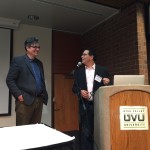
- Michael Rees receiving the Lifetime Achievement Award from Joseph Olin
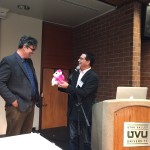
-
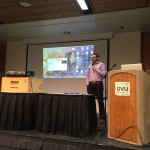
- Dave Beck announcing the award winners
-
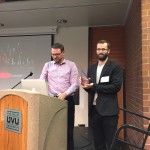
- Juror’s Choice Award winner Paul Clay
-
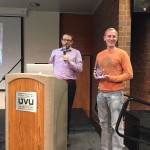
- Audience Award Winner Aaron Higgins Guy with presenter Dave Beck
-
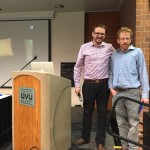
- Best in Show Award Winner Dave Ryan of SleepCycle with Dave Beck
-
- Cher Cornett announcing East Tennessee State as the conference location in 2015


-
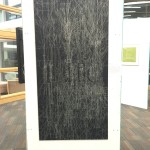
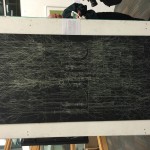
- iDEAs exhibition
-
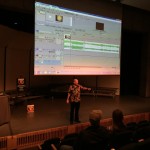
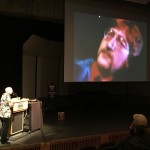
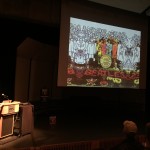
- Michael Wisland Deconstructing the Beatles
Faculty Spotlight
January 30, 2014
Meet iDMAa member Kari Barber — an assistant professor in the Reynolds School of Journalism at the University of Nevada, Reno. She is an award-winning documentary filmmaker, a journalist and a multimedia producer. Kari’s current project and passion is her first interactive documentary, Struggle and Hope, which deals with historic black towns in her home state of Oklahoma.
Last November, Kari presented a paper on Struggle and Hope at the iDMAa Fast Forward/2013 conference in Laguna Beach. In a recent interview, we asked why she decided to take an interactive approach to document the story.
iDMAa: Tell us about your latest endeavor.
Kari: The project is called Struggle and Hope and it’s about an effort in my home state of Oklahoma to create an all-black state after the Civil War. It didn’t happen. Most of the nearly 50 towns that were set up in the effort have disappeared, but a dozen remain. The remaining towns are struggling for survival and for their history to be included in mainstream history. I grew up in Oklahoma, and never even heard of this story.
iDMAa: What are some of the challenges you are facing with this project?
Kari: I initially thought of doing a traditional documentary, but I knew that would mean having to leave so many towns and stories on the cutting room floor. Because part of the problem is that history has been so top-down and now we are seeing a real interest in robust people’s history, I wanted the project to be interactive. Many people with ties to these towns now live in places like California or New York, but they still care about the towns and the history. I wondered how I could make this project a way to connect people through this history across geographical divides. I decided it should be a participatory people’s history documentary. This is something totally new for me, but I’m excited about the chance to experiment.
iDMAa: In what stage of production are you?
Kari: I spent last summer filming and collecting stories from about half of the remaining towns and this year I will finish visiting the rest of the towns. I am working with a team of historical advisers who are really the top in their fields, as well as another filmmaker. Now we are looking for partners to help us build the interactive site. We are also in the midst of fundraising for the project.
iDMAa: When are you hoping to complete Struggle and Hope?
Kari: I hope to debut the project in 2015.
iDMAa: How long have you been a member of iDMAa?
Kari: I just joined last year (2013).
iDMAa: How did you find out about us?
Kari: In graduate school I worked as a graduate assistant for Brigid Maher who has been active in iDMAa for some time. I was familiar with her work with iDMAa and then when I became a professor she encouraged me to join.
iDMAa: You attended the iDMAa conference for the first time this year, what did you enjoy about the conference?
Kari: The best thing about the conference was stretching my limits and getting beyond my comfort zone. I’m very comfortable talking about video production, documentaries and journalism, but talking and thinking about forms of digital media arts outside of my area of expertise was challenging and exciting.
iDMAa: Will the experience help inform your research or curriculum development and, if so, in what way?
Kari: Since I’m in the planning stages of my first interactive documentary, the new ideas I learned from the conference will be instrumental in how I approach the project and the new narrative challenges that come with interactive documentary. Also, I want to help encourage my students to be excited about the marriage of art and technology.
In addition to her teaching and creative projects at the Reynolds School, Kari has worked as a researcher and reporter for two documentaries for the PBS public affairs show Frontline and has been a part of numerous independent documentary productions. She worked internationally as a freelance multimedia producer in Southeast Asia and West and Central Africa where she reported for international news organizations including the Voice of America, Associated Press Television News, Marie Claire magazine, Reuters news agency, France 24, the United Nations humanitarian news analysis site IRIN, and The Christian Science Monitor. She also worked in Sierra Leone as a media trainer for the organization Journalists for Human Rights.
Kari has a Master of Fine Arts in Filmmaking and Electronic Media from American University in Washington, D.C. and a BA in Journalism from the University of Oklahoma.
Welcome to iDMAa, Kari! We look forward to working with you in the future.
Korsakow System Workshop Offered at Fast Forward 2013
October 11, 2013
 The International Digital Media and Arts Association is delighted to offer a Korsakow System Workshop as a part of Fast Forward 2013 Conference in Laguna Beach. The workshop will be held on Thursday (the second day of the conference), November 7 at 12:30 - 2:00 pm, and will include background notes, a tour of software and the opportunity to make a simple film.
The Korsakow System is an opensource software application for the easy creation of database-driven interactive narratives. The software was invented in 2000 by Berlin-based artist and documentary filmmaker Florian Thalhofer. Since then, Korsakow has been used extensively, across the world, to create innovative, web-based, nonlinear films. Some outstanding examples can be found on the showcase page of the Korsakow website.
Matt Soar, Associate Professor & BA Program Director at Department of Communication Studies at Concordia University, will lead this exciting workshop. Matt’s recent film, Ceci N’est Pas Embres, has just been selected for Montreal’s International Documentary Festival (RIDM), as has Florian’s new film Money and the Greeks. Matt has previously given this workshop at Concordia, York University (Toronto), NYU, USC, RMIT (Melbourne), and the University of Western Sydney to name a few.
This workshop is free to Fast Forward conference attendees. Non-attendees can register for a $25 fee, which will be collected at the door. Participants are asked to bring a newer laptop with them. Korsakow software does not run on tablets. Instructor will provide some video on a cloud drive, but you are welcome to use your own video via USB keys or internet. Wifi access will be available and a boxed lunch will be served for your convenience.
Workshop space is limited, so please register today to reserve your seat!
Fast Forward 2013 - iDMAa’s eleventh national conference - will be held in Laguna Beach November 6-8, 2013. This three-day conference will include keynote academic and industry speakers, lively Pechakucha presentations, a juried art exhibition for faculty and student work highlighting creative research in interactive media and digital arts, plus topical discussions focused on the future of digital media in industry and evolving pedagogies in academia. Learn more and register.Scott Ross: iDMAa 2013 Lifetime Achievement Award Recipient
August 22, 2013
As one of the most notable pioneers in digital media and entertainment, Scott Ross’ career has been stellar. iDMAa is proud to honor Scott at this year’s fast forward 2013 conference and will feature him in the Friday morning keynote address.
Scott founded, along with Hollywood luminaries James Cameron and Stan Winston, Digital Domain, one of the largest digital production studios in the motion picture and advertising industries. Under Ross’ direction, Digital Domain garnered multiple Academy Award nominations, receiving its first Oscar for the ground breaking visual effects in TITANIC. That success was followed by a second Oscar for WHAT DREAMS MAY COME and a third for THE CURIOUS CASE OF BENJAMIN BUTTON. Digital Domain received additional nominations for TRUE LIES, APOLLO 13 and I, ROBOT and has won four Scientific and Technical Achievement Academy Awards for its proprietary software.
For well over a decade Ross oversaw the company that created imagery for movies such as TITANIC, THE FIFTH ELEMENT,APOLLO13, FIGHT CLUB, TRUE LIES, INTERVIEW WITH THE VAMPIRE, O BROTHER WHERE ART THOU, X-MEN, THE LORD OF THE RINGS, THE DAY AFTER TOMORROW, I ROBOT and many, many others. Ross has worked with the who’s who of film directors such as Cameron, Bay, Fincher, Howard, Scorsese, Coppola, The Coen Brothers, Spielberg, Kurosawa, Jackson, Salles and generally, has nice things to say about them.
In 2006 as Digital Domain’s CEO and Chairman, he successfully sold Digital Domain to director Michael Bay and a group of private equity investors.
Prior to forming Digital Domain he led George Lucas’ vast entertainment empire, running ILM, Skywalker Sound, LucasFilm Commercial Productions and DroidWorks. Ross first joined LucasFilm as General Manager of Industrial Light and Magic and under his leadership, ILM won five Academy Awards for Best Visual Effects (WHO FRAMED ROGER RABBIT; INNERSPACE; TERMINATOR 2; THE ABYSS; DEATH BECOMES HER). The company re-organized in the 90’s and Ross was named Sr. VP of the LucasArts Entertainment Group, which was comprised of Skywalker Sound, LucasArts Commercial Productions, LucasArts Attractions, Editdroid/Soundroid and ILM.
Ross has played a significant role in the worldwide advertising industry as well. Having started commercial production companies while at LucasFilm (ILM and LCP) as well as Digital Domain’s Commercials Division, he has led two of the largest VFX commercial production companies on the planet. Digital Domain has continually established itself as the premiere visual effects studio in the advertising industry. With Fortune 500 clients such as Nike, American Express, Gatorade, Anheuser-Busch, Coca-Cola and Mercedes Benz, the DD Commercials Division has garnered dozens of Clio Awards and numerous Cannes Golden Lions.
In addition to the visual effects divisions, Mr. Ross launched Digital Domain Films, a feature film production division. The first feature film produced by Mr. Ross was the New Line Cinema release SECONDHAND LIONS which achieved both critical and box office success.
Prior to his celebrated career in film and advertising, Ross was a sound engineer touring with bands such as Miles Davis, The Allman Brothers and Johnny Winter.
A native of New York City, Ross began his career in Media Studies at Hofstra University where he graduated with a BS in Communication Arts. He returned to Hofstra to receive an honorary doctorate degree from his alma mater.
Mr. Ross is a member of the Academy of Motion Picture Arts and Sciences (OSCARS); The Academy of Television Arts and Sciences (EMMYS). He has worked on over 100 of the world’s largest special effects films and has lectured extensively about the creative process, content and technology in over 30 countries around the world.
University Marketing & Communications
By Mike Rigert | June 26, 2013

Sam Sawyer and Joe Albrethsen, developers of the game DubWars, pose for a portrait at the Daily Herald in Provo on Friday, June 28, 2013. DubWars is a multi-platform video game that uses its dubstep soundtrack as a trigger for various game actions. SPENSER HEAPS/Daily Herald
A team of five digital media students at Utah Valley University have successfully created and published the university’s first video game that is also currently trending online with fans and CEOs in the industry. Completing a hat trick, their product is also a featured game on a new video game console launching today on the U.S. retail market.
“DubWars,” a twin-stick shooter with weapons that fire to the beat of bass-thumping, original tracks composed by known artists in the “dub step” music genre’s industry, is already available for download on PC, Mac and Linux devices. But beginning today, the title is one of select number of featured games available on a newly released indie video game console (called OUYA) now available at major retailers and e-tailers.
Kellee Santiago, Ouya’s head of developer relations and formerly with the studio that produced “Flow, Flower and Journey,” raves about DubWars’ infectious mass appeal that led to the company selecting the game to kickoff the console’s launch.
“I wish there were more levels of it right now. … I have thoroughly enjoyed the audiovisual stimulation from ‘DubWars,’” Santiago previously told the reviews editor for Joystiq, a popular online source for news and information on the video game industry.

Sam Sawyer, left, and Joe Albrethsen, right, developers of the game DubWars, pose for a portrait with their UVU professor, Rodayne Esmay, at the Daily Herald in Provo on Friday, June 28, 2013. DubWars is a multi-platform video game that uses its dubstep soundtrack as a trigger for various game actions. SPENSER HEAPS/Daily Herald
Julie Urhman, Ouya’s CEO, who along with Santiago are considered to be among the top five female power brokers in the video game industry today, was equally impressed with the UVU students’ product. “Is this featured? This needs to be featured!,” Urhman said when demoing the beta version of the game.
More amazing still is the fact that the UVU team — comprised of digital media juniors Joe Albrethsen, Michael Chugg, Sam Sawyer, Evan Phillips and Ben Hale — conceptualized, designed and formed their business, MURA Interactive LLC, around DubWars in less than four months.
Other companies in the video game industry began taking notice of DubWars’ thunder and the students reached an agreement with peripheral controller manufacturer Nyko to demo the game at E3, a major industry trade fair of computer and video game related businesses held earlier this month in Los Angeles. Since Nyko was an official E3 sponsor, DubWars received critical national exposure to E3 vendors and participants.
The marketing coupe didn’t come without a marathon effort by the students the week prior to E3 as they raced against the clock to make DubWars Nyko-compatible and finalize preparations for the Ouya launch.
“I probably worked a 141-hour week prior to E3 and these guys were right up there, too,” said Albrethsen, MURA’s business manager.

Sam Sawyer and Joe Albrethsen, developers of the game DubWars, pose for a portrait at the Daily Herald in Provo on Friday, June 28, 2013. DubWars is a multi-platform video game that uses its dubstep soundtrack as a trigger for various game actions. SPENSER HEAPS/Daily Herald
Now, the key to keeping the DubWars snowball rolling is to obtain investment funding for the game to develop versions for mobile apps, and hopefully, other major platforms, such as Xbox and PlayStation 3. DubWars created a page on Kickstarter to drum up some financial support, with current pledges totaling $7,178. However the students only have 25 days to generate their target figure of $30,000. At the Kickstarter link, dubwarsgame.com/kickstarter, visitors’ can view a DubWars trailer, play four demo levels of the game and make a voluntary contribution.
The students’ efforts with their game and business epitomize the hands-on learning that is a key point of emphasis at UVU, said Rodayne Esmay, a UVU professor of digital media, and MURA’s guide and adviser. Esmay and Kent Millington, director of UVU’s Technology Commercialization Office, assisted the students in acquiring the property rights to the game in order for them to form MURA and take DubWars to market.
“We’ve built an in-house internship that compliments the senior capstone experience,” Esmay said.
The students hope to produce at least one or two more games prior to completing their senior year at UVU.
“Our goal is to have the company take off, and then we can move right into running it full-time upon graduation,” Albrethsen said.
Written by: Mike Rigert
Peter Weishar Appointed Dean of CVATD
By Anna Prentiss | May 29, 2013

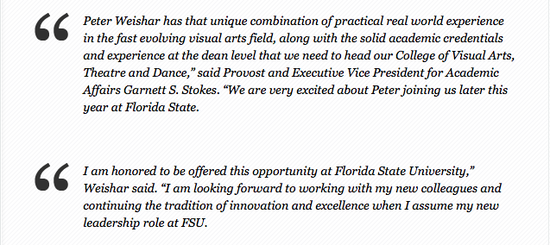
Peter Weishar has been appointed dean of Florida State University’s College of Visual Arts, Theatre and Dance, effective July 1, 2013.
Most recently, Weishar served as dean of the Savannah College of Art and Design’s School of Entertainment Arts where he started in 2004. Prior to his time at SCAD, Weishar served as a professor of computer animation and new media, as well as acting director of the animation program at New York University Tisch School of the Arts. He is the author of three books on animation arts and has private sector experience includes design and animation development management and work with a number of video and new media technology companies, as well as creative firms and advertising agencies. He earned his degree at Union College in 1983. He also studied at the Rhode Island School of Design and Tel Aviv University.
The College of Visual Arts, Theatre and Dance houses the Schools of Art and Design, Dance and Theatre. These academic units encompass six academic departments awarding bachelor of science, bachelor of arts, bachelor of fine arts, master of science, master of fine arts, specialists and doctor of philosophy degrees to over 300 students each year. In addition, the dean of the college oversees the Florida State University Museum of Fine Arts and the Facility for Arts Research in Tallahassee, and the John and Mable Ringling Center for the Arts in Sarasota, which includes the John and Mable Ringling Museum of Art, the FSU/Asolo Conservatory for Actor Training and the FSU Performing Arts Center.
Illustration Alumnae Win Awards
April 16, 2013
Tiffany England and Karsen Slater from Los Angeles, CA, and graduates of Laguna College of Art & Design were honored Sunday night, April 14, at the 29th Annual L. Ron Hubbard Achievement awards at the prestigious Wilshire Ebell Theatre in Los Angeles, California. With Tiffany and Karsen three Laguna College students have now been honored at this event. James Galindo was the first LCAD graduate receiving the Illustrators of the Future award in 2008.
The annual event celebrated the winners in the L. Ron Hubbard Writers and Illustrators of the Future Contests (www.writersofthefuture.com) before a packed hall of over 1,200 guests and thousands more who were logged on to watch the event as it streamed live. The night’s keynote speaker was Mr. Brett Kennedy, Supervisor of the Robotic Vehicles and Manipulators Group at NASA’s Jet Propulsion Laboratory in Pasadena who spoke on the bleeding edge of mobile robotic applications, having worked the past 15 years at JPL on diverse systems, the most immediate being the Robotic Arm aboard the Mars Curiosity Rover. He addressed writers and artists of the past who provided the inspiration for scientists such as him, and quoted L. Ron Hubbard from the opening line of his gritty space travel story written in the nascent days of science fiction, “Space is deep, Man is small, and Time is his relentless enemy.” He concluded his speech by asking the evening’s winners, “So, tell us, writers and artists of the future—what are we going to do next? What will motivate our Will and our Urgency? Is it something further, different, or more? And how will finding it show us ourselves? The future is in your minds and in your hands.”
The event celebrated the annual winners in the L. Ron Hubbard Writers and Illustrators of the Future Contests, where Tiffany England was one of the twelve illustrator winners making it further than some several thousand others who entered the international competition, and where she saw her illustration published in the bestselling Science Fiction anthology series –
L. Ron Hubbard Presents Writers of the Future Volume XXIX now available online at Amazon.com and BN.com and soon to be available in print wherever books are sold.
Tiffany was trilled to find out that she was one of the winners. She said “Most of the time you never hear back from the contests you enter. I am honored to have received this prize which affirms that all the hard work is paying off but it also shows me how much further I can still go.”
Tiffany graduated from Laguna College of Art and Design in 2008. She said: “Laguna helped me catch up with the digital race. I remember one teacher in particular: Ashiyn Pentony whose class really changed everything for me. I learned structure and how to keep everything organized as well as having freedom to be creative.” The education at Laguna was significant for her career and for her winning the L. Ron Hubbard Illustrators of the Future contest. “Another great thing about Laguna that set the stage for where I am now, was taking Marshall Vandruff’s class,“ Tiffany said, “his excitement and passion for teaching paired with all the great material he had to say about story and structure has really pushed my passion for storytelling.”
The second winner of the 2013 Illustrators of the Future Contest and recent graduate of Laguna College for Arts & Design, Karsen Slater, was surprised when she heard she had won and said: “To be honest, when I found out I had won, I didn’t believe it was true. I had this surreal moment where the whole situation felt like a dream, or a joke, or something. Eventually it did sink in.”
Karsen also credits LCAD for the education she received which contributed to where she is today as an artist. She said in part: “The most impressive thing I learned at LCAD was the advice I gleaned from my mentor and teacher, Lou Police. He told me not to get caught up in becoming extremely specialized but to be the best painter and illustrator I can be. I got my bigger picture in terms of my art.”
With writers and illustrators coming from all walks of life, the winners attended a week long workshop taught by contest judges —including New York Times bestselling authors Dave Wolverton (Runelord series) and Kevin J. Anderson (Dune series), World Fantasy Award winner Tim Powers (On Stranger Tides, adapted as the 4th Pirates of the Caribbean film), multiple Hugo and Nebula award winner Robert J. Sawyer (Flash Forwardand The WWW Trilogy), Hugo and Nebula award winning author Larry Niven (the Ringworld series), and internationally acclaimed artists, Stephen Hickman (over 350 book and magazine covers), and Cliff Nielsen (cover artist for Chronicles of Narnia)—each one an experienced professional in the field providing sound advice based on hard-won experience.
Karsen said about the workshops: “I can tell already that my life has been changed forever. This week came at a time in my career where I was in need of connections, directions and advice. The workshops gave me all of that and more. There have been so many moments this week that I’ll never forget, but perhaps the most memorable has been visiting Cliff Nielsen’s studio and drawing with him and the other winners and judges.”
Each illustrating and writing contest winner was presented their trophy by contest judges at the ceremony and combined cash prizes and royalties of over $30,000, and their story with artwork published in the L. Ron Hubbard Writers of the Future Volume XXIX.
The Writers of the Future writing contest (www.writersofthefuture.com) was initiated by L. Ron Hubbard in 1983 to provide a means for aspiring writers to get that much-needed break. Due to the success of the Writing Contest, the companion Illustrators of the Future Contest was created in 1988.
The intensive mentoring process has proven very successful. The 276 past winners of the Illustrating Contest have produced over 4,500 illustrations, 356 comic books, graced 594 books and albums with their art and visually contributed to 36 TV shows and 46 major movies.
The 348 past winners of the Writing Contest have published 838 novels and nearly 4,000 short stories. They have produced 27 New York Times bestsellers and their works have sold over 50 million copies.
Tiffany encourages illustrators to enter the contest and she said: “This contest is a great opportunity for aspiring artists to take a look into the publishing side of the field and getting the right direction to go further with their career.”
Karsen says about the contest overall: “I think it is fantastic that L. Ron Hubbard was so intent on keeping this contest going. The contest has grown and evolved over the years and I think it is currently one of the best opportunities for aspiring artists such as myself.”
For more information and to see the awards ceremony online, go to www.writersofthefuture.com
Creating New Audiences for Student Work
By Suzanne Plesha | March 29, 2013
 As educators, new technology allows us to challenge our students like never before. Not only do they have more options to create multimedia concepts but, with a little creativity, they can also share their work outside the classroom with a variety of audiences. If you think about it, the latter challenge – finding ways to get their work seen and critiqued – is absolutely critical to our students’ development and future careers in the field.
Here at Ball State, faculty and students do inventive, multimedia and interactive work in class, but, after that effort, only a small percentage of it is seen or critiqued by the outside world . . . up until now. This semester I have heard of two innovative ways instructors are helping students get more attention for their digital media work.
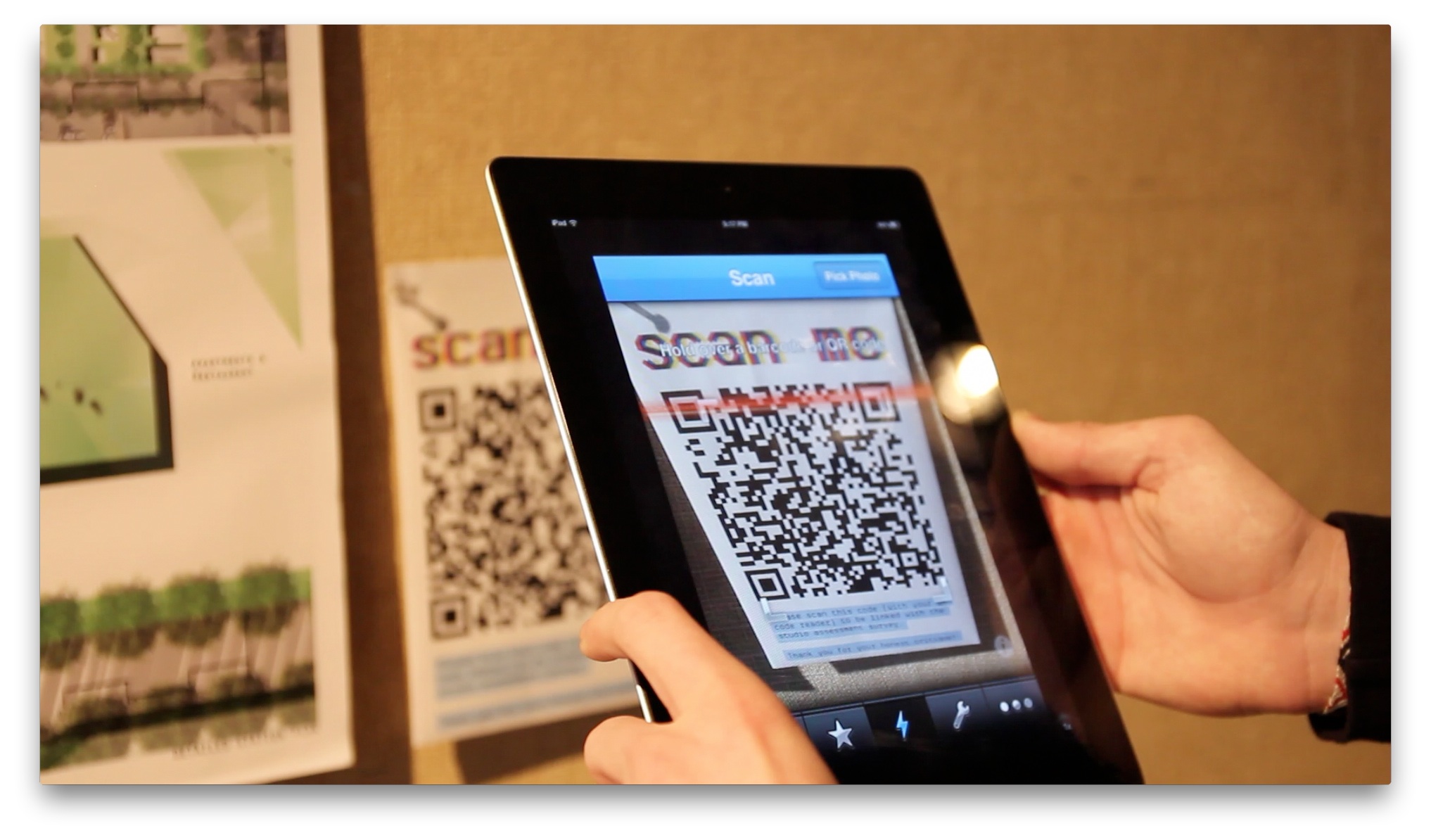
Like many architecture students across the nation, our students present studio design projects in poster presentations at different points in their program. Typically, these presentations are to their instructors and classmates alone. Here at Ball State, students in Simon Bussiere (Landscape) and Lohren Deeg’s (Urban Planning) studio classes, present their work beyond the classroom. Last week their designs were hung the Architecture Building lobby, and through QR codes, visitors could fill out an online critique survey, post comments and or visit web sites to get additional information about the work. One student showed redesign plans for a performance area and then provided a video showing dancers actually performing in the finished space.
In another example, Ball State Information Technology is exploring how student work can be made available to a mass audience using Adobe’s Digital Publishing Studio. Released last summer, this software solution migrates multi-media work into a tablet environment, offering interactivity and other features that cannot be done in print or with non-digitized assets alone. Journalism Graphics instructor, Jennifer George-Palilonis’ students use a plug-in to convert print stories and graphics into interactive pieces that include imbedded video and interactive elements. The plug-in is free of charge, and access to server space is available for an annual fee. These tools not only give the user multimedia functionality, but student pieces can then be distributed to an international market through the Apple App Store or Android Marketplace.
Palilonis’ students are working on dozens of projects with departments across Ball State’s campus – everything from a sports app to a museum exhibit that delves into the science behind the Star Wars franchise. One project, Prism, is documenting an experiential learning collaboration between music and theater students who are teaching disabled children social skills through the performing arts.
These solutions are delivering a broader audience for student work and should challenge them to push for even greater innovation. What have your programs tried?
STUDENT SHOWCASE: University of Toledo
March 28, 2013
Winner of the 2012 Achievement in Digital Art & Design Award
In the Digital Art and Design division, works of digital art in all media are considered including, but not limited to, individual or team-based student digital design, illustration, interactive works; animation; video/film; installations, game art, and 3D modeling. “Stories from Toledo” was an innovative, collaborative project that connected University of Toledo students to their community.
Through a collaborative partnership with Lamar Outdoor Advertising, the work of UT art students appeared on 20 local digital billboards from mid-October through the end of December, 2012. Art students from the “Time, Motion, Space” class, joined by others representing the UT BFA program, created fictional film still as a part of the series.
Student images were interspersed among the regular scheduled advertising throughout the period, thanks to billboard time donated by Lamar. The images were shown for two and a half months, but moved to different billboard locations throughout that time in order to have the work shown in numerous places in Toledo.
Barry Whittaker, Assistant Professor of Art and Coordinator of New Media Design Practices at the University of Toledo directed the project. He says this project provided the opportunity for students to see their images directly connected to the city. “For their work to be considered for display, the students had to consider ways to suggest movement or story beyond the frame in order to suggest a larger narrative.”
This experience provided students with a chance to experience art production for large format media types and exposure to the technical considerations and limitations of outdoor, public display. The images had to be easily read at a distance or from a passing car. The students had to create each image for multiple billboard sizes, so they could easily be shown on any of Lamar’s digital billboard locations. Each image was constructed to work within two different aspect ratios.
For those reading the billboards, the works briefly altered the advertising format of the billboards to display another look at life in and around Toledo.
The student artists who participated in the project are Clinton Bales, Alyssa Brown, Kasia Gacek, Yang Gao, Morgan Hayward, Philip Herman, Thomas Johnson, Marko Milliken, Halah Mohamed, Jessica Ostrander, Jeremy Pellington, Noah Roszczipka, Austin Tuttle, April VanSlambrouck, Jon Wittes and Mark Yappueying.
For a gallery of the images and a map to the billboard locations, please visit the Student Works – Featured Projects page online at http://www.utoledo.edu/cvpa/art/studentworks/splprojects.html


Submitted by Barry Whittaker, Assistant Professor of Art and Coordinator of New Media Design Practices at the University of Toledo